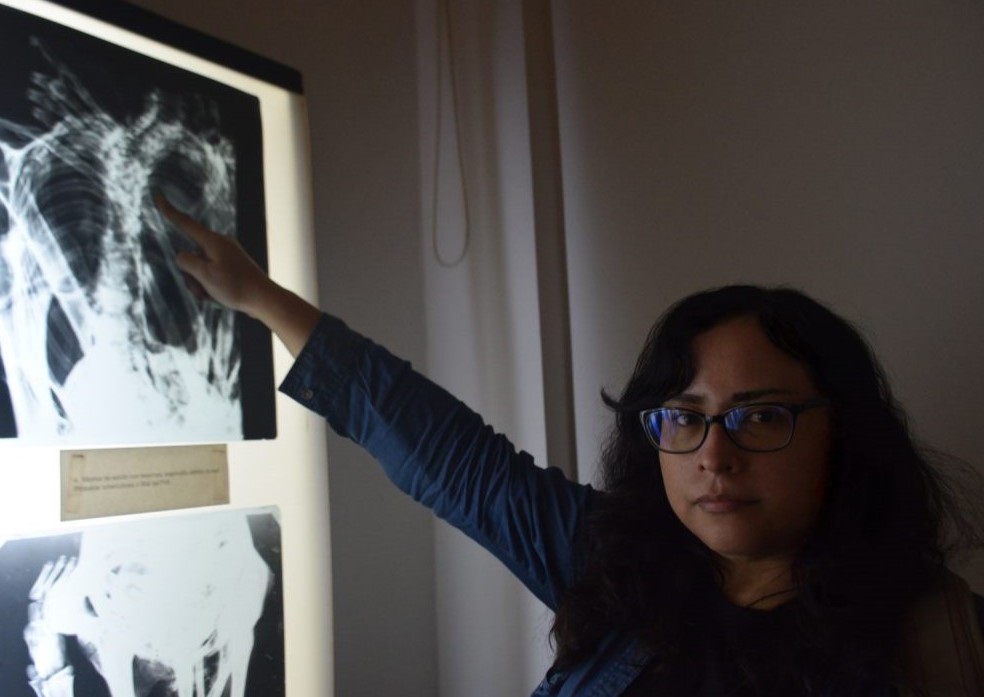
Patricia Maita

@unmsm.edu.pe

Professor, Department of Archaeology
Universidad Nacional Mayor de San Marcos

Patricia Maita

RESEARCH, TEACHING, or OTHER INTERESTS

Archeology, Conservation, Anthropology, Multidisciplinary
3

Scopus Publications

465

Scholar Citations

6

Scholar h-index

6

Scholar i10-index

Scopus Publications

  • Insights into changing coastlines, environments and marine hunter-gatherer lifestyles on the Pacific coast of South America from the La Yerba II shell midden, Río Ica estuary, Peru
    David G. Beresford-Jones, David E. Friesem, Fraser Sturt, Alexander Pullen, George Chauca, Justin Moat, Manuel Gorriti, Patricia K. Maita, Delphine Joly, Oliver Huaman, Kevin J. Lane, Charles French
    Quaternary Science Reviews, 2022
    Shell middens are conspicuous manifestations of the exploitation of rich, sustainable, easily seen and harvested marine resources that, worldwide, enabled hunter-gatherers to reduce mobility and increase population and social complexity. Globally, known sites tend to cluster chronologically around 6 k BP, after slowing eustatic sea-level rise, although the Pacific coast of South America offers some rare earlier exceptions. We report investigations of La Yerba II, a Middle Preceramic shell matrix site on the Río Ica estuary, south coast Peru. These show how, beginning around 7000 Cal BP, over 4.5 m of stratigraphy accumulated in less than 500 years. Consisting of prepared surfaces, indurated floors and the ashy interiors of wind shelters and their associated midden deposits, alternating with phases of abandonment, this was the outcome of an intense rhythm of repeated occupations by logistically mobile marine hunter-gatherers. Final phases, dominated by Mesodesma surf clams, mark change towards more task-specific activities. La Yerba II's topographic position and well-preserved cultural and environmental markers provide insight into the local history of relative sea level change and changing marine hunter-gatherer lifestyles during a period critical to the transition to sedentism and the formation of new estuarine and beach habitats following the stabilisation of eustatic sea-levels.
  • Re-evaluating the resource potential of lomas fog oasis environments for Preceramic hunter-gatherers under past ENSO modes on the south coast of Peru
    David Beresford-Jones, Alexander G. Pullen, Oliver Q. Whaley, Justin Moat, George Chauca, Lauren Cadwallader, Susana Arce, Alfonso Orellana, Carmela Alarcón, Manuel Gorriti, Patricia K. Maita, Fraser Sturt, Agathe Dupeyron, Oliver Huaman, Kevin J. Lane, Charles French
    Quaternary Science Reviews, 2015
    Lomas – ephemeral seasonal oases sustained by ocean fogs – were critical to ancient human ecology on the desert Pacific coast of Peru: one of humanity's few independent hearths of agriculture and “pristine” civilisation. The role of climate change since the Late Pleistocene in determining productivity and extent of past lomas ecosystems has been much debated. Here we reassess the resource potential of the poorly studied lomas of the south coast of Peru during the long Middle Pre-ceramic period (c. 8000–4500 BP): a period critical in the transition to agriculture, the onset of modern El Niño Southern Oscillation (‘ENSO’) conditions, and eustatic sea-level rise and stabilisation and beach progradation. Our method combines vegetation survey and herbarium collection with archaeological survey and excavation to make inferences about both Preceramic hunter–gatherer ecology and the changed palaeoenvironments in which it took place. Our analysis of newly discovered archaeological sites – and their resource context – show how lomas formations defined human ecology until the end of the Middle Preceramic Period, thereby corroborating recent reconstructions of ENSO history based on other data. Together, these suggest that a five millennia period of significantly colder seas on the south coast induced conditions of abundance and seasonal predictability in lomas and maritime ecosystems, that enabled Middle Preceramic hunter–gatherers to reduce mobility by settling in strategic locations at the confluence of multiple eco-zones at the river estuaries. Here the foundations of agriculture lay in a Broad Spectrum Revolution that unfolded, not through population pressure in deteriorating environments, but rather as an outcome of resource abundance.
  • Human and animal diet at Conchopata, Peru: stable isotope evidence for maize agriculture and animal management practices during the Middle Horizon
    Brian Finucane, Patricia Maita Agurto, William H. Isbell
    Journal of Archaeological Science, 2006

RECENT SCHOLAR PUBLICATIONS

  • Insights into changing coastlines, environments and marine hunter-gatherer lifestyles on the Pacific coast of South America from the La Yerba II shell midden, Río Ica estuary, Peru
    DG Beresford-Jones, DE Friesem, F Sturt, A Pullen, G Chauca, J Moat, ...
    Quaternary Science Reviews 285, 107509 , 2022
    2022
    Citations: 14
  • Forensic archaeology and humanitarian context: Localization, recovery and documentation of human remains
    FE Moreno, P Maita
    Forensic Science and Humanitarian Action: Interacting with the Dead and the … , 2020
    2020
    Citations: 4
  • ANÁLISIS OSTEOLÓGICO DE CAMÉLIDOS HALLADOS EN HUACA 33 DEL COMPLEJO ARQUEOLÓGICO MONUMENTAL MARANGA, COSTA CENTRAL DEL PERÚ
    R Sánchez, G Tuesta, P Maita Agurto
    Boletín del Museo de Sitio ERNST W. MIDDENDORF, 2-11 , 2018
    2018
  • Re-evaluating the resource potential of lomas fog oasis environments for Preceramic hunter–gatherers under past ENSO modes on the south coast of Peru
    D Beresford-Jones, AG Pullen, OQ Whaley, J Moat, G Chauca, ...
    Quaternary Science Reviews 129, 196-215 , 2015
    2015
    Citations: 95
  • El trauma en la piel: un análisis paleopatológico de tatuajes paracas-necrópolis
    PK Maita Agurto, E Minaya Cabello
    Jangwa Pana 13 (1), 14-33 , 2014
    2014
    Citations: 23
  • INFRARED REFLECTOGRAPHY USE IN TATTOO REGISTRATION OF PARACAS-NECRÓPOLIS MOMIAS
    P Maita Agurto, E Minaya Cabello
    2013
  • El uso de reflectografía infrarroja en el registro de tatuajes en momias Paracas-Necrópolis
    P Maita, E Minaya
    Arqueología y Sociedad, 117-130 , 2013
    2013
    Citations: 10
  • Informe arqueozoológico de materiales recuperados en el complejo arqueológico Wari
    P Maita, I Pérez
    Conchopata, Revista de Arqueología, 71-123 , 2011
    2011
    Citations: 2
  • Dismorfismo sexual y funciones discriminantes a partir del fémur y de la segunda vértebra cervical en una poblacion moderna de Ayacucho y Huancavelica, Perú
    PKM Agurto
    Pontificia Universidad Católica del Perú , 2009
    2009
  • Human and animal diet at Conchopata, Peru: stable isotope evidence for maize agriculture and animal management practices during the Middle Horizon
    B Finucane, PM Agurto, WH Isbell
    Journal of Archaeological Science 33 (12), 1766-1776 , 2006
    2006
    Citations: 305
  • Fauna arqueológica del Sector II de Pueblo Viejo. Informe interno, Proyecto Arqueológico-Taller de Campo«Lomas de Lurín»
    P Maita
    Unpublished report , 2006
    2006
  • Fauna arqueológica de Passa [sic] Qullqa
    P Maita Agurto
    Unpublished report , 2006
    2006
  • Fauna arqueológica del Sector IV, unidad 1 de Pueblo Viejo
    P Maita Agurto
    Informe zooarqueológico presentado al Proyecto Arqueológico Lomas de Lurín … , 2005
    2005
  • Pictografías de camélidos en el Santuario Nacional de Huayllay, Pasco
    P Maita Agurto
    Disponible en Rupestreweb [http://www. rupes-treweb. info/camelidos. html] , 2005
    2005
    Citations: 12

MOST CITED SCHOLAR PUBLICATIONS

  • Human and animal diet at Conchopata, Peru: stable isotope evidence for maize agriculture and animal management practices during the Middle Horizon
    B Finucane, PM Agurto, WH Isbell
    Journal of Archaeological Science 33 (12), 1766-1776 , 2006
    2006
    Citations: 305
  • Re-evaluating the resource potential of lomas fog oasis environments for Preceramic hunter–gatherers under past ENSO modes on the south coast of Peru
    D Beresford-Jones, AG Pullen, OQ Whaley, J Moat, G Chauca, ...
    Quaternary Science Reviews 129, 196-215 , 2015
    2015
    Citations: 95
  • El trauma en la piel: un análisis paleopatológico de tatuajes paracas-necrópolis
    PK Maita Agurto, E Minaya Cabello
    Jangwa Pana 13 (1), 14-33 , 2014
    2014
    Citations: 23
  • Insights into changing coastlines, environments and marine hunter-gatherer lifestyles on the Pacific coast of South America from the La Yerba II shell midden, Río Ica estuary, Peru
    DG Beresford-Jones, DE Friesem, F Sturt, A Pullen, G Chauca, J Moat, ...
    Quaternary Science Reviews 285, 107509 , 2022
    2022
    Citations: 14
  • Pictografías de camélidos en el Santuario Nacional de Huayllay, Pasco
    P Maita Agurto
    Disponible en Rupestreweb [http://www. rupes-treweb. info/camelidos. html] , 2005
    2005
    Citations: 12
  • El uso de reflectografía infrarroja en el registro de tatuajes en momias Paracas-Necrópolis
    P Maita, E Minaya
    Arqueología y Sociedad, 117-130 , 2013
    2013
    Citations: 10
  • Forensic archaeology and humanitarian context: Localization, recovery and documentation of human remains
    FE Moreno, P Maita
    Forensic Science and Humanitarian Action: Interacting with the Dead and the … , 2020
    2020
    Citations: 4
  • Informe arqueozoológico de materiales recuperados en el complejo arqueológico Wari
    P Maita, I Pérez
    Conchopata, Revista de Arqueología, 71-123 , 2011
    2011
    Citations: 2
  • ANÁLISIS OSTEOLÓGICO DE CAMÉLIDOS HALLADOS EN HUACA 33 DEL COMPLEJO ARQUEOLÓGICO MONUMENTAL MARANGA, COSTA CENTRAL DEL PERÚ
    R Sánchez, G Tuesta, P Maita Agurto
    Boletín del Museo de Sitio ERNST W. MIDDENDORF, 2-11 , 2018
    2018
  • INFRARED REFLECTOGRAPHY USE IN TATTOO REGISTRATION OF PARACAS-NECRÓPOLIS MOMIAS
    P Maita Agurto, E Minaya Cabello
    2013
  • Dismorfismo sexual y funciones discriminantes a partir del fémur y de la segunda vértebra cervical en una poblacion moderna de Ayacucho y Huancavelica, Perú
    PKM Agurto
    Pontificia Universidad Católica del Perú , 2009
    2009
  • Fauna arqueológica del Sector II de Pueblo Viejo. Informe interno, Proyecto Arqueológico-Taller de Campo«Lomas de Lurín»
    P Maita
    Unpublished report , 2006
    2006
  • Fauna arqueológica de Passa [sic] Qullqa
    P Maita Agurto
    Unpublished report , 2006
    2006
  • Fauna arqueológica del Sector IV, unidad 1 de Pueblo Viejo
    P Maita Agurto
    Informe zooarqueológico presentado al Proyecto Arqueológico Lomas de Lurín … , 2005
    2005