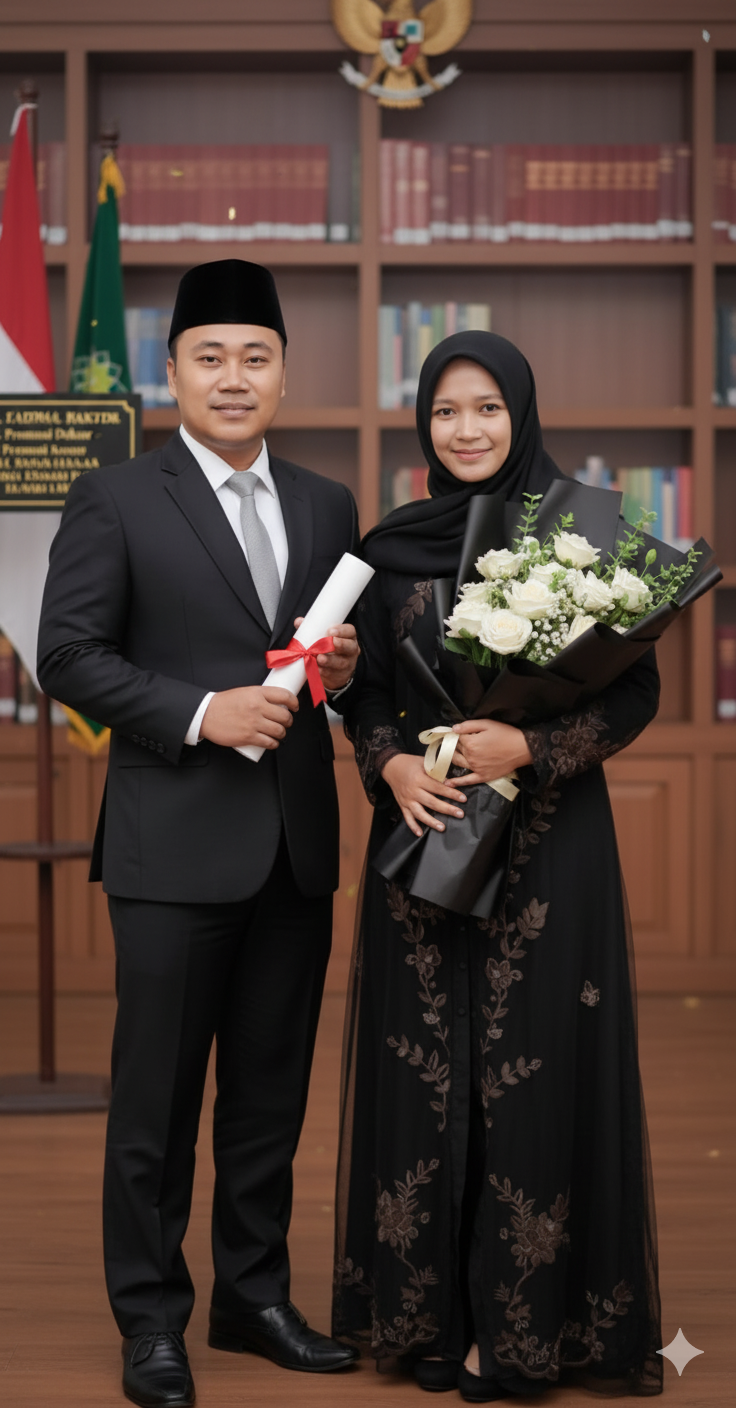
Dr. Hisam Ahyani, author of the book "Grounding Sharia: Family and Economic Fiqh Approach Towards Social Welfare", was born on February 22, 1991 in Tambakreja Lakbok Village, Ciamis Regency. He has been a lecturer at the Miftahul Huda Al Azhar Institute (IMA) in Banjar City since 2015 and currently (2025) serves as Assistant Professor (Lecturer III-d). Dr. Ahyani completed his doctoral education at UIN SGD Bandung in 2023 after taking his undergraduate and postgraduate studies in various places (Purwokerto City - UIN Saizu, and Bandung City - UIN SGD. As a researcher, writer, editor, and reviewer, Dr. Ahyani has expertise in the field of Islamic law, including Islamic law, Islamic jurisprudence, Islamic economic jurisprudence, halal tourism jurisprudence, and Islamic political jurisprudence. His academic track record includes the publication of 25 books (with ISBN and HKI) and 19 journal articles that have been indexed in Scopus/WOS/Scimago, with several articles in the Q1, Q2, and Q3
EDUCATION
Bachelor of Islamic Education graduate from IAIN Purwokerto (2015)
Graduate of Master of Law from UIN Sunan Gunung Djati Bandung (2018)
Doctoral graduate of Islamic Law, Concentration in Sharia Economic Law, UIN Sunan Gunung Djati Bandung (2023)
RESEARCH, TEACHING, or OTHER INTERESTS
Law, Tourism, Leisure and Hospitality Management
25
Scopus Publications
96
Scholar Citations
5
Scholar h-index
3
Scholar i10-index
Scopus Publications
Divergent Jurisprudential Paradigms of Productive Zakat: A Madhhab-Based Comparative Study of Legal Reasoning in LAZISNU and LAZISMU Ending Solehudin, Idzam Fautanu, Hisam Ahyani, Mowafg Masuwd Mazahibuna Jurnal Perbandingan Mazhab, 2026 This study examines productive zakat not merely as a managerial instrument for economic empowerment, but as a manifestation of contemporary Islamic legal ijtihād (independent legal reasoning) shaped by divergent jurisprudential paradigms. Situated within the framework of comparative madhhab studies, this research analyzes how differences in legal reasoning between LAZISNU—rooted in the Shāfiʿī legal tradition—and LAZISMU—characterized by a reformist approach grounded in tajdīd (renewal) and tarjīḥ (legal preference)—influence the formulation and implementation of productive zakat practices in Indonesia. Employing a qualitative juridical-empirical method, the study draws on in-depth interviews with zakat administrators and institutional documents from LAZISNU and LAZISMU operating in Java and Bali. The findings reveal that the transformation of zakat from consumptive distribution to productive utilization is legitimized through distinct modes of istidlāl (legal reasoning or inferential deduction), wherein LAZISNU emphasizes adherence to authoritative Shāfiʿī doctrines, particularly concerning the principle of tamlīk (transfer of ownership to beneficiaries), while LAZISMU adopts a more flexible form of ijtihād that prioritizes maqāṣid al-sharīʿah (the higher objectives of Islamic law) and socio-economic outcomes. This divergence reflects an ongoing dialectic within contemporary Islamic legal thought regarding the boundaries of zakat utilization. By integrating empirical practices with cross-madhhab legal analysis, this study contributes to the development of comparative fiqh al-zakāt (Islamic jurisprudence of zakat) and demonstrates how modern philanthropic institutions negotiate classical legal doctrines within heterogeneous socio-legal contexts such as Java and Bali.
STRENGTHENING HALAL TOURISM GOVERNANCE IN PEKALONGAN: A Maqāṣid-Based Collaborative Governance Framework within Siyasah Dusturiyah Mustofa Mustofa, Agus Supriadi, Muhamad Buchori, Saepudin Saepudin, Muhammad Muzakkir, Ihwanul Muadib, Hisam Ahyani, Salisu Muhammad Gumel Al Risalah Forum Kajian Hukum Dan Sosial Kemasyarakatan, 2026 The rapid growth of halal tourism has generated increasing global attention toward governance models that integrate religious values with sustainable and accountable public policy frameworks. As Muslim-friendly tourism expands across diverse jurisdictions, regulatory implementation often faces structural, institutional, and coordination challenges. In Indonesia, the Central Java Governor Regulation No. 40 of 2023 on Muslim-Friendly Tourism seeks to regulate halal services, worship facilities, and information transparency to accommodate Muslim travelers. This study evaluates the implementation of this regulation in Pekalongan City using a juridical-empirical approach. Data were collected through 12 in-depth interviews with key stakeholders, including tourism actors, religious leaders, and government officials, complemented by field observations. The findings reveal that although the regulation formally reflects Islamic legal values, particularly maq??id al-shar?‘ah, its implementation remains suboptimal due to weak inter-agency coordination, limited public literacy, and the absence of measurable evaluation indicators. This study proposes a Maq??id-based collaborative governance model that integrates Islamic legal objectives, consumer protection principles, and cross-sectoral coordination mechanisms. The model contributes to the broader discourse on halal tourism governance by offering an analytically grounded framework for strengthening accountability, stakeholder collaboration, and policy sustainability in Muslim-friendly tourism regulation.
Contextualizing Maqāṣid al-Sharī‘ah in Indigenous Legal Practices: A Comparative Study of Family Resilience in Kasepuhan Ciptagelar and Kampung Naga Opik Rozikin, Oyo Sunaryo Mukhlas, Aden Rosadi, Ine Fauzia, Muharir Muharir, et al. Nurani, 2025 Strengthening the normative foundation and maqāṣid orientation of Indonesia’s religious court system allows it to render fair judgments for the parties while safeguarding the future of children. While Islamic family law is often studied normatively, limited attention is given to its lived application in plural legal settings. Using a descriptive qualitative approach with socio-legal and phenomenological methods, data were collected through purposive sampling of 20 participants, including traditional leaders, religious figures, and village officials. Field observations and the analysis of local documents, including customary manuscripts, sermons, and marriage records, serve to complement the data. The findings reveal that family resilience emerges from a dynamic interplay between Islamic and customary norms, particularly in areas like inheritance, marriage, and gender roles. Integration of maqāṣid al-sharī‘ah occurs through contextual reinterpretation aligned with communal structures and values. Differences between the communities are notable in the role of traditional authority, the interpretation of qiwāmah, and dispute resolution mechanisms. This study contributes to the discourse on Islamic legal pluralism by presenting a contextual model of normative integration. It highlights the potential of a culturally grounded and adaptive Islamic legal framework to strengthen sustainable family systems across diverse local contexts.
The role of sharia law in promoting social justice and sustainable development in southeast Asia Hisam Ahyani, Ending Solehudin, Naeli Mutmainah, Nurul Ilyana binti Muhd Adnan, Yogi Triswandan, Aini Nurun Nazhifah, Miftakhul Huda, Moh. Syarif Hidayat, Dian Permana Routledge Handbook of Islamic Economics and Finance, 2025 This study uses a qualitative approach and case study methodology to assess online gambling regulations in Indonesia and Malaysia. It gathers data through literature reviews, document analysis, and interviews with experts and officials to evaluate regulatory effectiveness and challenges. The research focuses on how incorporating sharia law into online gambling regulation can enhance societal welfare and support Sustainable Development Goals (SDGs). With online gambling expanding rapidly, effective regulation is crucial to protect society from its negative impacts. The paper investigates sharia law as an alternative regulatory approach, emphasizing social justice and harm reduction. In Indonesia, gambling is largely banned under national and sharia laws, though enforcement is inconsistent. Malaysia faces ongoing issues with illegal online gambling despite strict regulations and sharia enforcement in some states. Sharia law, which prohibits gambling due to its perceived societal harm, offers a comprehensive framework that emphasizes justice and social protection. The study finds that sharia law could strengthen online gambling regulations in a more equitable and transparent manner, reducing gambling’s adverse effects. The research highlights that applying sharia principles can contribute to several SDGs, such as SDG 1 (No Poverty), SDG 3 (Good Health and Well-being), and SDG 8 (Decent Work and Economic Growth). Effective regulation can mitigate poverty risks from gambling losses, improve public health, and foster economic stability. Overall, integrating sharia law into online gambling regulations provides a viable solution to counteract negative impacts, requiring consistent enforcement and an inclusive approach to social and economic changes to enhance community well-being in both countries.
Reversed Burden of Proof in Online Gambling Fraud: Consumer Protection Based on Islamic Law in West Java Kukun Abdul Syakur Munawar, Hisam Ahyani, Abdul Rahim, Ali Mutakin, Md Yazid Ahmad Jurnal Hukum Bisnis Bonum Commune, 2025 The widespread practice of online gambling in West Java has led to an increase in digital fraud cases causing significant consumer losses. Common schemes involve fictitious investment programs and fake prize offers that victims find difficult to prove directly. In this context, the application of the reversed burden of proof serves as a strategic criminal law policy to strengthen the position of victims before the law. This study examines the effectiveness of the reversed burden of proof in handling online gambling fraud cases, while exploring the role of Islamic legal principles—such as zakat and social justice—in expanding consumer protection. Using normative juridical and conceptual approaches, the study analyzes the Indonesian positive legal framework and its potential integration with Islamic legal mechanisms. The findings indicate that reversing the burden of proof can reduce evidentiary obstacles during judicial processes, while Islamic law adds a socio-economic dimension that complements the penal aspect. This study recommends an integrated legal reform that not only emphasizes sanctions but also reinforces substantive justice and comprehensive victim protection.
Legal Protection for Private Lecturers: Addressing Sub-Minimum Wage Challenges in West Java Hisam Ahyani, Naelul Azmi, Sérgio Lousada, Agus Yosep Abduloh, Miftakhul Huda Jurnal Media Hukum, 2025 Private lecturers in Indonesia play a crucial role in higher education; however, they face significant welfare issues, particularly concerning salaries that often fall below the Regional Minimum Wage (UMK). This study aims to identify the challenges faced by private lecturers in West Java related to inadequate salaries and offer recommendations for improvement. Using a qualitative research approach, the study interviews private lecturers and analyzes employment agreements from several private universities. It also examines relevant laws and regulations, including Law Number 14 of 2005 on Teachers and Lecturers, Government Regulation Number 37 of 2009 on Lecturers, Law Number 30 of 2014 on Government Administration, and Law Number 13 of 2003 on Manpower. The findings reveal that, despite formal employment agreements, many lecturers earn less than the UMK, negatively impacting their welfare. Contributing factors include a lengthy certification process, inadequate social security, and the lack of academic ranks for many permanent lecturers. Many private lecturers are not registered with the social security program (BPJS). This study concludes that salaries below the UMK create injustice and undermine the teaching profession. Strengthening employment contracts, clarifying rights and obligations, and raising awareness about lecturers' rights are essential for improving their welfare.
Fraud in the Digital Space: A Comparative Study of Jinayah Fiqh and Indonesian Criminal Law Hisam Ahyani, Parhan Parhan, Muhtolib Muhtolib, Ahmad Berizi, Nurhasana Nurhasana, et al. Jurnal Hukum Islam, 2025 The development of digital technology has opened the door to various forms of digital crime, including schemes involving fictitious job offers, illegal crypto investments and fake refunds that financially harm victims and potentially lead to money laundering offenses. This article examines digital fraud in Indonesia by comparing Islamic criminal law (Fiqh Jinayah) with Indonesian positive law. This normative juridical research employs statutory, conceptual, comparative, and case study approaches. The findings reveal that the “Remote Mining Network” case illustrates how perpetrators exploit digital anonymity to evade legal oversight. Such practices violate Islamic legal norms, including the prohibitions against gharar (uncertainty) and tadlis (deception), which align with the elements of fraud as defined in the Indonesian Penal Code and the Law on Electronic Information and Transactions. The article concludes that both Islamic and national criminal law aim to protect public interests and individual property rights (hifz al-mal). This study contributes to the development of contemporary fiqh jinayah, while also supporting efforts to enhance legal literacy and protect Muslim communities from the risks of digital crime, in accordance with the principle of hifz al-mal within the framework of maqaṣid al-shari‘ah.
The Dynamics of the Fatwa on the Prohibition of Interfaith Greetings: Maqasid al-Shariah and its Implications for Multicultural Families In Indonesia Encep Taufik Rahman, Muharir Muharir, Hisam Ahyani, Nurul Ilyana Muhd Adnan Justicia Islamica, 2025 The fatwa issued by the Indonesian Ulema Council (MUI) on the prohibition of interfaith greetings by Muslims has triggered significant discourse in the context of Indonesia's religiously and culturally plural society. This research aims to analyze the theological basis of the fatwa and its socio-cultural implications, especially in the context of multicultural families, through the maqasid syariah approach. Using a qualitative method based on content analysis, this research examines fatwa documents and related literature that discuss Islamic legal theory and interfaith social dynamics. The results show a tension between the principle of hifz al-din (protection of religion) and the goals of adl (justice) and maslahah (public welfare), especially since the implementation of this fatwa has the potential to cause emotional tension, social fragmentation, and decreased cohesion in interfaith families and communities. This study confirms that a normative and rigid theological approach, if it does not consider socio-cultural realities, can hinder efforts to build interfaith harmony. Therefore, a contextual and dialogical approach is needed in the stipulation of fatwas so that they are in line with the lived experience of Muslims in pluralistic societies. These findings provide conceptual and practical contributions to the development of Islamic fiqh that is more inclusive and adaptive to social diversity in Indonesia.
Islamic Legal Hermeneutics on Riba in Digital Banking: Contextualizing Imam al-Qurṭubī’s Exegesis of Qur’an 2:275 Muharir Muharir, Irfan Kuncoro, Agus Yosep Abduloh, Ulummudin Ulummudin, Hisam Ahyani Jurnal Ilmiah Mizani, 2025 This study explores the application of riba (interest-based transactions) within the context of digital banking, with a specific focus on the BRImo application developed by Bank Rakyat Indonesia (BRI). Using a hermeneutic approach, it examines Imam Al-Qurthubi’s classical tafsir on Surah Al-Baqarah verse 275 to contextualize Islamic legal principles in contemporary financial practices. The research adopts a qualitative-descriptive method to analyze textual interpretations of riba while also identifying the ethical, social, and economic implications of these interpretations in digital financial systems. Findings indicate that Imam Al-Qurthubi strongly opposes riba as a form of financial exploitation, a stance that remains relevant in evaluating modern digital banking operations. Moreover, the study discusses how BRImo’s integrated social finance features—such as zakat and infaq services—represent an effort to align digital banking with Islamic ethical values. While this article provides a theoretical framework through classical tafsir, it also underscores the need for further empirical investigation and comparative analysis with other scholarly interpretations to enhance the practical applicability of non-riba models in digital finance. This research contributes to the discourse on contextualized Islamic law by bridging classical legal thought with emerging financial technologies, offering insight into how Islamic jurisprudence can inform the development of ethical, Shari’ah-compliant digital banking system
Learning from Malaysia's Progressive Islamic Law Framework on Online Gambling: Insights for Indonesia Ending Solehudin, Mustopa, Muhammad Mudzakkir, Saepudin, Hisam Ahyani Al Ihkam Jurnal Hukum Dan Pranata Sosial, 2025 Online gambling has become a rapidly growing issue, leading to financial losses and mental health challenges. In Malaysia, online gambling is regulated under progressive Islamic law which focuses on social justice, while Indonesia struggles with weak enforcement despite existing regulations. This study discusses three main parts: first, current online gambling regulation in Indonesia and Malaysia; second, Malaysia’s progressive legal experience as a blueprint for Indonesia; and third, social justice and SDGs-based online gambling regulation for Muslim-majority countries. A qualitative approach, including case studies, in-depth interviews with legal experts, and document analysis in both countries, was employed. The findings show that Malaysia’s implementation of progressive Islamic law has been effective in managing online gambling, promoting social justice, and reducing financial and mental health impacts. In contrast, weak law enforcement in Indonesia exacerbates the social issues related to online gambling. The research concludes that Malaysia’s approach has successfully regulated online gambling and supported SDG achievement. Therefore, Indonesia should consider adopting more progressive Islamic legal principles to enhance law enforcement and reduce the social harms of online gambling.
Global awareness of halal products in Indonesia in Era 4.0 N Mutmainah, A Hapidin, MA Ramdhani, BW Nuryadin, M Muharir, ... Al-Amwal: Jurnal Ekonomi Dan Perbankan Syari'ah 14 (1), 14-34 , 2022 2022.0 Citations: 14
Curriculum Management And Assessment System In Basic Education (Dikdas) Era Of Industrial Revolution 4.0 H Ahyani, R Waluyo, M Mahfud E-Tech: Jurnal Ilmiah Teknologi Pendidikan 9 (1) , 2021 2021.0 Citations: 7
Manajemen kurikulum dan sistem penilaian pada bidang pendidikan dasar (dikdas) era revolusi industri 4.0 H Ahyani, R Waluyo, M Mahfud Jurnal Ilmu Pendidikan 2 (8), 1-17 , 2021 2021.0 Citations: 3
The Contribution of the Western World to the Islamic Economy in Indonesia H Ahyani, M Slamet, N Mutmainah Al-Amwal: Jurnal Ekonomi dan Perbankan Syari’ah 13 (2), 153-70 , 2021 2021.0 Citations: 7
†œThe Potential of Halal Food as A Driver of the Economic Development in Regional Community. †Jurnal Pariwisata Terapan 4 (2): 163–82 H Ahyani, M Mahfud, R Waluyo, W Ulya, M Muharir 2021.0 Citations: 1
Jurnal Nahdlatul Fikr BJSDWCAN REALIZE Jurnal Nahdlatul Fikr 2 (1) , 2020 2020.0
The Potential of Halal Food as A Driver of the Economic Development in Regional Community H Ahyani, M Mahfud, R Waluyo, W Ulya, M Muharir Jurnal Pariwisata Terapan 4 (2) , 2020 2020.0 Citations: 38
The Potential of Halal Food as A Driver of the Economic Development in Regional Community A Hisham, M Muntaha, R Waluyo Jurnal Pariwisat Terapan 4 (2) , 2020 2020.0
Peran Pendidikan Agama Islam dalam Membentuk Karakter Religius Peserta Didik di SMPIT Harapan Ummat Kabupaten Purbalingga A Waluyo IAIN Purwokerto , 2018 2018.0 Citations: 5
Peningkatan Karir Guru DI MI Ma‟ arif NU Windu Negara Kecamatan Wangon Kabupaten Banyumas Tahun Pelajaran 2013/2014 R Waluyo Skripsi STAIN Purwokerto: tidak diterbitkan , 2014 2014.0 Citations: 1
Muharir.(2021). The Potential Of Halal Food On The Economy Of The Community In The Era Of Industrial Revolution 4.0 H Ahyani, M Mahfud, W Rohmat, U Widadatul Indonesia Journal of Halal 3 (2), 112-128 , 0 Citations: 19
THE POTENTIAL OF HALAL FOOD ON THE ECONOMY OF THE COMMUNITY IN THE ERA OF INDUSTRIAL REVOLUTION 4.0 H Ahyani, M Mahfud, R Waluyo, W Ulya
Muharir. 2021. †œThe Potential Of Halal Food On The Economy Of The Community In The Era Of Industrial Revolution 4.0. †Indonesia Journal of Halal 3 (2): 112–28 H Ahyani, M Mahfud, W Rohmat, U Widadatul Citations: 1
MOST CITED SCHOLAR PUBLICATIONS
The Potential of Halal Food as A Driver of the Economic Development in Regional Community H Ahyani, M Mahfud, R Waluyo, W Ulya, M Muharir Jurnal Pariwisata Terapan 4 (2) , 2020 2020.0 Citations: 38
Muharir.(2021). The Potential Of Halal Food On The Economy Of The Community In The Era Of Industrial Revolution 4.0 H Ahyani, M Mahfud, W Rohmat, U Widadatul Indonesia Journal of Halal 3 (2), 112-128 , 0 Citations: 19
Global awareness of halal products in Indonesia in Era 4.0 N Mutmainah, A Hapidin, MA Ramdhani, BW Nuryadin, M Muharir, ... Al-Amwal: Jurnal Ekonomi Dan Perbankan Syari'ah 14 (1), 14-34 , 2022 2022.0 Citations: 14
Curriculum Management And Assessment System In Basic Education (Dikdas) Era Of Industrial Revolution 4.0 H Ahyani, R Waluyo, M Mahfud E-Tech: Jurnal Ilmiah Teknologi Pendidikan 9 (1) , 2021 2021.0 Citations: 7
The Contribution of the Western World to the Islamic Economy in Indonesia H Ahyani, M Slamet, N Mutmainah Al-Amwal: Jurnal Ekonomi dan Perbankan Syari’ah 13 (2), 153-70 , 2021 2021.0 Citations: 7
Peran Pendidikan Agama Islam dalam Membentuk Karakter Religius Peserta Didik di SMPIT Harapan Ummat Kabupaten Purbalingga A Waluyo IAIN Purwokerto , 2018 2018.0 Citations: 5
Manajemen kurikulum dan sistem penilaian pada bidang pendidikan dasar (dikdas) era revolusi industri 4.0 H Ahyani, R Waluyo, M Mahfud Jurnal Ilmu Pendidikan 2 (8), 1-17 , 2021 2021.0 Citations: 3
†œThe Potential of Halal Food as A Driver of the Economic Development in Regional Community. †Jurnal Pariwisata Terapan 4 (2): 163–82 H Ahyani, M Mahfud, R Waluyo, W Ulya, M Muharir 2021.0 Citations: 1
Peningkatan Karir Guru DI MI Ma‟ arif NU Windu Negara Kecamatan Wangon Kabupaten Banyumas Tahun Pelajaran 2013/2014 R Waluyo Skripsi STAIN Purwokerto: tidak diterbitkan , 2014 2014.0 Citations: 1
Muharir. 2021. †œThe Potential Of Halal Food On The Economy Of The Community In The Era Of Industrial Revolution 4.0. †Indonesia Journal of Halal 3 (2): 112–28 H Ahyani, M Mahfud, W Rohmat, U Widadatul Citations: 1
Jurnal Nahdlatul Fikr BJSDWCAN REALIZE Jurnal Nahdlatul Fikr 2 (1) , 2020 2020.0
The Potential of Halal Food as A Driver of the Economic Development in Regional Community A Hisham, M Muntaha, R Waluyo Jurnal Pariwisat Terapan 4 (2) , 2020 2020.0
THE POTENTIAL OF HALAL FOOD ON THE ECONOMY OF THE COMMUNITY IN THE ERA OF INDUSTRIAL REVOLUTION 4.0 H Ahyani, M Mahfud, R Waluyo, W Ulya