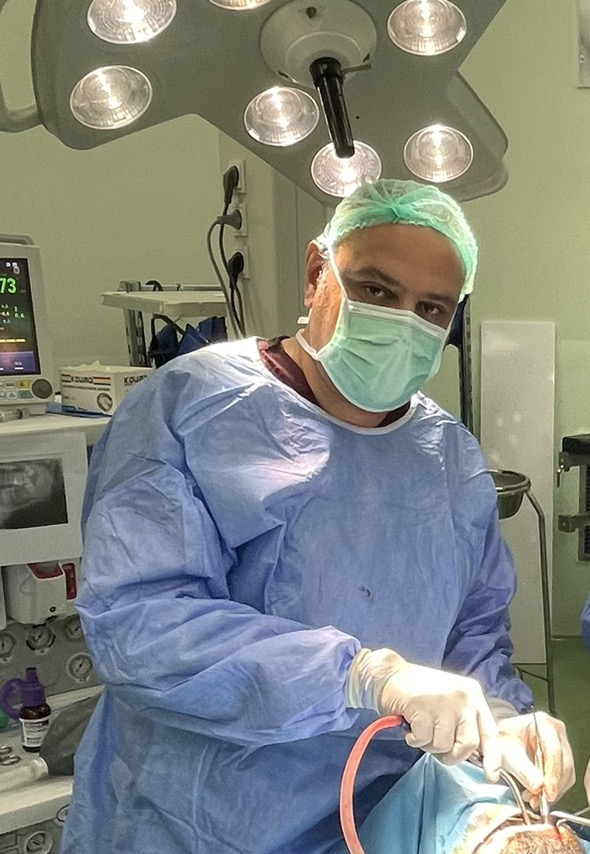
oral and maxillofacial surgery, maxillofacial trauma, orthognathic surgery, dental implants, oral and maxillofacial prosthesis, TMJ diseases, oral cancer
6
Scopus Publications
13
Scholar Citations
2
Scholar h-index
1
Scholar i10-index
Scopus Publications
EFFECT OF CHLORHEXIDINE ON VARIOUS DENTAL IMPLANT SURFACES TYPES: COMPARATIVE ANALYSIS OF ION RELEASE AND CORROSION IN AN IN VITRO SURGICAL MODEL Haydar Salih, Zaid Mustafa Akram, Abdulrahman Al-Najjar Bulletin of Stomatology and Maxillofacial Surgery, 2025 Background: Chlorhexidine (CHX) mouthwash is one of the most commonly used antimicrobial solutions in dental practice. Nevertheless, this copolymer material on implant surface is susceptible to corrosion and ion release, which can result in the reduction of the lifetime of implant-supported restorations. Objective: The aim of this comparative in vitro study was to evaluate the effect of chlorhexidine on the corrosion resistance and release of ions of various surface material associated dental implants with different clinical designs under simulated surgical conditions . Materials and Methods: Thirty dental implants in six groups were tested by material (Grade IV Titanium, Titanium alloy Ti-6Al-4V, and Zirconia) and design (Endosteal, Subperiosteal, and Mini implants). The samples were all soaked with 0.2% and 0.12% chlorhexidine for 7 and 21 days in artificial saliva. The scale inhibition performance and corrosion resistance were observed by electrochemical impedance spectroscopy (EIS) and scanning electron microscopy (SEM), and the ion concentration was analyzed through inductively coupled plasma mass spectrometry (ICP-MS). Results: Chlorhexidine exposure resulted in different degrees of corrosion and ionic release on different implant materials and designs. Ion release of Ti alloys was higher than that of Grade IV Ti and Zirconia. Mini implants showed higher levels of surface degradation with their larger surface-to-volume ratio. Conclusion: The interaction of chlorhexidine with dental implant surfaces varies according to the material and clinical design of the implants. These results highlight the importance to use CHX with caution in implant patients and to consider material- and design-specific responses to chemical exposure.
Antimicrobial resistance of bacterial pathogens isolated from the infections of post maxillofacial surgery Zaid Mustafa Akram, , , Khalid Burhan Khalid, Qaisar Khaleel Oraibi, Maadh Fawzi Nassar, , , and Journal of Medicine and Life, 2022 Inappropriate antibiotic prescriptions contributed to a global issue of antimicrobial resistance. This study aimed to assess the prevalence of bacterial pathogens and antimicrobial resistance isolated from maxillofacial infections (MIs). Two hundred and twenty-two patients with different MIs were included in this study. Swab samples were taken from the site of infections. Samples were cultured, and isolated bacteria were identified using various biochemical tests. Antimicrobial resistance patterns of isolates were assessed by the disk diffusion method. The mean age of the patients was 50.8 years. The male-to-female ratio was 127/95 (P<0.05). Smoking and alcohol consumption were found in 60.36% and 37.38% of patients, respectively. Most patients had a ≤1-week infection duration (P<0.05). Abscess lesion was the most predominant infection type (P<0.05). The prevalence of aerobic bacteria among abscess, pus localization, and deep facial infections was 59.33%, 64.28%, and 46.66%, respectively. The prevalence of anaerobic bacteria among abscess, pus localization, and deep facial infections was 40.66%, 23.80%, and 53.33%, respectively. Staphylococcus aureus (10.36%) and Prevotella buccalis (8.55%) had the uppermost distribution amongst all examined samples. Isolated bacteria exhibited the uppermost resistance rate toward penicillin (65.76%), tetracycline (61.26%), gentamicin (58.10%), and ampicillin (57.65%) antimicrobials. The lowest resistance rate was obtained for linezolid (25.67%), ceftriaxone (31.08%), and azithromycin (31.08%) antimicrobials. Linezolid, ceftriaxone, and azithromycin had effective antimicrobial activities toward bacteria isolated from MIs. Therefore, cautious antibiotic prescription might decrease the prevalence of antimicrobial resistance in dental and maxillofacial infections.
Combination use of aloe vera and VEGF promotes osseointegration and stability of titanium implants Indian Journal of Forensic Medicine and Toxicology, 2020
Salivary zinc level and taste detection thresholds in hypertensive patients on amlodipine and on losartan (A comparative study) Indian Journal of Forensic Medicine and Toxicology, 2020
EFFECT OF CHLORHEXIDINE ON VARIOUS DENTAL IMPLANT SURFACES TYPES: COMPARATIVE ANALYSIS OF ION RELEASE AND CORROSION IN AN IN VITRO SURGICAL MODEL AZAN Haydar Munir Salih ,Zaid Mustafa Akram BULLETIN OF STOMATOLOGY AND MAXILLOFACIAL SURGERY 21 (7), 407-416 , 2025 2025.0 Citations: 2
Relationship between endodontic reduction and fracture prevention ZMAYM Akram International Journal of Applied Dental Sciences 11 (2), 109-114 , 2025 2025.0
Antimicrobial resistance of bacterial pathogens isolated from the infections of post maxillofacial surgery ZM Akram, KB Khalid, QK Oraibi, MF Nassar Journal of Medicine and Life 15 (8), 944 , 2022 2022.0 Citations: 10
Salivary Zinc level and Taste Detection Thresholds in Hypertensive Patients on Amlodipine and on Losartan (A Comparative Study) YM Akram, TF Zaidan, ZM Akram, OAA Alsattar Indian Journal of Forensic Medicine & Toxicology 14 (2), 2129-2135 , 2020 2020.0
Combination Use of Aloe Vera and VEGF Promotes Osseointegration and Stability of Titanium Implants AY Al-Hijazi, ZM Akram, EH Abdulla Indian Journal of Forensic Medicine & Toxicology 14 (2), 2019 , 2020 2020.0 Citations: 1
Acceleration of Socket Healing by Using Placental Collagen with BDNF: Radiological and Histological Studies AY Al-Hijazi, IKA Al-Rifae, ZM Akram, LN Kaka SCOPUS IJPHRD CITATION SCORE 10 (7), 758 , 2019 2019.0
Impact of Arthrocentesis in Treatment of Temporomandibular Joint Problems IKA al-Rifae, ZM Akram, QK Oraibi
MOST CITED SCHOLAR PUBLICATIONS
Antimicrobial resistance of bacterial pathogens isolated from the infections of post maxillofacial surgery ZM Akram, KB Khalid, QK Oraibi, MF Nassar Journal of Medicine and Life 15 (8), 944 , 2022 2022.0 Citations: 10
EFFECT OF CHLORHEXIDINE ON VARIOUS DENTAL IMPLANT SURFACES TYPES: COMPARATIVE ANALYSIS OF ION RELEASE AND CORROSION IN AN IN VITRO SURGICAL MODEL AZAN Haydar Munir Salih ,Zaid Mustafa Akram BULLETIN OF STOMATOLOGY AND MAXILLOFACIAL SURGERY 21 (7), 407-416 , 2025 2025.0 Citations: 2
Combination Use of Aloe Vera and VEGF Promotes Osseointegration and Stability of Titanium Implants AY Al-Hijazi, ZM Akram, EH Abdulla Indian Journal of Forensic Medicine & Toxicology 14 (2), 2019 , 2020 2020.0 Citations: 1
Relationship between endodontic reduction and fracture prevention ZMAYM Akram International Journal of Applied Dental Sciences 11 (2), 109-114 , 2025 2025.0
Salivary Zinc level and Taste Detection Thresholds in Hypertensive Patients on Amlodipine and on Losartan (A Comparative Study) YM Akram, TF Zaidan, ZM Akram, OAA Alsattar Indian Journal of Forensic Medicine & Toxicology 14 (2), 2129-2135 , 2020 2020.0
Acceleration of Socket Healing by Using Placental Collagen with BDNF: Radiological and Histological Studies AY Al-Hijazi, IKA Al-Rifae, ZM Akram, LN Kaka SCOPUS IJPHRD CITATION SCORE 10 (7), 758 , 2019 2019.0
Impact of Arthrocentesis in Treatment of Temporomandibular Joint Problems IKA al-Rifae, ZM Akram, QK Oraibi