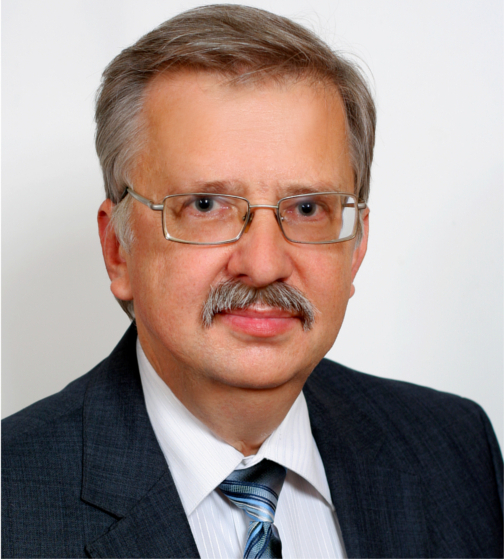
I graduated from the Vinnytsia Polytechnic Institute in 1979, majoring in Radio Engineering.
Then I worked as a radio-engineer at the plant.
At the start my science carrier was dealt with the problems of creating active antenna systems and measuring their parameters.
Later I developed and implemented the next projects:
1. Medical computer diagnostic systems for cardiology, rheography and radiology. Electronics and software.
2. Automated cash register control systems.
3. Automated sugar measurement control systems for laboratories. Electronics and software.
4. Automated management systems for dairy farms. Electronics and software.
5. Electronic systems of management of educational processes of universities.
EDUCATION
Candidate of Technical Sciences, specialty 05.11.13 "Devices and methods of controlling the parameters of materials and products", docent.
Professor of the Department of Automation and Intelligent Information Technologies, Vinnytsia National Technical University.
RESEARCH, TEACHING, or OTHER INTERESTS
Human-Computer Interaction, Information Systems, Hardware and Architecture, Electrical and Electronic Engineering
16
Scopus Publications
235
Scholar Citations
8
Scholar h-index
7
Scholar i10-index
Scopus Publications
Principles for Constructing the Architecture of Information Ecosystems In Education Yevhen Palamarchuk, Olena Kovalenko Proceedings International Conference on Advanced Computer Information Technologies Acit, 2024 Information ecosystems are the basis of the development of modern economy and business. The peculiarities of their use are the use of contemporary information technologies and management rules according to the concept of Management 4.0. The results of research, development and implementation of information ecosystems and their development in education allowed the authors to highlight the main principles of architecture construction and to determine the indicators of ensuring the quality of functioning of the information ecosystem in education. A detailed analysis of each principle makes it possible to form general architectural models. These models can be used to create and introduce an information ecosystem for other educational institutions. The main principles of the information ecosystem in education are determined. Among them - are systematicity, modularity, scalability, multiple use of information, minimization of duplication of data and information in different forms, adequate storage of information and knowledge, and role focus on user and human-machine interaction. The considered scenarios of the implementation of the specified principles and the formation of mathematical models for assessing the completeness of their implementation allow us to evaluate the level of development of the information ecosystem.The evolution of versions of information systems at the university, from the automation of information processes to the implementation of complex technical and management solutions, made it possible to more accurately form service modules and assess the level of coverage of information processes by the ecosystem. The electronic university information systems introduced by the authors in various educational institutions confirm the adequacy of the proposed models.
Testing Module Models for the 'Electronic University' Information Ecosystem Yevhen Palamarchuk, Olena Kovalenko, Dmytro Pylypenko International Scientific and Technical Conference on Computer Sciences and Information Technologies, 2024 The article presents research findings on testing and evaluating the quality of the “Electronic University” information ecosystem. The relevance of the research is confirmed by several scientific works, practical developments, and the need for qualitative testing and evaluation of information systems software. The authors propose a comprehensive model for testing and assessing the quality level of the “Electronic University” system based on its defined goals, actual implementation, and test coverage matrices. Such a system allows for the analysis of all digital processes and the level of their implementation to generate data for evaluating the level of maturity of the “Electronic University” information ecosystem. The authors identified the peculiarities of assessing the quality of educational systems' software according to traditional indicators. The model of sequential determination of test results, assessment of software quality levels and system maturity allows the formation of tables of indicators of three levels - testing, quality, and maturity. A balanced approach to the formation and further testing of the information ecosystem allows you to determine the structure of the modules and the types of information content representations. The Case method of software testing test cases is a systematic and structured approach to software testing. This method involves the creation of detailed test cases, each a mini-case that systematically defines and describes the situation with indicators for testing and further assessment of quality and maturity. The simulation of various situations allows for the definition of mini-cases according to requirements and the evaluation of the level of coverage. The proposed models, with their systematic nature, ensure the improvement of the quality of the software of the ‘Electronic University’ information ecosystem, while also taking into account the goals of digitalization strategies and the level of quality of the implemented modules of the system. The obtained results are implemented for the ‘Electronic University’ system on the JetIQ platform at the Vinnytsia National Technical University, and they can be used for systems similar to those of other educational institutions.
JetIQ electronic ecosystem at the service of the university in the country that has undergone armed aggression Roman Kvyetnyy, Oleh Bisikalo, Yevhen Palamarchuk, Volodymyr Storchak Problems and Perspectives in Management, 2023 The development of modern technologies and innovations provides opportunities for higher education institutions (HEIs) and directly for teachers and students to voluntarily use tools for distance and mixed learning. However, remote access in a pandemic or a state of war is necessity and has no alternatives.The purpose of this study is to determine the role of the JetIQ electronic ecosystem for Vinnytsia National Technical University (VNTU) in wartime conditions. As in all HEI of Ukraine, the educational process at VNTU changed significantly during the year of military aggression. The need for students and teachers to hide in bomb shelters during air raids, frequent and, most importantly, unexpected interruptions of the educational process, and significant complications of access to laboratory equipment negatively affect the psychological state of all participants in educational activities. In these conditions, the JetIQ electronic ecosystem brought substantial benefits and became the primary tool for the management of the educational activities at VNTU. Reliable technological support also improved the psychological confidence of students and teachers. A comparison of the interim indicators of the 2022/2023 academic year with the trends of the three previous academic years in terms of quantitative indicators of educational resources and actions of all groups of JetIQ users showed positive trends. This testifies to its stability in the conditions of martial law.
IT strategies for the development of higher educational institutions Yevhen Palamarchuk, Nataliia Zamkova, Ruslan Novytsky, Olena Kovalenko International Scientific and Technical Conference on Computer Sciences and Information Technologies, 2022 The article contains the concept of building an IT strategy for the development of a higher educational institution, its information electronic systems, and the corresponding electronic information educational environment. The IT strategy can be presented as a separate document for the development of a higher educational institution or/and as part of its general strategy in terms of digitalization. The development of the electronic university is related to its target areas. Among them are the educational process, scientific research, management processes, information technologies, etc. These directions should be combined into a single integrated system. For the effective operation of such a system and the reduction of the payback paradox, it is necessary to determine not only the strategic directions but also the steps of their implementation. The basis for the implementation of such a strategy is the definition of the university’s development specifics and scenarios for IT strategy implementation. Research and practical implementation of learning management systems in higher education institutions of Vinnytsia allowed the development of a general concept of forming IT strategy development by using contours of the interaction of its agents. Each of its contours corresponds to the definite target of the development direction. It was determined that the digitalization implementation processes correspond to the expected strategic results. It is recommended to choose implementation scenarios by using the method of hierarchies which is based on the results of expert evaluation. The research results will make it possible to formulate recommendations for building and implementing an IT strategy for a higher educational institution. These recommendations are based on the determined performance indicators of the IT strategy and the results of the practical implementation of digitalization systems of higher education institutions in Vinnytsia.
Assessing the level of maturity of the automated management system of a higher education institution Olena Kovalenko, Yevhen Palamarchuk, Rymma Yatskovska International Scientific and Technical Conference on Computer Sciences and Information Technologies, 2021 The article contains the results of a study of the processes of automation of educational and management processes of higher education. The experience of the authors of the development and implementation of learning management systems and support for management of higher education, analytical studies of the need for automation of educational and support management processes revealed the need to measure the level of maturity of learning management systems and support for management processes (LMS&SMP). The variety of activities in higher education institutions is due to the need for research, development and implementation of teaching methods, organization of various projects, etc. On the other hand, the management of a higher education institution involves ensuring the level of quality of education, proper qualification of teachers and satisfaction of applicants for higher education. The latter are the target audience for the provision of educational services and key customers of such services. From the point of view of e-learning and blended learning systems, four categories of users have needs for automation: students; teachers; management; support staff. In accordance with their functional processes, it is necessary to create an electronic information educational environment with a high level of maturity of the learning management system and support management processes. In many cases, automated management systems of the educational process and management of the institution are almost unconnected, which, requires duplication of information. A comprehensive system of learning management and management support for higher education allows to form an effective information ecosystem from the level of an individual teacher, department to management. The proposed method of assessing the maturity of LMS&SMP allows to form a catalog of processes, the level of their automation, identify “white spots” of non-automated processes and design plans to improve the learning management system.
Optimization of electronic test parameters in learning management systems Ceur Workshop Proceedings, 2020
Models of Behavior of Agents in the Learning Management System Oleg Bisikalo, Olena Kovalenko, Yevgen Palamarchuk International Scientific and Technical Conference on Computer Sciences and Information Technologies, 2019 The urgency of the research. The behavior of agents as components of a learning management systems is being investigated at all stages of the life cycle of creating and using a software product. Learning management systems are characterized by the fact that the scenarios of their operation is associated with various aspects of educational activity. Directions of functional, emotional and motivational behavior of users are especially relevant. In addition, it is expedient to introduce software agents for the detection and prevention of crisis situations. Target setting. The purpose of research is deal with the close relationship between the behavior of users and the results of their activities in blended learning. The results obtained will test the basic functions of the system and identify their impact on user behavior. Actual scientific researchers and issues analysis. Recent research in various fields of science and practice focuses on user behavior, as well as the formation of special software modules (agents) that detect the problem moments of the system and warn the user. The algorithms of human-machine interaction, communications between users of information systems are studied by scientists from various fields of science and technology. Models of behavior of agents of the management training systems allow to verify the requirements to the system at different stages of the life cycle. For example, to identify the crisis moments of functioning, to consider organizational, motivational and emotional aspects. Uninvestigated problems. We have to focus the opinion on issues that require more detailed research and adaptation for learning management systems. They are: the definition of agents of information systems and their features in learning management systems; consideration of the system as a complex agent; definition of the main agent circuits of the electronic information environment on the basis of the training management system; models of agent behavior patterns and their relevance in the interfaces of program modules and user instructions. The research objective is to shape the behavior patterns of agents in the information management education system. The statement of basic materials. This research includes refinement of such basic definitions as the e-learning management system; the agent; the agent behavior pattern. Such definitions allow us to use the theory of mirrors and to determine the main contours of the functioning of the information system for blended learning in an educational institution. Detailed models are formed for the module of test final control and portfolio of the teacher. Formalized mathematical and informational models are the basis for studying of users behavior and the research basis of university blended learning system functioning. The implementation of the system modules was carried out according to the concept of “Electronic University”. The JetIQ VNTU system is implemented as a multi-agent learning system. Conclusions. The practical result of the exploration is the bundle of formalized models, definition of contours of the blended learning system and its modules. The checklist of the main processes of user behavior patterns and their description in user instructions forms the basis for analyzing of the existence of programing modules (agents) for warning, reminding and helping the user to work in particularly risky moments.
Algorithms of blended learning in IT education Olena Kovalenko, Yevhen Palamarchuk International Scientific and Technical Conference on Computer Sciences and Information Technologies, 2018 Blended learning is a modern trend in education. It enables the formation of synergies between traditional educational communications, electronic information dialogues and appeals to electronic resources. System algorithms of blended learning allow to use the method of “small steps” and to create a composition of interrelated educational processes. The purpose of the study is to identify key processes, roles of learners, learning situations and outcomes. A number of scientific and practical knowledge of authors and their practical experience are the base of this research and the introduction of its results into a practical educational process. Among them are the implementation of the method of “inverted class”, the active involvement of specialists and the formation of simulation model of practical activity students for future. The peculiarities of self-development in the direction of the management education platform and the teaching experience of the authors are the basis for making changes in the well-known approaches in blended learning of IT education. The purpose of the study is to identify key educational processes, to find algorithms of using internal and external electronic resources. The introduction of the proposed algorithms is tested during the teaching of disciplines “Algorithms and Data Structures”, “Fundamentals of Software Engineering”, “Project Management”, “Computer Networks” etc. The main changes in educational processes are: using of special network simulation software and project management software; using new approaches tests construction and encouraging students their mastering; the students' individual and teamwork in an education management system environment. The results of the research consist of determining role-based behavioural educational processes in management of education systems. The new opportunities for dynamics of improving of educational resources is based on involving practitioners, the using of open distance courses and the using of new forms of work with students. The question of activating the role of employers in the educational process and involving them in the evaluation of students' work, as well as the introduction of real cases, is an important issue.
Measuring of the relative milk mass fraction in water-milk solution Volodymyr KUCHERUK Przeglad Elektrotechniczny, 2017 In this article the dependence of the output voltage of photo-receiver based on photodiode-operational amplifier pair from relative mass fraction of milk in water-milk solution, during infrared radiation is passaging through it, is received. The method for determining the optimum wavelength for providing maximum sensitivity of measuring the relative mass fraction of milk is created. The results of theoretical research are confirmed by an experiment. Streszczenie. W artykule przedstawiono zależność napięcia wyjściowego foto-odbiornika opartego na parze wzmacniaczy z fotodiodami przy odbieraniu sygnału podczas promieniowania podczerwonego poprzez próbkę mieszaniny wody z mlekiem. Opracowana została metoda określania optymalnej długości fali dla zapewnienia maksymalnej czułości pomiaru względnej masy frakcji mleka. Wyniki badań teoretycznych zostały potwierdzone przez doświadczenia. (Pomiar względnej masy frakcji mleka w roztworze wody z mlekiem).
Statistical models of machinery milking duration Володимир Юрійович Кучерук, Євген Анатолійович Паламарчук, Павло Ігорович Кулаков, Тетяна Вікторівна Гнесь Eastern European Journal of Enterprise Technologies, 2014
ВИКОРИСТАННЯ МАШИННОГО НАВЧАННЯ ДЛЯ ВИЗНАЧЕННЯ МІСЦЕЗНАХОДЖЕННЯ ЛЮДЕЙ У ПРИМІЩЕННЯХ АІ Топольський, ЄА Паламарчук Вісник Вінницького політехнічного інституту, 92-103 , 2025 2025 Citations: 2
Моделі побудови комунікацій в електронних системах інклюзивної освіти Є ПАЛАМАРЧУК, О ЧЕРЕШНЮК, О КОВАЛЕНКО Herald of Khmelnytskyi National University. Technical sciences 347 (1), 330-336 , 2025 2025 Citations: 2
Компютерна програма «Фінансовий кабінет студента (FK)»(«FK») ЄА Паламарчук, ОО Коваленко, ВВ Гороль Державна організація «Український національний офіс інтелектуальної … , 2025 2025
Компютерна програма «Система обміну файлами та комунікації студент-викладач «Файл-Експрес»(«FEX») ЄА Паламарчук, ОО Коваленко, ІП Малініч, ПП Малініч Державна організація «Український національний офіс інтелектуальної … , 2025 2025
Компютерна програма «Система документообігу (Doc-JetIQ)»(«(Doc-JetIQ)») ЄА Паламарчук, ОО Коваленко, ОВ Бісікало, ВМ Севастьянов Державна організація «Український національний офіс інтелектуальної … , 2025 2025
Компютерна програма «Електронний гуртожиток»(Dorm-JetIQ)»(«Dorm-JetIQ») ЄА Паламарчук, О Коваленко, ЮЮ Бурєнніков, АІ Теклюк Державна організація «Український національний офіс інтелектуальної … , 2025 2025
Компютерна програма «Модуль моніторингу показників викладачів відповідно до ліцензійних умов (CV)»(«CV») ЄА Паламарчук, ОО Коваленко, ОВ Петров, ОП Войтович Державна організація «Український національний офіс інтелектуальної … , 2025 2025
Використання комп’ютерного зору в інклюзивній освіті ОІ Черешнюк, ЄА Паламарчук //Матеріали LIV науково-технічної конференції підрозділів ВНТУ, Вінниця, 24 … , 2025 2025
Модуль конвертації файлів у системі управління документами doc jetiq СО Луговський, ЄА Паламарчук //Матеріали LIV науково-технічної конференції підрозділів ВНТУ, Вінниця, 24 … , 2025 2025
Особливості побудови людино-машинного інтерфейсу електронних навчальних систем для людей з порушеннями зору ОІ Черешнюк, ЄА Паламарчук Інформаційне суспільство: технологічні, економічні та технічні аспекти … , 2025 2025
Формування адаптивного контенту в електронних навчальних системах Є Паламарчук, О Щиров Herald of Khmelnytskyi National University. Technical sciences 339 (4), 470-476 , 2024 2024 Citations: 3
Інформаційні системи і технології у фінансах. Програма навчальної практики для студентів галузі знань 0305 «Економіка і підприємництво» напряму підготовки 6.030508 «Фінанси та … СВ Коляденко, ЄА Паламарчук, НП Юрчук 2024
Аналіз практичних реалізацій автоматизованих систем ідентифікації студентів в електронних навчальних системах АІ Топольський, ЄА Паламарчук Вісник Вінницького політехнічного інституту, 61-70 , 2024 2024
Удосконалення методів та засобів реалізації комунікацій в електронному освітньому середовищі ОО Сай, ЄА Паламарчук //Матеріали Всеукраїнської науково-практичної інтернет-конференції «Молодь в … , 2024 2024
Розробка моделі системи аналізу контексту з урахуванням поведінки здобувача на всіх етапах оцінювання ОІ Денесяк, ЄА Паламарчук Матеріали LІII науково-технічної конференції підрозділів ВНТУ, Вінниця, 20 … , 2024 2024
Розробка автоматизованої системи управління транзакціями та контролю фінансами МР Іванишин, ЄА Паламарчук Матеріали LІII науково-технічної конференції підрозділів ВНТУ, Вінниця, 20 … , 2024 2024 Citations: 2
Автоматизація процесу завантаження матеріалів конференцій у репозитарій університету ЄА Паламарчук, НІ Бондар Матеріали LІII науково-технічної конференції підрозділів ВНТУ, Вінниця, 20 … , 2024 2024
Метод оцінювання соціотехнічності системи управління навчанням ОО Коваленко, ЄА Паламарчук, ЮВ Сторожук Збірник матеріалів Міжнародної науково-практичної Інтернет конференції … , 2024 2024
Результати запровадження інструментів штучного інтелекту для тестового оцінювання знань студентів ЄА Паламарчук, ОО Коваленко Суми/Вінниця: НІКО , 2024 2024
Статистичні моделі тривалості машинного доїння ВЮ Кучерук, ЄА Паламарчук, ПІ Кулаков, ТВ Гнесь Восточно-Европейский журнал передовых технологий 1 (3 (67)), 4-7 , 2014 2014.0 Citations: 20
Моделі гейміфікації в системі управління навчанням ОО Коваленко, ЄА Паламарчук, СЮ Сорока 2021.0 Citations: 18
Methods of building microservice architecture of e-learning systems Є Паламарчук Інформаційні технології та комп'ютерна інженерія 53 (1), 43-54 , 2022 2022.0 Citations: 15
Датчик інтенсивності молоковіддачі переносного доїльного апарату для стійлового молокопроводу ВЮ Кучерук, ПІ Кулаков, ТВ Гнесь, ЄА Паламарчук Вимірювальна та обчислювальна техніка в технологічних процесах, 44-48 , 2013 2013.0 Citations: 11
Верифікація механізму обрахунку спектральних характеристик варіабельності серцевого ритму в діагностичних системах за допомогою програмного етелону гармонічних сигналів. ЄА Паламарчук, КП Воробйов Клиническая информатика и телемендицина, 1: 41-46 , 2004 2004.0 Citations: 11
Комплексна система прокторінгу в інформаційних технологіях аналізу контексту в системах оцінювання знань ОІ Денесяк, ЄА Паламарчук Вісник Вінницького політехнічного інституту, 93-99 , 2021 2021.0 Citations: 10
Статистичні моделі тривалості машинного доїння на групових доїльних установках ВЮ Кучерук, ЄА Паламарчук, ПІ Кулаков Восточно-Европейский журнал передовых технологий 4 (4 (70)), 13-17 , 2014 2014.0 Citations: 10
Система інтеграції електронних ресурсів вищого навчального закладу" Інтегровані електронні ресурси ВНТУ JetIQ «Концепція інтеграції електронних ресурсів ВНТУ» службовий твір … ВВ Грабко, ОН Романюк, ОВ Бісікало, МП Боцула, ЄА Паламарчук, ... Режим доступу: https://iq. vntu. edu. ua , 0 Citations: 9
Двоконтурна система радіочастотної ідентифікації тварин ВЮ Кучерук, ПІ Кулаков, ЄА Паламарчук Вимірювальна та обчислювальна техніка в технологічних процесах, 140-144 , 2014 2014.0 Citations: 7
Гейміфікація в системі управління навчанням О Коваленко, Є Паламарчук Редакційна колегія, 165 , 2019 2019.0 Citations: 6
Measuring of the relative milk mass fraction in water-milk solution VY Kucheruk, EA Palamarchuk, PI Kulakov, NI Storozhuk, W Wójcik, ... Przeglad Elektrotechniczny.№ 3: 83-87. , 2017 2017.0 Citations: 6
Огляд інформаційно-вимірювальних систем зоотехнічних параметрів тварин ВЮ Кучерук, ЄА Паламарчук, ПІ Кулаков, ТВ Гнесь Вісник Вінницького політехнічного інституту, 15-23 , 2015 2015.0 Citations: 6
Система радіочастотної ідентифікації тварин для стійлової доїльної установки ВЮ Кучерук, ЄА Паламарчук, ПІ Кулаков, ТВ Гнесь Збірник наукових праць одеської державної академії технічного регулювання та … , 2014 2014.0 Citations: 5
A Comprehensive method of building intelligent career guidance systems АХ Жабер, Є Паламарчук Інформаційні технології та комп'ютерна інженерія 52 (3), 16-21 , 2021 2021.0 Citations: 4
Results of implementation of the pilot project of management system for learning and concomitance of the educational, methodological and scientific activities “JetIQ” O Bisiкalo, Y Palamarchuk, O Kovalenko Редакційна колегія, 73 , 2017 2017.0 Citations: 4
Способи отримання доступу до метаданих статей через API-інтерфейси пакету програмного забезпечення DSpace І Малініч, Є Паламарчук Матеріали XLVI науково-технічної конференції підрозділів ВНТУ, Вінниця, 22 … , 2017 2017.0 Citations: 4
Підвищення достовірності ідентифікації тварин у інформаційно-вимірювальних системах контролю зоотехнічних параметрів ВЮ Кучерук, ЄА Паламарчук, ПІ Кулаков Методи та прилади контролю якості. 2 (33), 2014, С. 115-123. , 2015 2015.0 Citations: 4
Засіб вимірювання рівню молока для переносного доїльного апарату стійлової установки ВЮ Кучерук, ЄА Паламарчук, ПІ Кулаков, ТВ Гнесь Восточно-европейский журнал передовых технологий 3 (9 (69)), 16-22 , 2014 2014.0 Citations: 4
Формування адаптивного контенту в електронних навчальних системах Є Паламарчук, О Щиров Herald of Khmelnytskyi National University. Technical sciences 339 (4), 470-476 , 2024 2024.0 Citations: 3