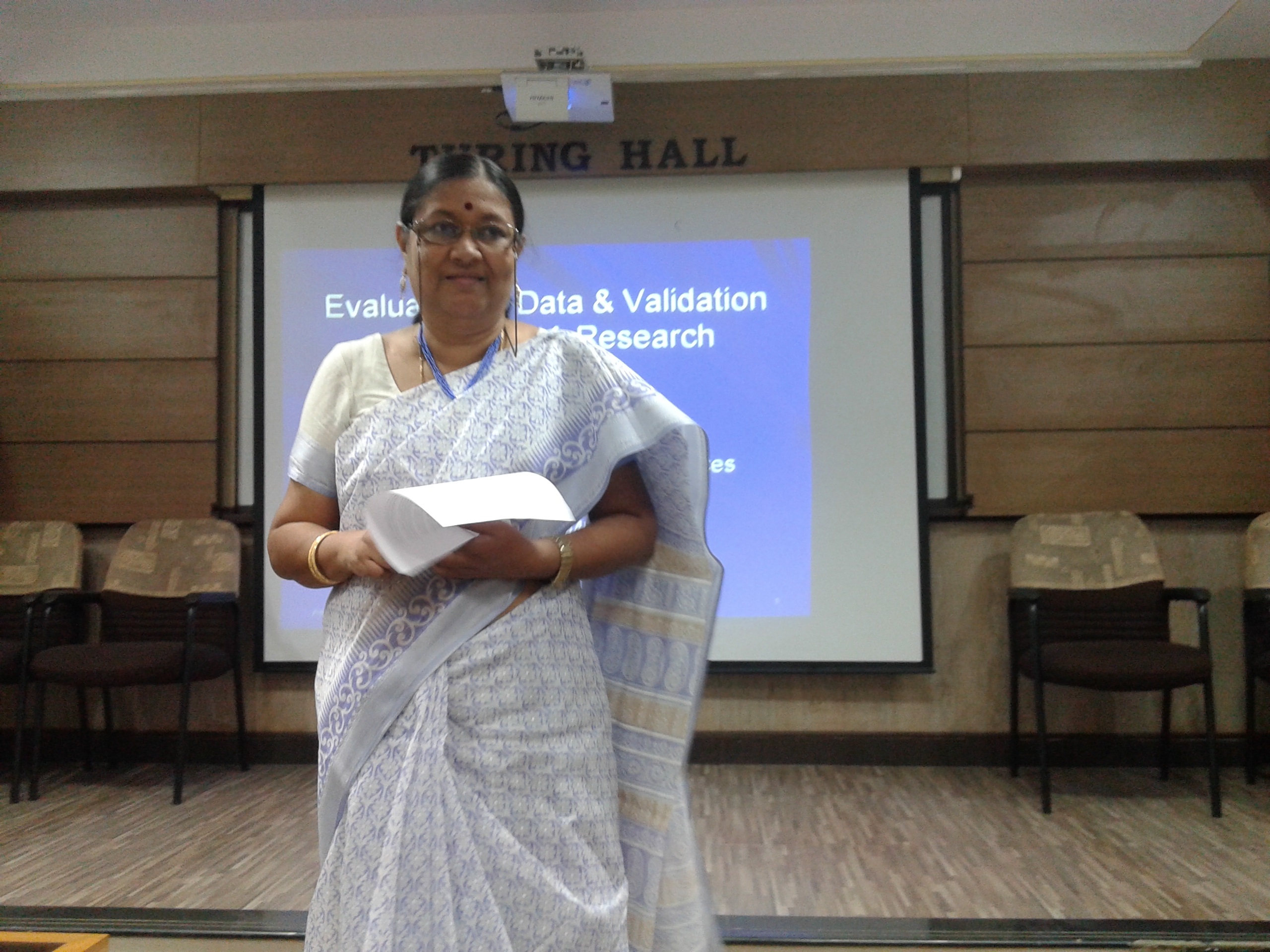
Personal Details
Name:
Designation: BSR Faculty Fellow (UGC) Senior Professor (Retired),
Department of Computer Science and Engineering,
CEG, Anna University
Former Dean, (June 2017-May 2020) CEG, Anna University
Address: GA, Abirami Struthilaya,
42, 28th Cross Street,
Indira Nagar,
Chennai-600020
Mobile no: 9445040791
drtvgeetha@, tv_g@
EDUCATION
B.E. (Electronics and Communication Engineering)
M.E ( Computer Science and Engineering)
Ph.D (Computer Science and Engineering
RESEARCH INTERESTS
Artificial Intelligence, Machine Learning, Natural Language Processing, Text Analytics, Web Search, Biomedical Data Mining
FUTURE PROJECTS
Machine learning for Pre-clinical drug repurposing
Applications Invited
Games for Lifestyle Change
Applications Invited
149
Scopus Publications
2346
Scholar Citations
26
Scholar h-index
64
Scholar i10-index
Scopus Publications
Genetically and semantically aware homogeneous network for prediction and scoring of comorbidities Karpaga Priyaa Kartheeswaran, Arockia Xavier Annie Rayan, Geetha Thekkumpurath Varrieth Computers in Biology and Medicine, 2024 OBJECTIVE: Patients with comorbidities are highly prone to mortality risk than those suffering from a single disease. Therefore, quantification and prediction of disease comorbidities is necessary to stratify the mortality risk of the patients, predict the probability of their occurrence, design treatment strategies, and to prevent the progression of diseases. Enriching comorbidity disease relationships with rich semantics established by genetic components play a vital role in effectively quantifying and predicting comorbidities. However, the existing studies have not extensively explored the semantic richness conveyed by different types of genetic links connecting the comorbidity pairs. METHODS: To solve this, a novel genetic-semantic aware weighted homogeneous network-based method, GSWHomoNet is proposed which first constructs the gene enriched comorbidity heterogeneous network, CoGHetNet with encoded genetic semantic aware weighted meta-path instance disease pair embedding to obtain an enhanced disease node embedding of the network. For enhanced comorbidity prediction and scoring, both direct and indirect semantically enriched comorbidity relationships of the disease nodes is preserved while transforming heterogeneous to homogeneous comorbidity network GSWHomoNet. The proposed GSWHomoNet not only helps discover comorbidity links transductively between known-known disease pairs but also improves the inductive link prediction between known-unknown disease pairs by supplying unknown disease nodes with semantically enriched heterogeneous structural knowledge. RESULTS: The effectiveness of the proposed components is proved by AUC scores of 0.895 and 0.860, as well as AUPR scores of 0.903 and 0.873 for transductive and inductive link prediction respectively. In comorbidity scoring, GSWHomoNet outperformed other methods with a correlation result of 0.848. The effect of the improved association prediction ability of the genetic semantic aware weighted meta-path instance embedding based node embedding is proved on disease-microbe and bibliographic heterogeneous network datasets. For biological significance of GSWHomoNet-based comorbidity scoring, we compared it with gene, pathway, and protein-protein interaction (PPI) perspectives, revealing a stronger correlation with the PPI aspect. We identified a substantial number of predicted comorbidity disease pairs, with 77,456 and 48,972 pairs supported by literature evidence for transductive and inductive predictions, respectively. Additionally, we highlighted shared pathways and PPIs for these pairs, demonstrating the robustness of comorbidity predictions.
Learning Joint Topic Representation for Detecting Drift in Social Media Text J. Vijayarani, T.V. Geetha International Journal of Uncertainty Fuzziness and Knowledge Based Systems, 2024 Social media texts like tweets and blogs are collaboratively created by human interaction. Rapidly changing trends are leading to topic drift in the social media text. This drift is usually associated with words and hashtags. However, geotags play an essential part in determining topic distribution with location context. The rate of change in the distribution of words, hashtags and geotags cannot be considered uniform and must be handled accordingly. This paper builds a topic model that associates the topic with a mixture of distributions of words, hashtags and geotags. Stochastic gradient Langevin dynamic model with varying mini-batch sizes is used to capture the changes due to the asynchronous distribution of words and tags. Topic representations with co-occurrence and location contexts are specified as hashtag context vector and geotag context vector respectively. These two vectors are jointly learned to yield topical word embedding vectors over time conditioned on hashtags and geotags that can predict location-based topical variations effectively. When evaluated with Chennai and UK geolocated Twitter data, the proposed joint topical word embedding model enhanced by the social tags context, outperforms other methods.
DTiGNN: Learning drug-target embedding from a heterogeneous biological network based on a two-level attention-based graph neural network Saranya Muniyappan, Arockia Xavier Annie Rayan, Geetha Thekkumpurath Varrieth Mathematical Biosciences and Engineering, 2023 <abstract> <p>Motivation: In vitro experiment-based drug-target interaction (DTI) exploration demands more human, financial and data resources. In silico approaches have been recommended for predicting DTIs to reduce time and cost. During the drug development process, one can analyze the therapeutic effect of the drug for a particular disease by identifying how the drug binds to the target for treating that disease. Hence, DTI plays a major role in drug discovery. Many computational methods have been developed for DTI prediction. However, the existing methods have limitations in terms of capturing the interactions via multiple semantics between drug and target nodes in a heterogeneous biological network (HBN). Methods: In this paper, we propose a DTiGNN framework for identifying unknown drug-target pairs. The DTiGNN first calculates the similarity between the drug and target from multiple perspectives. Then, the features of drugs and targets from each perspective are learned separately by using a novel method termed an information entropy-based random walk. Next, all of the learned features from different perspectives are integrated into a single drug and target similarity network by using a multi-view convolutional neural network. Using the integrated similarity networks, drug interactions, drug-disease associations, protein interactions and protein-disease association, the HBN is constructed. Next, a novel embedding algorithm called a meta-graph guided graph neural network is used to learn the embedding of drugs and targets. Then, a convolutional neural network is employed to infer new DTIs after balancing the sample using oversampling techniques. Results: The DTiGNN is applied to various datasets, and the result shows better performance in terms of the area under receiver operating characteristic curve (AUC) and area under precision-recall curve (AUPR), with scores of 0.98 and 0.99, respectively. There are 23,739 newly predicted DTI pairs in total.</p> </abstract>
Enhanced disease-disease association with information enriched disease representation Karpaga Priyaa Kartheeswaran, Arockia Xavier Annie Rayan, Geetha Thekkumpurath Varrieth Mathematical Biosciences and Engineering, 2023 <abstract> <p>Objective: Quantification of disease-disease association (DDA) enables the understanding of disease relationships for discovering disease progression and finding comorbidity. For effective DDA strength calculation, there is a need to address the main challenge of integration of various biomedical aspects of DDA is to obtain an information rich disease representation. Materials and Methods: An enhanced and integrated DDA framework is developed that integrates enriched literature-based with concept-based DDA representation. The literature component of the proposed framework uses PubMed abstracts and consists of improved neural network model that classifies DDAs for an enhanced literaturebased DDA representation. Similarly, an ontology-based joint multi-source association embedding model is proposed in the ontology component using Disease Ontology (DO), UMLS, claims insurance, clinical notes etc. Results and Discussion: The obtained information rich disease representation is evaluated on different aspects of DDA datasets such as Gene, Variant, Gene Ontology (GO) and a human rated benchmark dataset. The DDA scores calculated using the proposed method achieved a high correlation mainly in gene-based dataset. The quantified scores also shown better correlation of 0.821, when evaluated on human rated 213 disease pairs. In addition, the generated disease representation is proved to have substantial effect on correlation of DDA scores for different categories of disease pairs. Conclusion: The enhanced context and semantic DDA framework provides an enriched disease representation, resulting in high correlated results with different DDA datasets. We have also presented the biological interpretation of disease pairs. The developed framework can also be used for deriving the strength of other biomedical associations.</p> </abstract>
Building and Analysis of Tamil Lyric Corpus with Semantic Representation Amta 2022 15th Conference of the Association for Machine Translation in the Americas Proceedings Workshop on Empirical Translation Process Research, 2022
Machine Learning: Concepts, Techniques and Applications T V Geetha, S Sendhilkumar Machine Learning Concepts Techniques and Applications, 2022 Machine Learning: Concepts, Techniques and Applications starts at basic conceptual level of explaining machine learning and goes on to explain the basis of machine learning algorithms. The mathematical foundations required are outlined along with their associations to machine learning. The book then goes on to describe important machine learning algorithms along with appropriate use cases. This approach enables the readers to explore the applicability of each algorithm by understanding the differences between them. A comprehensive account of various aspects of ethical machine learning has been discussed. An outline of deep learning models is also included. The use cases, self-assessments, exercises, activities, numerical problems, and projects associated with each chapter aims to concretize the understanding. Features Concepts of Machine learning from basics to algorithms to implementation Comparison of Different Machine Learning Algorithms – When to use them & Why – for Application developers and Researchers Machine Learning from an Application Perspective – General & Machine learning for Healthcare, Education, Business, Engineering Applications Ethics of machine learning including Bias, Fairness, Trust, Responsibility Basics of Deep learning, important deep learning models and applications Plenty of objective questions, Use Cases, Activity and Project based Learning Exercises The book aims to make the thinking of applications and problems in terms of machine learning possible for graduate students, researchers and professionals so that they can formulate the problems, prepare data, decide features, select appropriate machine learning algorithms and do appropriate performance evaluation.
Entity Resolution and Blocking: A Review K.A. Vidhya, T.V. Geetha Proceedings of the 2019 IEEE 9th International Conference on Advanced Computing Iacc 2019, 2019
Unsupervised domain ontology learning from text Sree Harissh Venu, Vignesh Mohan, Kodaikkaavirinaadan Urkalan, Geetha T.V. Lecture Notes in Computer Science Including Subseries Lecture Notes in Artificial Intelligence and Lecture Notes in Bioinformatics, 2017
Modified PageRank for concept based search Journal of Web Engineering, 2015
Patent search and trend analysis A.M. Supraja, S. Archana, S. Suvetha, T.V. Geetha Souvenir of the 2015 IEEE International Advance Computing Conference Iacc 2015, 2015
Automatic construction of Tamil UNL dictionary Ganesh J, Ranjani Parthasarathi, Geetha T. V Lecture Notes in Computer Science Including Subseries Lecture Notes in Artificial Intelligence and Lecture Notes in Bioinformatics, 2015
Automatic data extraction in deep web using bootstrapping approach International Journal of Applied Engineering Research, 2015
Pattern based bootstrapping technique for tamil POS tagging Jayabal Ganesh, Ranjani Parthasarathi, T. V. Geetha, J. Balaji Lecture Notes in Computer Science Including Subseries Lecture Notes in Artificial Intelligence and Lecture Notes in Bioinformatics, 2014
A Tamil lyrics search and visualization system Karthika Ranganathan, B. Barani, T. V. Geetha Lecture Notes in Computer Science Including Subseries Lecture Notes in Artificial Intelligence and Lecture Notes in Bioinformatics, 2013
A deconverter framework for Malayalam Misiriya Shahul Hameed, C. N. Subalalitha, T. V. Geetha, Ranjani Parthasarathi ACM International Conference Proceeding Series, 2012
UNL based context clustering for news event detection Proceedings of the 5th Indian International Conference on Artificial Intelligence Iicai 2011, 2011
Adaptive personalization and Presentation of Recommendations to Learners (APPRL) using Latent Dirichlet Allocation Proceedings of the 5th Indian International Conference on Artificial Intelligence Iicai 2011, 2011
Anaphora resolution in tamil using universal networking language Proceedings of the 5th Indian International Conference on Artificial Intelligence Iicai 2011, 2011
Popular trend summarization system Proceedings of the 5th Indian International Conference on Artificial Intelligence Iicai 2011, 2011
A multilevel UNL concept based Searching and Ranking Webist 2011 Proceedings of the 7th International Conference on Web Information Systems and Technologies, 2011
Challenges in personalization for general information search Proceedings of the 4th Indian International Conference on Artificial Intelligence Iicai 2009, 2009
Semantic role based tamil sentence generator S. Lakshmana Pandian, T.V. Geetha 2009 International Conference on Asian Language Processing Recent Advances in Asian Language Processing Ialp 2009, 2009
Reasoning and evolution of consistent ontologies using NORM International Journal of Artificial Intelligence, 2009
Design of Teaching Learning System based on Indian logic Proceedings of the Iadis International Conference E Learning 2009 Part of the Iadis Multi Conference on Computer Science and Information Systems Mccsis 2009, 2009
Music information retrieval of tamil film music using melody and similarity measures Proceedings of the 4th Indian International Conference on Artificial Intelligence Iicai 2009, 2009
CRF models for tamil part of speech tagging and chunking S. Lakshmana Pandian, T. V. Geetha Lecture Notes in Computer Science Including Subseries Lecture Notes in Artificial Intelligence and Lecture Notes in Bioinformatics, 2009
Automatic tamil content generation S. Kohilavani, T. Mala, T.V. Geetha 2009 International Conference on Intelligent Agent and Multi Agent Systems Iama 2009, 2009
Gautama - Ontology Editor Based on Nyaya Logic G. S. Mahalakshmi, T. V. Geetha, Arun Kumar, Dinesh Kumar, S. Manikandan Lecture Notes in Computer Science Including Subseries Lecture Notes in Artificial Intelligence and Lecture Notes in Bioinformatics, 2009
Tamil question classification using morpheme features S. Lakshmana Pandian, T. V. Geetha Lecture Notes in Computer Science Including Subseries Lecture Notes in Artificial Intelligence and Lecture Notes in Bioinformatics, 2008
Game theoretic model for P2P trust management D.S. Guru, M.G. Suraj Proceedings International Conference on Computational Intelligence and Multimedia Applications Iccima 2007, 2008
An evaluation of personalized web search for an individual user International Conference on Artificial Intelligence and Pattern Recognition 2007 Aipr 2007, 2007
I-KARe - A rational approach to knowledge acquisition and reasoning using Indian logic based knowledge models Proceedings of the 3rd Indian International Conference on Artificial Intelligence Iicai 2007, 2007
Personalized web search using a modified User Conceptual Index based on a Search Flow Graph Proceedings of the 3rd Indian International Conference on Artificial Intelligence Iicai 2007, 2007
Named entity recognition in Tamil using context-cues and the E-M algorithm Proceedings of the 3rd Indian International Conference on Artificial Intelligence Iicai 2007, 2007
A model for the world knowledge representation based on nyaya theory Journal of the Institution of Engineers India Part CP Computer Engineering Division, 2007
Trusted domain web services for delivering e-government services S. Swamynathan, A. Kannan, T. V. Geetha Advances in Computer Science and Eng Reports and Monographs Innovative Applications of Information Technology for the Developing World Proc of the 3rd Asian Applied Comput Conf Aacc 2005, 2007
A mathematical model for argument procedures based on indian philosophy Proceedings of the IASTED International Conference on Artificial Intelligence and Applications Aia 2006, 2006
Topical and temporal visualization using wavelets T. Mala, T. V. Geetha, Sathish Kumar Lecture Notes in Computer Science Including Subseries Lecture Notes in Artificial Intelligence and Lecture Notes in Bioinformatics, 2006
Web search using personalized user conceptual index Proceedings of the 2nd Indian International Conference on Artificial Intelligence Iicai 2005, 2005
Mixed language speech recognition and automated dialog management Proceedings of the 2nd Indian International Conference on Artificial Intelligence Iicai 2005, 2005
Introducing pitch modification in residual excited LPC Based tamil text-to-speech synthesis Lecture Notes in Computer Science Including Subseries Lecture Notes in Artificial Intelligence and Lecture Notes in Bioinformatics, 2004
Semantic search engine D. Manjula, T. V. Geetha Journal of Information and Knowledge Management, 2004
Semantics based information retrieval using conceptual indexing of documents Lecture Notes in Computer Science Including Subseries Lecture Notes in Artificial Intelligence and Lecture Notes in Bioinformatics, 2004
Automatic generation of description logic representation of documents Proceedings of the International Conference on Artificial Intelligence IC AI 2003, 2003
Retraction Note: Knowledge-enhanced temporal word embedding for diachronic semantic change estimation J Vijayarani, TV Geetha Soft Computing 28 (Suppl 1), 165-165 , 2024 2024
Learning Joint Topic Representation for Detecting Drift in Social Media Text J Vijayarani, TV Geetha International Journal of Uncertainty, Fuzziness and Knowledge-Based Systems … , 2024 2024 Citations: 1
Network alignment and link prediction using event-based embedding in aligned heterogeneous dynamic social networks: M. Balakrishnan and TV Geetha M Balakrishnan, G TV Applied Intelligence 53 (20), 24638-24654 , 2023 2023 Citations: 7
Machine learning: concepts, techniques and applications TV Geetha, S Sendhilkumar Chapman and Hall/CRC , 2023 2023 Citations: 55
Enhanced disease-disease association with information enriched disease representation KP Kartheeswaran, AXA Rayan, GT Varrieth Mathematical Biosciences and Engineering 20 (5), 8892-8932 , 2023 2023 Citations: 3
DTiGNN: learning drug-target embedding from a heterogeneous biological network based on a two-level attention-based graph neural network S Muniyappan, AXA Rayan, GT Varrieth Mathematical Biosciences and Engineering 20 (5), 9530-9571 , 2023 2023 Citations: 8
Poetic and Semantic Features for Lyricist Identification from Tamil Film Lyrics K Ranganathan, TV Geetha SN Computer Science 4 (1), 4 , 2022 2022
Building and Analysis of Tamil Lyric Corpus with Semantic Representation K Ranganathan, TV Geetha Proceedings of the 15th biennial conference of the Association for Machine … , 2022 2022 Citations: 1
Features of Semantic Similarity Assessment: Content-and Model-Based Perspectives J Vijayarani, TV Geetha Handbook of Research on Opinion Mining and Text Analytics on Literary Works … , 2022 2022 Citations: 1
Relation Extraction between Biomedical Entities from Literature using Semi-Supervised Learning Approach M Saranya, M Saranya, R Arockia Xavier Annie, TV Geetha CS & IT Conference Proceedings 11 (23) , 2021 2021
Phrase Extraction Using Pattern-Based Bootstrapping Approach R Hema, TV Geetha Intelligent Computing and Innovation on Data Science: Proceedings of ICTIDS … , 2021 2021
Comparative analysis of different deep learning techniques for relation extraction from biomedıcal literature M Saranya, TV Geetha, RAX Annie Sentimental Analysis and Deep Learning: Proceedings of ICSADL 2021, 423-438 , 2021 2021 Citations: 1
Joint learning of author and citation contexts for computing drift in scholarly documents J Vijayarani, TV Geetha International Journal of Machine Learning and Cybernetics 12 (6), 1667-1686 , 2021 2021 Citations: 1
Pattern-based bootstrapping framework for biomedical relation extraction SS Deepika, TV Geetha Engineering Applications of Artificial Intelligence 99, 104130 , 2021 2021 Citations: 27
Things and everything: Internet of nano-things future growth trends T Geetha, J Balaji, M Dinesh, MS DHIVAKAR International Journal of Computer Science Engineering Techniques, 6 (2), 1-11 , 2021 2021 Citations: 1
Joint topical word embedding for detecting drift in social media text J Vijayarani, TV Geetha 2020 Citations: 1
Concept map information content enhancement using joint word embedding and latent document structure K Urkalan, TV Geetha International Journal on Semantic Web and Information Systems (IJSWIS) 16 (4 … , 2020 2020 Citations: 2
RETRACTED ARTICLE: Knowledge-enhanced temporal word embedding for diachronic semantic change estimation: J. Vijayarani, TV Geetha J Vijayarani, TV Geetha Soft Computing 24 (17), 12901-12918 , 2020 2020 Citations: 3
A neural network framework for predicting dynamic variations in heterogeneous social networks M Balakrishnan, G TV Plos one 15 (4), e0231842 , 2020 2020 Citations: 15
Lexical Syntactic Patterns and Novel Statistical Measures based Bootstrapping Approach for Evolution of Biomedical Ontologies B Sathiya, TV Geetha International Journal of Computer Applications 177 (39), 21-27 , 2020 2020
MOST CITED SCHOLAR PUBLICATIONS
Learning content design and learner adaptation for adaptive e-learning environment: a survey KR Premlatha, TV Geetha Artificial Intelligence Review 44 (4), 443-465 , 2015 2015 Citations: 147
A survey on crossover operators G Pavai, TV Geetha ACM Computing Surveys (CSUR) 49 (4), 1-43 , 2016 2016 Citations: 140
Raga identification of carnatic music for music information retrieval R Sridhar, TV Geetha International Journal of recent trends in Engineering 1 (1), 571 , 2009 2009 Citations: 115
Dynamic learner profiling and automatic learner classification for adaptive e-learning environment KR Premlatha, B Dharani, TV Geetha Interactive Learning Environments 24 (6), 1054-1075 , 2016 2016 Citations: 98
A meta-learning framework using representation learning to predict drug-drug interaction SS Deepika, TV Geetha Journal of biomedical informatics 84, 136-147 , 2018 2018 Citations: 62
Machine learning: concepts, techniques and applications TV Geetha, S Sendhilkumar Chapman and Hall/CRC , 2023 2023 Citations: 55
Morphological analyzer for Tamil P Anandan, K Saravanan, R Parthasarathi, TV Geetha International Conference on Natural language Processing 3, 12-22 , 2002 2002 Citations: 54
CRF models for Tamil part of speech tagging and chunking SL Pandian, TV Geetha International Conference on Computer Processing of Oriental Languages, 11-22 , 2009 2009 Citations: 45
Personalized ontology for web search personalization S Sendhilkumar, TV Geetha Proceedings of the 1st Bangalore annual Compute conference, 1-7 , 2008 2008 Citations: 42
Morpheme based language model for Tamil part-of-speech tagging S Lakshmana Pandian, TV Geetha Polibits, 19-25 , 2008 2008 Citations: 38
Tamil document summarization using semantic graph method M Banu, C Karthika, P Sudarmani, TV Geetha International conference on computational intelligence and multimedia … , 2007 2007 Citations: 37
Swara indentification for south indian classical music R Sridhar, TV Geetha 9th International Conference on Information Technology (ICIT'06), 143-144 , 2006 2006 Citations: 37
Semi-supervised bootstrapping approach for named entity recognition S Thenmalar, J Balaji, TV Geetha arXiv preprint arXiv:1511.06833 , 2015 2015 Citations: 35
Document summarization and information extraction for generation of presentation slides KG Prasad, H Mathivanan, TV Greetha, M Jayaprakasam 2009 International Conference on Advances in Recent Technologies in … , 2009 2009 Citations: 34
New crossover operators using dominance and co-dominance principles for faster convergence of genetic algorithms G Pavai, TV Geetha Soft Computing 23 (11), 3661-3686 , 2019 2019 Citations: 33
Morpho-Semantic Features for Rule-based Tamil Enconversion J Balaji, P Ranjani, K Madhan International Journal of Computer Applications 26 (6), 11-18 , 2011 2011 Citations: 30
Rough set theory for document clustering: A review KA Vidhya, TV Geetha Journal of Intelligent & Fuzzy Systems 32 (3), 2165-2185 , 2017 2017 Citations: 29
Unl deconverter for tamil T Dhanabalan, TV Geetha International Conference on the Convergences of Knowledge, Culture, Language … , 2003 2003 Citations: 29
Unsupervised domain ontology learning from text SH Venu, V Mohan, K Urkalan, G Tv International Conference on Mining Intelligence and Knowledge Exploration … , 2016 2016 Citations: 28
Automatic extractive text summarization based on fuzzy logic: a sentence oriented approach ME Hannah, TV Geetha, S Mukherjee International Conference on Swarm, Evolutionary, and Memetic Computing, 530-538 , 2011 2011 Citations: 28