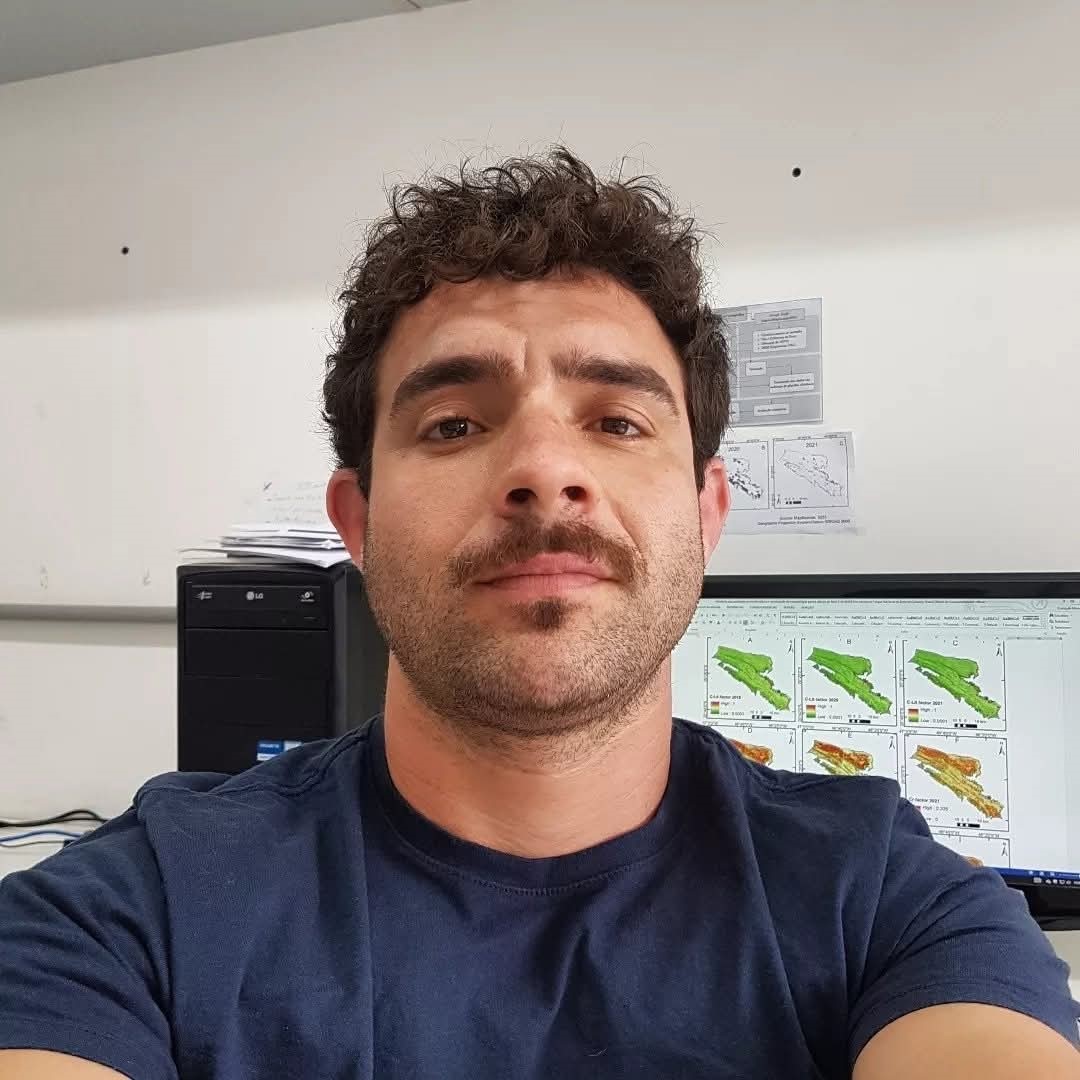
Guilherme Rios is a geographer, MSc, and PhD candidate in Environmental Sciences at the Federal University of Alfenas (UNIFAL-MG). His research explores wildfire dynamics, post-fire vegetation recovery, spectral indices, watershed processes, and soil erosion modeling. With a strong background in GIS and remote sensing, he investigates how geotechnologies can support environmental analysis, conservation planning, and sustainable landscape management.
EDUCATION
Geographer, MSc, and PhD candidate in Environmental Sciences at the Federal University of Alfenas.
RESEARCH, TEACHING, or OTHER INTERESTS
Computers in Earth Sciences, Earth-Surface Processes
9
Scopus Publications
22
Scholar Citations
3
Scholar h-index
Scopus Publications
Greenhouse Gas Emissions of Tropical Coffee Production Systems † Derielsen Brandão Santana, Fellipe Silva Gomes, Guilherme da Silva Rios, Felipe Gomes Rubira, Isabella de Oliveira Carvalho, et al. Agriculture Switzerland, 2026 Brazil is the main coffee producer in the world. However, the impacts of climate change driven by greenhouse gas (GHG) emissions pose a major challenge for agriculture in tropical regions. This study established a GHG inventory of coffee production on farms in southern Minas Gerais, Brazil, over a two-year period, adopting a cradle-to-farm-gate approach. It considered scopes 1 and 2 emissions from on-farm activities. The emission inventories were based on Intergovernmental Panel on Climate Change (IPCC) methodologies adapted for Brazilian conditions. The emissions were categorized in direct and biogenic and by area (in hectares) and production (kg of coffee). Electricity consumption, fossil fuel use, wood burning and fertilizer application were considered. Direct total emissions ranged from 2617 to 6211 t CO2e, 2.67 to 3.81 t CO2e ha−1, and from 1.52 to 4.59 kg CO2e kg−1 of coffee. Biogenic emissions ranged from 336 to 4955 t CO2e, 0.28 to 2.95 t CO2e ha−1, and from 0.32 to 2.21 kg CO2e kg−1 of coffee. Urea-based nitrogen fertilizers were the main source of direct emission and wood burning was the main source of biogenic emission. Management practices such as applying non-urea-based fertilizers, adjusting nitrogen rates according to soil analyses and manual harvesting contributed to mitigating GHG emissions. The observed emission intensities were consistent with other reported values for Brazilian coffee production. Further reductions may be achieved by adopting agroforestry systems, increasing coffee straw retention in the soil and replacing urea with alternative nitrogen sources, including slow-release fertilizers and urease-inhibitor technologies.
Spatiotemporal Dynamics of Soil and Soil Organic Carbon Losses via Water Erosion in Coffee Cultivation in Tropical Regions Derielsen Brandão Santana, Guilherme Henrique Expedito Lense, Guilherme da Silva Rios, Raissa Eduarda da Silva Archanjo, Mariana Raniero, et al. Sustainability Switzerland, 2025 Water erosion has severe impacts on soil and the carbon cycle. In tropical regions, it is significantly influenced by rainfall, soil erodibility, rapid changes in land use and land cover (LULC), and agricultural management practices. Understanding the dynamics of water erosion is essential for implementing precise land degradation control. This study aimed to estimate soil and soil organic carbon (SOC) losses due to water erosion over five years in a coffee-producing area in Brazil using the revised universal soil loss equation (RUSLE). The results revealed that average soil losses in coffee plantation areas ranged from 1.77 to 1.80 Mg ha−1 yr−1, classified as very low. Total and potential soil loss ranged from 2184.60 to 6657.14 Mg ha−1, a 305% difference, demonstrating the efficiency of vegetative cover (C factor) and conservation practices (P factor) in reducing soil loss rates. SOC losses were less than 200 kg ha−1 yr−1, with averages of 17.67 and 13.00 kg ha−1 yr−1 in coffee areas. In conclusion, agricultural management practices, such as the presence of native vegetation, maintaining vegetative cover in coffee rows, contour planting, and improving agronomic techniques, are essential for reducing soil and SOC losses, even in scenarios of biennial alternation in coffee production. Thus, sustainable agricultural management plays a crucial role in mitigating water erosion, maintaining productivity, and addressing climate change.
ECONOMIC VIABILITY OF CONVERTING FROM CONVENTIONAL TO ORGANIC COFFEE CULTIVATION IN SOUTHERN MINAS GERAIS Elivandro Miguel Reis, Luciana Azevedo, Marcelo Lacerda Rezende, Guilherme da Silva Rios Revista De Gestao Social E Ambiental, 2024 Objective: This study aims to explore the economic viability of converting conventional coffee cultivation to organic practices on a rural property in southern Minas Gerais, assessing the economic and operational impacts of this process. Theoretical Framework: The literature on sustainability in coffee production suggests economic benefits and a reduction in negative environmental impacts for farmers who adopt sustainability certifications. However, empirical evidence is mixed, with studies indicating a dependence on financial premiums to offset the lower productivity of organic cultivation. Method: A case study was conducted on a property that uses both production systems. Data from the 2022/2023 harvest were collected and analyzed, comparing the operational costs and profitability between conventional and organic cultivation methods. Results and Discussion: The findings indicate that the high cost of organic inputs negatively impacted the profitability of organic production, despite the significantly higher sales prices of organic produce. The low productivity of the organic plot resulted in losses, highlighting a gap in the efficiency of production management. Research Implications: The findings of this study suggest the need for more effective management strategies and possibly the development of agricultural technologies that increase the productivity of organic cultivation, without compromising the principles of sustainable agriculture. Originality/Value: This study contributes to existing literature by exploring the conversion of cultivation in a specific and coffee-producing region in Brazil, providing data on the real economic challenges faced by farmers during the transition to sustainable agricultural practices. The detailed analysis of costs and benefits reinforces the complexity and nuances involved in adopting sustainable agricultural practices on a local scale.
Serra da Canastra National Park: Influence of forest fires on the RUSLE C factor and its impact on water erosion Guilherme S. RIOS, Derielsen B. SANTANA, Guilherme H.E. LENSE, Felipe G. RUBIRA, Joaquim E.B. AYER, et al. Notulae Botanicae Horti Agrobotanici Cluj Napoca, 2024 The adverse impacts of soil degradation and nutrient loss resulting from water erosion are significant environmental concerns that have profound implications for both water quality and biodiversity. This study aims to evaluate the impact of forest fires on soil loss through water erosion in the Serra da Canastra National Park, in Minas Gerais state, Brazil. Using the Revised Universal Soil Loss Equation (RUSLE), which considers rainfall erosivity, soil erodibility, slope length and slope and vegetation cover, the C factor (vegetation cover) values were obtained from data from literature and methods based on the Normalized Differential Vegetation Index (NDVI). Validation was carried out using data on total sediment, water flow and daily runoff from the hydrosedimentological station and the InVEST software. The results highlight the significant impact of wildfires on soil loss through water erosion and indicate that areas recently affected by wildfires, especially on steep slopes and with more erodible soils, are subject to the highest rates of soil loss. Soil loss rates varied from 0.75 to 12.55 Mg ha-1 yr-1, in part due to the different ways of obtaining factor C. The research emphasizes the need to conserve vegetation cover to prevent soil erosion, particularly in regions impacted by forest fires. This study offers valuable insights that can contribute to enhancing the sustainable environmental management of the Serra da Canastra National Park.
Modeling soil losses by water erosion in a coffee growing area in Southeastern Brazil Derielsen Brandão Santana, Guilherme da Silva Rios, Guilherme Henrique Expedito Lense, Guilherme Rodrigo Brizolari, Flávio Roberto Araújo Franceschi, et al. Revista Brasileira De Geografia Fisica, 2023 Water erosion is one of the main soil degradation problems, especially in tropical areas due to high rainfall rates. Several factors affect water erosion, especially anthropic actions related to land use and occupation. In this scenario, the objective of the work was to estimate the rates of soil loss by water erosion in a coffee production area in the south Minas Gerais State, compare them with the soil loss tolerance limits and evaluate the sustainability of the agricultural production system. The hypothesis of this work is that the adoption of conservationist practices in coffee production areas has the potential to reduce soil losses in areas of steep relief, highly susceptible to water erosion. The methodology employed was based on the application of the Revised Universal Soil Loss Equation and the calculation of soil loss tolerance. The results showed a variation of soil loss rates between 0.08 and 21.97 Mg ha-1 year-1, with the highest soil loss rates obtained in the bare soil and the lowest in the native forest. In areas with coffee plantations, low soil losses were observed, indicating that conservation practices adopted in this crop, such as level planting and management of plant residues and soil cover, have the potential to reduce soil loss, especially in high slope areas. Therefore, soil loss modeling was an efficient tool to evaluate the stage of soil degradation and to define sustainable agricultural management practices and preservation of the vegetation cover.Keywords: RUSLE; land use and land cover; soil loss tolerance. Modelagem das perdas de solo pela erosão hídrica em uma área de produção de café no Sudeste do BrasilR E S U M OA erosão hídrica é um dos principais problemas de degradação dos solos, especialmente em áreas tropicais em virtude dos índices pluviométricos elevados. Vários fatores afetam a erosão hídrica, especialmente as ações antrópicas relacionadas ao uso e ocupação do solo. Neste cenário, o objetivo do trabalho foi estimar as taxas de perdas de solo por erosão hídrica em uma área de produção cafeeira no sul do Estado de Minas Gerais, comparar com os limites de tolerância de perda de solo e avaliar a sustentabilidade do sistema de produção agrícola. A hipótese do presente trabalho, é que a adoção de práticas conservacionistas nas áreas de produção de café tem o potencial de reduzir as perdas de solo em áreas de relevo íngreme, altamente suscetíveis a erosão hídrica. A metodologia empregada foi baseada na aplicação da Equação Universal da Perda de Solo Revisada e no cálculo da tolerância de perda de solo. Os resultados mostraram uma variação das taxas de perdas de solo entre 0,08 e 21,97 Mg ha-1 ano-1, com as maiores taxas de perdas de solos obtidas nas áreas de solos expostos e as menores nas de mata nativa. Nas áreas com plantações de café foram observadas baixas perdas de solo, indicando que as práticas conservacionistas adotadas nesta cultura, como plantio em nível e o manejo de resíduos vegetais e da cobertura do solo, têm o potencial de reduzir a perda de solo, especialmente em áreas de alta declividade. Portanto, a modelagem das perdas de solo foi ferramenta eficiente para avaliar o estágio de degradação do solo e definir práticas de manejo agrícola sustentáveis e de preservação da cobertura vegetal.Palavras-chave: RUSLE; uso e ocupação do solo; tolerância de perda de solo.
Morphometric parameters of the relief and drainage network of the Formiga River subbasin, Minas Gerais, Brazil Igor Luís Reis, Gustavo Sousa Marinho, Guilherme Da Silva Rios, Derielsen Brandão Santana, Guilherme Henrique Expedito Lense, et al. Revista Brasileira De Geomorfologia, 2023 This research analyzed the morphological/morphometric parameters of the relief and drainage network of the Formiga River subbasin, southern Minas Gerais State, Brazil. This study identified and examined the influences of control mechanisms in the development of current configurations. The methodology was based on the application of indices and parameters: (1) slope length (Hack's Sl); (2) normalized slope index (ksn); (3) river hierarchy; (4) drainage density; (5) hydrographic density; (6) sinuosity index; (7) density of structural lineaments; (8) transverse topographic symmetry factor; (9) asymmetry factor of drainage basins; (10) topographic profiles transverse to the valleys; (11) relief ratio; (12) roughness index; (13) roughness concentration index; (14) compactness coefficient; (15) circularity index and (16) form factor. The results indicated 3 sectors of the subbasin with distinct geomorphic behaviors, which resulted in peculiar surface structures and divergent current dynamics. The subbasin presents physical evidence that demonstrates and corroborates strong tectonic and structural control in the development of the current drainage network and relief. Human action has also affected, from the construction of dams, the dynamics of the lower course of the river, drowned by the reservoir of the hydroelectric plant of Furnas.
RECENT SCHOLAR PUBLICATIONS
ESTIMATIVA DAS PERDAS DE SOLO POR EROSÃO HÍDRICA NA SUB-BACIA HIDROGRAFIA DO CÓRREGO DA ESTIVA–ALFENAS-MG EG Fachina, RM da Silva, LB Zanete, DB Santana, G da Silva Rios, ... Caderno de Geografia 36 (2), 1-1 , 2026 2026
Reorganization of the drainage network based on morphostructural controls in passive margins BL da Cruz, RE da Silva Archanjo, RVMA da Silva, DB Santana, ... Geomorphology 478, 109693 , 2025 2025 Citations: 7
ESTIMATES OF SOIL LOSSES DUE TO WATER EROSION IN THE AMAZON BIOME. G da Silva RIOS, D Brandao SANTANA, GH Expedito LENSE, BA SILVA, ... Agriculture & Forestry/Poljoprivreda i šumarstv 70 (1) , 2024 2024
Morphometric parameters of the relief and drainage network of a tropical subbasin IL Reis, GS Marinho, G da Silva Rios, DB Santana, GHE Lense, ... Revista Brasileira de Geomorfologia 24 (2) , 2023 2023 Citations: 5
Morphometric parameters of the relief and drainage network of a tropical subbasin I Luís Reis, G Sousa Marinho, G Da Silva Rios, D Brandão Santana, ... Revista Brasileira de Geomorfologia 24, 2311 , 2023 2023 Citations: 1
Modeling soil losses by water erosion in a coffee growing area in Southeastern Brazil DB Santana¹, G da Silva Rios, GHE Lense, G Rodrigo, FRAF Brizolari, ... Revista Brasileira de Geografia Física 16 (04), 2031-2046 , 2023 2023 Citations: 3
Análise multitemporal de incêndios florestais ocorridos no Estado de Minas Gerais entre 2001 e 2020 M de Oliveira Latuf, G da Silva Rios, RC Pereira Revista Cerrados (Unimontes) 20 (01), 120-148 , 2022 2022 Citations: 6
MOST CITED SCHOLAR PUBLICATIONS
Reorganization of the drainage network based on morphostructural controls in passive margins BL da Cruz, RE da Silva Archanjo, RVMA da Silva, DB Santana, ... Geomorphology 478, 109693 , 2025 2025 Citations: 7
Análise multitemporal de incêndios florestais ocorridos no Estado de Minas Gerais entre 2001 e 2020 M de Oliveira Latuf, G da Silva Rios, RC Pereira Revista Cerrados (Unimontes) 20 (01), 120-148 , 2022 2022 Citations: 6
Morphometric parameters of the relief and drainage network of a tropical subbasin IL Reis, GS Marinho, G da Silva Rios, DB Santana, GHE Lense, ... Revista Brasileira de Geomorfologia 24 (2) , 2023 2023 Citations: 5
Modeling soil losses by water erosion in a coffee growing area in Southeastern Brazil DB Santana¹, G da Silva Rios, GHE Lense, G Rodrigo, FRAF Brizolari, ... Revista Brasileira de Geografia Física 16 (04), 2031-2046 , 2023 2023 Citations: 3
Morphometric parameters of the relief and drainage network of a tropical subbasin I Luís Reis, G Sousa Marinho, G Da Silva Rios, D Brandão Santana, ... Revista Brasileira de Geomorfologia 24, 2311 , 2023 2023 Citations: 1
ESTIMATIVA DAS PERDAS DE SOLO POR EROSÃO HÍDRICA NA SUB-BACIA HIDROGRAFIA DO CÓRREGO DA ESTIVA–ALFENAS-MG EG Fachina, RM da Silva, LB Zanete, DB Santana, G da Silva Rios, ... Caderno de Geografia 36 (2), 1-1 , 2026 2026
ESTIMATES OF SOIL LOSSES DUE TO WATER EROSION IN THE AMAZON BIOME. G da Silva RIOS, D Brandao SANTANA, GH Expedito LENSE, BA SILVA, ... Agriculture & Forestry/Poljoprivreda i šumarstv 70 (1) , 2024 2024