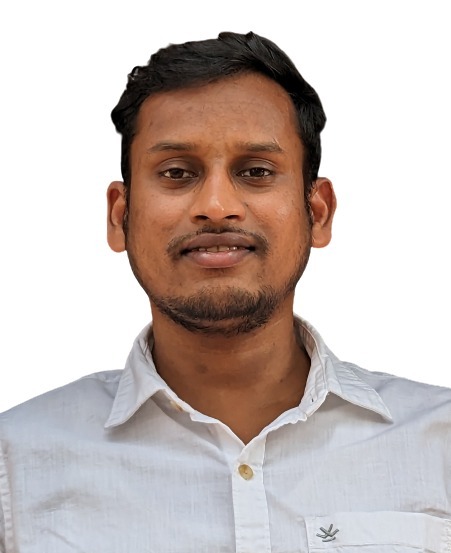
Maheshwar Kumar

@niser.ac.in

PhD Scholar at School of Humanities and Social Sciences
National Institute of Science Education and Research, Bhubaneswar

Maheshwar Kumar holds a PhD from the National Institute of Science Education and Research (NISER) Bhubaneswar, an Off-Centre Campus of Homi Bhabha National Institute (HBNI), India. His PhD thesis is entitled- “Performance as Cultural Text: Defamiliarizing the Performing Art Tradition of Purulia His current research article has been published in Performance Research (Taylor & Francis), The Oriental Anthropologist (Sage), and Asian Anthropology (Taylor & Francis). His primary areas of research interest are- Purulia Chhau, Cultural Studies, Performance Studies, Dance Research, and Indigenous Culture.

EDUCATION

 Ph.D. in English, 2024- National Institute of Science Education and Research Bhubaneswar
 UGC NET in English, 2018
 M.A. English, 2018- Banaras Hindu University, Uttar Pradesh (1st Class)
 B.A. English, 2016- Sidho-Kanho-Birsha University, West Bengal (2nd Class)
 Higher Secondary, 2012- West Bengal Council of Higher Secondary Education (1st Class)
 Secondary, 2010- West Bengal Board of Secondary Education (1st Class)

RESEARCH, TEACHING, or OTHER INTERESTS

Arts and Humanities, Literature and Literary Theory, Visual Arts and Performing Arts, Language and Linguistics
6

Scopus Publications

Scopus Publications

  • Masked-Dance and Audience Reception in the Performing Art Tradition of Purulia Chhau
    Maheshwar Kumar, Amarjeet Nayak, Pranaya Kumar Swain
    Asian Theatre Journal, 2026
    Mask, a traditional and unique identifier, is the source of vital energy for the dancers of Purulia Chhau , a martial art masked-dance form of Eastern India. During performance, dancers leave behind their everyday personalities and become the characters represented by the masks they wear, transforming themselves into mythological figures . Chhau had no dedicated themes in its rudimentary form; however, with the emergence of Hinduism in the seventeenth century , Chhau ’s themes began to be adapted from the Hindu epics of The Ramayana and The Mahabharata , and a few stories were collected from The Puranas , which introduced certain mythological characters to the audience. In Chhau , making masks and performing masked characters requires in-depth knowledge of the Hindu epics, so that both the mask-makers and masked-dancers can bring life to the masks and determine the dancer’s gestures, postures, and dance movements, giving the masked-dance of Chhau an aesthetic performative sense among the audience. Referring to social and cultural perspectives and employing a qualitative approach as our primary methodological tool, this article first aims to take a deeper look into different aspects of the origin, development, and significance of masks, costumes, and musical instruments used in Purulia Chhau . Second, by exploring the nature of performance and the symbolic moments within dance representation, the essay critically examines the importance of audience reception in the performing art tradition of Purulia Chhau .
  • Dance as Cultural/Performance Text: Decoding the Cultural Labor of Purulia Chhau in India
    Maheshwar Kumar, Amarjeet Nayak, Pranaya Kumar Swain
    Dance Chronicle, 2026
    This study interrogates Purulia Chhau as a cultural/performance text through the frameworks of cultural labor and theater semiotics. Drawing on Bramha Prakash’s sanskrutik sram, it argues that the laboring body generates value, forging ties to place, memory, and identity. Mythic portrayals of Chhau’s semiotic network—masks, costumes, body language, music, and audience reception—construct authority and meaning while negotiating authenticity, commodification, and representation in global circuits. Arguing for a nuanced, embedded approach to folk performance, this study honors Chhau’s epistemological depth and the cultural labor through which it endures—ritualized, affective, and continually reinvented in dialogue with contemporary pressures.
  • SPECIAL ISSUE ON EMOTION-AWARE AI AND DIGITAL TRANSFORMATION OF VISUAL CULTURE
    Muskan Gupta
    Shodhkosh Journal of Visual and Performing Arts, 2025
    It is a pleasure to present this special issue of ShodhKosh: Journal of Visual and Performing Arts titled “Emotion-Aware AI and Digital Transformation of Visual Culture.” This issue highlights the growing role of emotion as a core analytical dimension in AI-driven visual arts. As affective computing and intelligent systems increasingly shape artistic creation and media practices, visual culture is undergoing significant transformation. The selected contributions explore creative, pedagogical, and ethical implications of emotion-aware technologies, bringing together perspectives from visual arts, digital humanities, and artificial intelligence. This special issue offers a scholarly platform for artists, educators, researchers, and students engaged with ethics and innovation in contemporary visual culture. Issue Editor: Dr. Mithun Baswaraj PatilAssociate Professor, Department of Artificial Intelligence and Data Science, Nagesh Karajagi Orchid College of Engineering & Technology (NKOCET), Solapur, Maharashtra, IndiaEmail: drmithunbpatil@gmail.com Dr. Mangala MadankarAssistant Professor and Head, Department of Artificial Intelligence, G H Raisoni College of Engineering, Nagpur, IndiaEmail: msmadankar@gmail.com Dr. Tahira Anwar LashariAssociate Professor, School of Electrical Engineering and Computer Science, SEECS National University of Sciences and Technology (NUST), Islamabad, PakistanEmail: tahiraa.lashari@gmail.com Dr. Hamzah Bin AhmadAssociate Professor, Faculty of Electrical & Electronics Engineering Technology, University Malaysia Pahang Al-Sultan Abdullah, Pekan Campus, 26600 Pekan, Pahang, MalaysiaEmail: hamzah@umpsa.edu.my Dr. Maheshwar KumarAssistant Professor, Birla School of Management, Birla Global University, Bhubaneswar, IndiaEmail: maheshwar.kumar@bgu.ac.in
  • Performance as cultural text: defamiliarizing the performing art tradition of Purulia Chhau
    Maheshwar Kumar
    Asian Anthropology, 2025
    Referring to the social and cultural anthropological perspectives and employing a qualitative approach as the primary methodological tool, this PhD dissertation explores the performing art tradition of Chhau in Purulia, West Bengal, as a cultural/performance text. According to Richard Schechner (2006), the performance process as a time-space sequence consists of (1) proto-performance – training, workshop, and rehearsal; (2) performance – warm-up, public performance, events/contexts sustaining the public performance, and cool down; and (3) aftermath – critical responses, archives, and memories. Conflating these three-phase performance sequences, first, the dissertation finds out the correlation between dance habits and restored behavior and analyzes the proto-performance practices of Purulia Chhau. Second, it analyzes the connection between the performative cultures of Chaitra Parva and Purulia Chhau and establishes a synthesis among ritual, performance, and spirituality. It also understands the core performance gist of Purulia Chhau, deriving from the cultures of orality, performativity, and make-believe/make-belief. Third, the dissertation critically looks at the various performance aftermaths such as audience reception, critical responses, archives, memories, new normalization, and women’s innovations that take place in Purulia Chhau.
  • Ritual, Performance and Spirituality: Revisiting the Performative Cultures of Chaitra Parva and Purulia Chhau in West Bengal
    Maheshwar Kumar, Amarjeet Nayak, Pranaya Kumar Swain
    Oriental Anthropologist, 2024
    Ritual, a reflection of human nature, society, and culture, influences various performance traditions as a form of symbolism, a way of communicating and a vehicle of transformation. Additionally, performance as an embodied process characterizes the constitutive of culture signifying the study of man. This integration of ritual and performance is mirrored in the Chaitra Parva or the Spring Festival, celebrated annually in honor of Lord Shiva, invoking rain. During this ritual worship, the devotees undertake severe austerities through renunciation and self-mortification, and the Chhau dancers incarnate the gods, goddesses, and demons through their highly stylized masked dance. Drawing references to a series of rituals and performances, the present study explores the major events of the last four days of Chaitra Parva and its constitutive performing art of Chhau. The study also involves enquiring about the people of Purulia district in West Bengal and their cultural heritage to provide an empirical grounding to this study. It also introduces the background and context of the Hindu epics and focuses on the myth of Lord Shiva and the history of Shiva temple at Lohoria in Purulia. Finally, through a synthesis of performative rituals, performances and spirituality, the present study shows how the people find meaning, significance, and connection in those ritual rites and performances which bind them together with a sense of cultural identity and belongingness.
  • Habit as Restored Behaviour in Purulia Chhau: A vignette
    Maheshwar Kumar, Amarjeet Nayak, Pranaya Kumar Swain
    Performance Research, 2023
    According to Richard Schechner, the overall time-space sequence of performance is divided into three parts: proto-performance, performance and aftermath. Schechner’s concept of restored behaviour falls under the time-space sequence of proto-performance, which comprises of training, workshop and rehearsal processes. As such, restored behaviour marks previously enacted embodiment and emphasizes the processes of repetition and revision. These behaviours can be aligned with habits as ‘a settled disposition or tendency to act in a particular way, acquired through repetition of the action in question’ (Felix Ravaisson (2008) Of Habit, trans. Clare Carlisle and Mark Sinclair, London: Continuum, p5). This article aims to open a window on the concepts of restored behaviour and habit and explores in the context of a particular aesthetic performance practice via an emphasis on repetition, enactment and embodied assimilation. Accordingly, this vignette focuses on Purulia Chhau of West Bengal, a tribal, martial, folk, masked dance-drama form of Eastern India, whose various habits of performance are considered in terms of restored behaviours. Within this context, we use Schechner’s theory and employ a qualitative approach as the primary methodological tool to analyse the threefold habits of proto-performance practices in Purulia Chhau, close read the recurring patterns as habits in practices of repetition and their improvisation, and examine how restored behaviour works both in symbolic and reflexive ways during the performances offered to the public.

Publications

1. Kumar, M., Nayak, A., & Swain, P. K. (2023). Habit as Restored Behaviour in Purulia Chhau: A Vignette. Performance Research, 28(6), 64–68.

2. Kumar, M., Nayak, A., & Swain, P. K. (2024). Ritual, Performance and Spirituality: Revisiting the Performative Cultures of Chaitra Parva and Purulia Chhau in West Bengal. The Oriental Anthropologist.

3. Kumar, M. (2024). Performance as Cultural Text: Defamiliarizing the Performing Art Tradition of Purulia Chhau. Asian Anthropology.

4. Kumar, M., Nayak, A., and Swain, P. K. (2024). Cultures of Orality and Performativity in the Performing Art Tradition of Purulia Chhau. ShodhKosh: Journal of Visual and Performing Arts, 5(1), 124-136.

5. Kumar, M., Nayak, A., & Swain, P. K. (2024). New Normal, Cultural Shifting and Intellectual Property Rights: An Anthropological Appraisal of Purulia Chhau Dance. Naad-Nartan: Journal of Dance and Music, 12(2), 103-106.