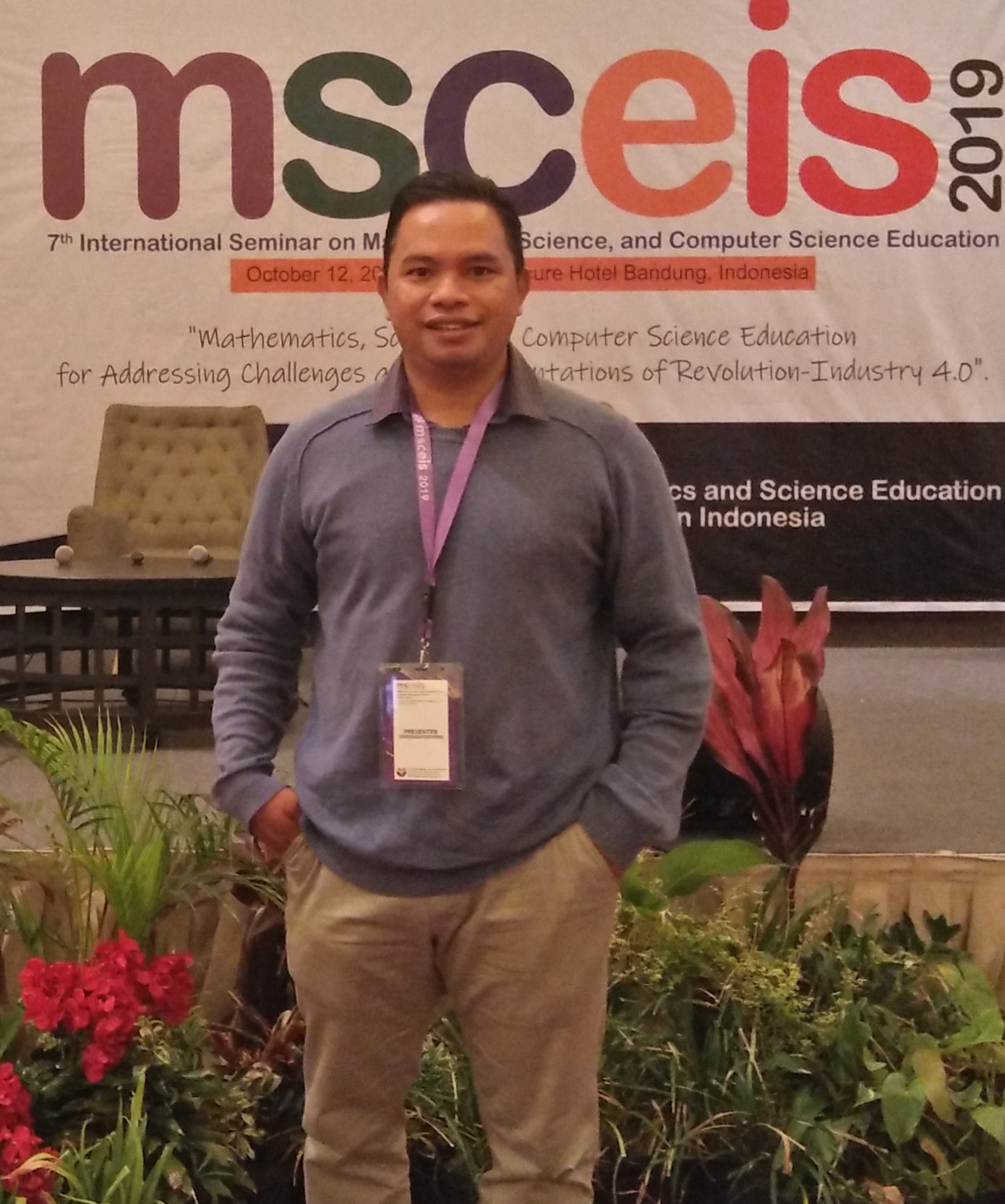
I am an academic born on April 5 1983, my name is Maximus Tamur. I was born in a beautiful village in Kampung Ndoso Manggarai Indonesia. I was born to Mother Anastasia Paul and Pastor Ambrose Lamu. Since I was born I have lived in Ndoso Manggarai. Started elementary school education at SDI Beci Elementary School. While studying at SDI, I often took part in competitions in the field of mathematics.
After graduating from elementary school, I continued my junior high school at SMP 2 Ruteng. I continued to SMA Negeri 1 Komba City.
I had to continue my studies at Widya Mandira Catholic University, Kupang, the Catholic Mathematics Education study program, strata 1 in 2002 – 2006. Luck was like me because that year I passed the exam to become a lecturer. I then continued my Masters in Mathematics Education at the Indonesian University of Education from 2010 to 2012. Then I took a doctoral program in Mathematics Education at the same campus from 2018 and finished in 2021. To support my duties
EDUCATION
Mathematics Education Doctoral Program, Indonesian University of Education
RESEARCH INTERESTS
Meta Analysis, Mathematics Learning Research
34
Scopus Publications
Scopus Publications
GLOBAL TREND OF ETHNOMATHEMATICS STUDIES OF THE LAST DECADE: A BIBLIOMETRIC ANALYSIS Yohanis Ndapa Deda, Hermina Disnawati, Maximus Tamur, Milton Rosa Infinity Journal, 2024 This study aims to investigate ethnomathematics research trends through bibliometric analysis on widely distributed Google Scholar (GS) and Scopus databases. One thousand seventy-seven papers were reviewed from GS and Scopus databases searched using Harzing's Publish on 9 January 2023. A descriptive study approach was used to investigate the data. The result of this study is that the number of ethnomathematics studies has increased over the last decade (2012-2022). The most productive author based on GS is Rosa from Brazil, and the full author based on Scopus is Widada from Indonesia. The principal authors with the highest citations are Ascher, based on GS, and Muhtadi, based on Scopus, with the highest citations. The Journal of Physics: Conference Series (JPCS) in the last decade is the most crucial source of ethnomathematics documents. Based on VosViewer visualization, Rosa is the author who has the most co-authorship papers and total link strength. The VosViewer displays four clusters related to Ethnomathematics: mathematics education, skills, ethnomathematics studies, and geometry. Our strong recommendations regarding this study are ethnomathematics research related to literacy, numeracy, technocracy, and mathematical abilities. The results can assist relevant researchers in understanding trends in ethnomathematics research and recommend guidelines for other studies.
META-ANALYSIS OF COMPUTER-BASED MATHEMATICS LEARNING IN THE LAST DECADE SCOPUS DATABASE: TRENDS AND IMPLICATIONS Maximus Tamur, Sabina Ndiung, Robert Weinhandl, Tommy Tanu Wijaya, Emilianus Jehadus, Eliterius Sennen Infinity Journal, 2023 Computer-Based Mathematics Learning (CBML) has gone global in the last decade and is making a substantial impact for educational purposes. But the fact is that in the scientific literature, it is found that studies aimed at testing these theoretical assumptions have inconsistent results. In this regard, this meta-analysis was conducted to determine the effect of CBML and to analyze categorical variables to consider the implications. Data were retrieved from the Scopus database using Publish or Perish between 2010 and 2023. This study examined 29 independent samples from 28 eligible primary studies with 1179 subjects. The population estimate was based on a random effects model, and the CMA software was used as a calculation aid. The study's results provide an overall effect size of 1.03 (large effect). This indicates that applying CBML significantly affects students' mathematical abilities. The four categorical variables considered in the study are discussed to clarify research trends. Furthermore, the research implications are outlined and contribute to future CBML implementation arrangements.
A Meta-Analysis of a Year of Virtual-Based Learning Amidst the COVID-19 Crisis: Possible Solutions or Problems? Dadang Juandi, Maximus Tamur, Bambang A P Martadiputra, Suparman, Valeria S Kurnila Aip Conference Proceedings, 2022 The shift in perspective brought about by the COVID-19 pandemic crisis regarding the reorganization of learning practices culminated in a shift toward a virtual-based learning process (VBL). Numerous individual research on the effects of VBL have been conducted in 2020, with mixed findings. A meta-analysis was performed to pool similar findings and to view the findings in the context of future VBL implementation. We searched the ERIC, SAGE, and Google Scholar databases for corresponding studies published in 2020. We estimated a random effects model using the Comprehensive Meta-Analysis (CMA) program. The study showed that VBL had a modest effect on student learning outcomes in general (ES = 0.67; SE = 0.15). Moderator research demonstrates that VBL is applied successfully when the media used and the domain being evaluated are considered. The implications of the research results and the differences in the effectiveness of VBL between countries are discussed, thus providing important information as a basic idea for further VBL research and development.
Does Mathematics Domain Cause the Heterogeneity of Students' Mathematical Critical Thinking Skills through Problem-Based Learning? A Meta-Analysis Dadang Juandi, Suparman, Bambang Avip Priatna Martadiputra, Maximus Tamur, Aan Hasanah Aip Conference Proceedings, 2022 Several meta-analysis studies have examined some potential factors causing the heterogeneity of students’ mathematical critical thinking skills (MCTS) through problem-based learning (PBL) such as PBL sample size, students’ education level, students’ demography, PBL treatment duration, and research year. However, mathematics domain does not seem to be examined. Therefore, we employed meta-analysis by selecting the random effect model to examine mathematics domain as the possible factor causing the heterogeneous students' MCTS through PBL. In addition, we employed the Q Cochrane test to justify the significance of mathematics domain as a significant or insignificant factor and used Comprehensive Meta-Analysis (CMA) software as a calculation tool. The results revealed that mathematics domain was not a significant factor (Q-value = 2.253; P-value > 0.05) that caused the heterogeneity of students' MCTS through PBL. It means that the effectivity of PBL implementation on the domain of algebra, geometry, number, calculus, statistics, and trigonometry are not different significantly on students’ MCTS. Also, it interprets that the low, moderate, or high students’ MCTS by implementing PBL are not caused by mathematics domain.
Analysis of Students’ Mathematical Problem Solving Ability: Arithmetic Operation Cases at Filial Baduro Elementary School Timor Leste Jerito Pereira, Jianlan Tang, Tan Shiwei, Tommy Tanu Wijaya, Maximus Tamur, Hermita Neni Aip Conference Proceedings, 2022 Similar to other countries, problem-solving skills are one of the goals of study in schools. This study aims to determine the problem-solving abilities of elementary school students in Timor-Leste. The results of this study can be used as suggestions and the basis for further research. The topic of mathematics that will be used in this research is the operation of multiplication and division of integers. This study uses a qualitative descriptive method to elaborate students’ problem-solving skills in solving multiplication and division problems. The research sample was taken from Filial Baduro Elementary School, Timor-Leste. The population in this study were all fifth-grade students, totaling 27 students. To determine the main subject of this study, the researcher used purposive sampling and got three representative students. The instrument used is a test sheet. The results showed that the problem-solving ability of the students of Filial Baduro Elementary School was still low. This can be seen in the errors made in understanding the questions and the recheck step of more than 50%. These results provide helpful information for teachers to use varied methods and appropriate media to minimize their mistakes.
Improving the critical thinking ability of junior high school students through realistic mathematics education innovation Asri Ode Samura, Darhim, Dadang Juandi, Arwan Mhd. Said, Karman La Nani, Maximus Tamur Aip Conference Proceedings, 2022 This study was conducted to examine and compare the effect of realistic mathematics education innovation (RME) on the critical thinking of junior high school students. The research method used a quantitative approach with experimental design, nonequivalent control-groups pattern. A sample of 76 people from two classes was not randomly selected. The first class was given an RME innovation course, and the second class received conventional learning. Data obtained by tests that were carried out twice, namely pretest and posttest. Data analysis using independent sample t-test. Based on the results of the analysis, it was found that the students' critical thinking skills increased significantly. These findings highlight the importance of making innovations in implementing RME in accordance with the characteristics and developments of the student learning environment.
A meta-analysis of the effects of E-books on students' mathematics achievement Tommy Tanu Wijaya, Yiming Cao, Robert Weinhandl, Maximus Tamur Heliyon, 2022 The 21st century allows the use of e-books to substitute printed books in educational context, thereby adapt teaching and learning to the potentialities of our digital era. Several studies examined the effect of mathematics e-books compared to traditional printed books on students' mathematics achievement, however, the results are still inconclusive. Therefore, this research conducted a meta-analysis to determine the effects of mathematics e-books on students' mathematics achievement. This is a quantitative research with data collected from 17 studies with 26 effect sizes (N = 3115) published between 2010 and 2021. The collected data were used to analyze the moderating effects of publication year, sample size, level education, treatment duration and type of e-books on students' mathematics achievement. The result showed that overall using mathematics e-books has a high effect (g = 0.82) on students' mathematics achievement. Furthermore, using e-Books does not affect students' mathematics achievement in year publication and significantly affects the pre-school level, who are more proficient in using technology. Mathematics e-books are more effective when used for less than 4 weeks and also effective when the sample is less than 30 students. There is no significant difference between non-interactive and interactive mathematics e-books. Moreover, this research provided a detailed description of the findings and implications as well as highlighted some suggestions for future studies.
Development of Least Common Material Learning Video in Elementari School Siska Nurjanah, Jesi Alexander Alim, Mahmud Alpusari, Neni Hermita, Jerito Pereira, Tommy Tanu Wijaya, Maximus Tamur Proceedings of Uricet 2021 Universitas Riau International Conference on Education Technology 2021, 2021