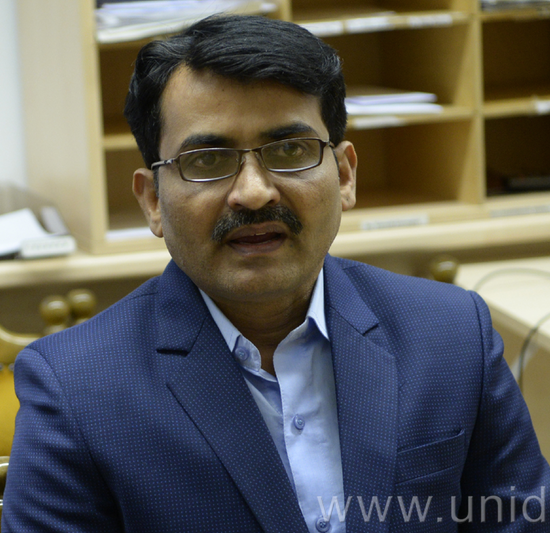
Dr. Tukaram Sambhaji Dudhamal is presently working as Professor and HOD, Dept. of Shalya Tantra,ITRA, Jamnagar, India. He obtained his MS (Ayu), Ph.D. (Ayu) degree.
He has 22 years teaching experience in UG & PG and 12 years to PhD. He guided 34 PG and 16 PhD scholars. Presently, 12 PG and 6 PhD scholars are doing research under his guidance. He received “Best Teacher Award-2021” by National Sushruta Association (NSA), India
Five books and 10 chapters on Ayurved and 5 Research Projects are in his credit. He has published more than 227 research articles in refereed journals. He delivered more than 60 guest lectures in CME, national and international seminars and attended more than 65 national and international seminars.
He visited to Tajikistan, Russia, Sri Lanka, China, Hungary, Nepal to deliver lectures on Ayurveda . His area of expertise includes Wound Healing, Ksharasutra, Ana-rectal surgery, Leech application, Musculo-skeletal disorders, Urinary disorders through Ayurveda.
EDUCATION
BAMS, MS (Ayurveda), PhD (Ayurveda)
RESEARCH, TEACHING, or OTHER INTERESTS
Public Health, Environmental and Occupational Health
13
Scopus Publications
851
Scholar Citations
16
Scholar h-index
27
Scholar i10-index
Scopus Publications
Posterior midline incision and dual Ksharasutra therapy in management of anal fistula: A case report Sreenadh P, Bharat Dulera, Dudhamal T.S, Pashmina Joshi Annals of Ayurvedic Medicine, 2026 Overreliance on imaging techniques like Magnetic Resonance Imaging (MRI) at the expense of clinical evaluation of Bhagandara (anal fistula), may lead to suboptimal outcomes. This case report presents an externally blind inter-sphincteric horseshoe anal fistula with bilateral ischio-anal fossa involvement on MRI, whereas clinical examination indicated only unilateral (left) involvement. A novel surgical management was planned here based upon clinical assessment, with drainage achieved through a posterior midline incision. Two Ksharasutra were employed for tract ligation and eradication of the cryptoglandular source. Postoperative care included Tab. Moxifloxacin 400mg (3 days), Tab. Aceclofenac (100mg) + Paracetamol (325mg) + Serratiopeptidase (15mg), Kanchanara guggulu, Tab. Septilin, Varunadi Kashaya, Isabgol husk (8 weeks), wound care with Triphala Kwatha and Jatydai Taila. Complete healing was achieved within 11 weeks, with no recurrence observed at 6 months. This case highlights the critical role of clinical judgment in fistula management. It emphasizes the need for surgical training to strengthen clinical assessment skills and developing the orientation for correlate them clinically in proctology. The posterior midline incision and dual Ksharasutra procedure offers an effective approach for treating complex horseshoe fistulas.
Multidiscipliary approach of Ayurveda and conventional principles in the management of diabetic foot ulcer-DFU: A Case Report P Sreenadh, Tukaram Dudhamal Journal of Ayurveda and Holistic Medicine, 2025 Background: Diabetic foot ulcer is a frequent complication of diabetic mellitus that constitutes a considerable burden in terms of direct medical expenditures, as well as prolonged hospital stays and disability periods. Clinical findings: This case report presents a foot ulcer of traumatic onset, in a 60-year-old male with a long history of type 2 diabetes mellitus. He was initially unaware about the ulcer till foul smell started to appear and presented to the out patient department of Shalya Tantra with a big ulcer at the foot with blackish discoloraion. It was diagnosed as a Madhumehajanya Vrana (diabetic foot ulcer). Intervention: After careful clinical evaluation, an integrative treatment plan including surgical wound debridement, medicinal leech therapy, wound care with Ayurvedic remedies, offloading using plaster casts, and a combination of Ayurvedic and allopathic medications for diabetes management was planned. Outcome: Gradually there was a significant reduction in infection, improved wound appearance, and complete healing achieved within 13 weeks. No adverse reactions were reported during the treatment, and no recurrence was observed throughout the 31 month follow-up period. Conclusion: Four week old diabetic foot ulcer of wagner grade 04, was successfully managed through a multidisciplinary approach that integrating Ayurvedic and allopathic wound care principles, thereby avoiding amputation. This case highlights the potential of integrating Ayurvedic and conventional approaches in diabetic foot ulcer management. Randomized controlled clinical trials, comparative clinical trials and black box study designs can be conducted to substantiate these findings.
Current Clinical Practice of Wound Management through Ayurveda: A Scoping Review Foram P. Joshi, T. S. Dudhamal Journal of Natural Remedies, 2025 Wound healing has been practised since the evolution of mankind in different forms, through different medical and life sciences. This study is about analysing published scientific documentation on wound healing from Ayurveda fraternity till now in public domain and understanding different angles of wound managements in clinical practice of Ayurveda. Published literature before November 2022 on wound management through Ayurveda was accessed through different search engines like, Dhara, Ayush Portal, Google Scholar, J-gate etc. with ‘wound management in Ayurveda’, ‘wound healing property’ key words. Received data was classified on the basis of journal indexing systems, study types and diagnosis. Total 93 scientific articles with different study designs, i.e., Case reports (38), Review studies (28), Clinical studies (17), Experimental works (10) and different indexing systems PubMed (27), Scopus (2), Index Copernicus (61), others (3) were found on Venous Leg Ulcer (VLU) (8), Diabetic foot Ulcer (DFU) (26), Non-Healing Ulcers (NHU) (43) etc., with principles applied and their success rates. Obtained data was depicting roles of Shodhana (wound cleaning) and Ropana (wound healing). Current scoping review provides sufficient evidence on potential role of wound care principles of Ayurveda in Vrana Shodhana (tissue debridement), and Vrana Ropana (tissue healing) purpose. Major Findings: The study provides consolidated data of published research works on classical medicaments and their utilization in the management of ulcers with a healing purpose. Ayurvedic principles of healing and wide range of indications and applications have been proven on modern as well as classical parameters with scientific evidences and assurance.
Management of Anantavata (Trigeminal Neuralgia) with Ayurvedic Para-surgical Procedures – A Case Report Aiswarya Das, Tukaram Dudhamal, Yogeshkumar Meghani Annals of Ayurvedic Medicine, 2025 Trigeminal neuralgia (TN) is a common neurological disorder caused by compression of the trigeminal nerve, leading to electric shock-like pain on one side of the face, primarily in the distribution of its branches. It can be correlated with Anantavata in Ayurveda, with the aggravation of Tridosha. A 40-year-old female patient visited our OPD, complaining of shooting pain on the right side of her face, which was triggered by chewing, talking, and cold weather. She had been taking carbamazepine for four years. The patient was treated with oral medications, including Vyoshadi Vati (two tablets twice daily), Abha Guggulu (two tablets thrice daily), and inhalation of Dasamula Kwatha steam twice daily. Additionally, Viddhakarma (needle puncturing up to 5mm) using a 26G needle and Agnikarma (indirect heat application) with Swarna Shalaka were performed near Marma points such as Sthapani, Avarta, Apanga, Utkshepa, Shanka, Phana, and Shrigataka at intervals of three days for two months. The oral medications helped alleviate Tridosha imbalance, while the para-surgical procedures contributed to pain reduction. After two months, the patient experienced significant relief from recurrent pain. This case demonstrates that Ayurvedic management of TN can effectively reduce recurrent pain and improve the patient\\'s quality of life.
A Comparative Clinical Study on Agnikarma Along with Panchatikta Guggulu in the Management of Janu Sandhigatvata (Osteoarthritis of Knee Joint) Manisha Kapadiya, Tukaram Dudhamal Journal of Natural Remedies, 2024 Background: Osteoarthritis is characterized by a slow and progressive deterioration of articular cartilage. It is a condition involving the breakdown of the protective cartilage covering the ends of the bones where two bones meet to form a joint. The aim was to evaluate the efficacy of Agnikarma with Panchatikta Guggulu in the management of Janu Sandhigatavata (osteoarthritis of knee joint). A total of 61 patients of Sandhigatavata (osteoarthritis of knee joint) were selected and randomly allocated into two groups, among them 57 were completed and 4 patients dropped out. In group A (n = 29), Agnikarma was done with Panchadhatu Shalaka and Panchatikta Guggulu orally given with lukewarm water after the meal. In group B (n = 28), Agnikarma was done with Panchadhatu Shalaka and a placebo capsule has orally given with lukewarm water after the meal. group‑A provided 70.35% relief in pain while group‑B provided 61.85% relief. Relief from crepitus was observed in 5.55% of patients of group‑A, while 1.92% of patients of group‑B. Both groups provided 68.57% relief in stiffness. There was a statistically insignificant difference between both groups. Group A shows better result in pain relief than group B. Agnikarma with Panchatikta Guggulu is more effective than Agnikarma alone in the management of Janu Sandhigatavata.
Pharmacognostical (Ingredient Analysis) and Pharmaceutical Evaluation of Yashtimadhu Taila (Glycyrrhiza glabra Linn.) Rajeshree Bhagvanjibhai Kumbhani, T. S. Dudhamal, V. J. Shukla, C. R. Harisha Journal of Datta Meghe Institute of Medical Sciences University, 2024 Context: In Ayurveda, Yashtimadhu is being used as one of the healing drugs in the management of different kinds of wounds. The preparations made from Yashtimadhu such as Churna, Ghrita, Taila, and Malahar are being practiced in wound care unit to treat different kinds of wounds as local application. Multiple treatment modalities are mentioned in Sushruta Samhita for the management of various types of Vrana. Aim and Objective: This study was to standardize the finished product Yashtimadhu Taila to confirm its identity, quality, and purity. Yashtimadhu Taila is standardized using different parameters like pharmacognostical study including organoleptic characters such as color, odor, and taste. Subjects and Methods: Yashtimadhu Taila is prepared as per Sneh Kalpana mentioned in Sharangdhara Samhita. The pharmacognostical study includes organoleptic characters such as color, odor, and taste. The pharmaceutical study of Yashtimadhu Taila includes specific gravity, acid value, saponification, iodine value, and refractive index by the following standard procedures as per the Ayurvedic Pharmacopoeia of India, and chromatographic examination includes high-performance thin-layer chromatography (HPTLC) study. Results: All the physicochemical parameters show acid value (0.4883), saponification (178.7), iodine value (82.91), and refractive index (1.4820). HPTLC profile of the methanolic extract of the drug showed 14 spots at 254 nm and 8 spots at 366 nm. Conclusions: This study will be helpful to establish the safety profile, efficacy, and acceptance of classical parameters for further research studies.
Management of non-healing post allergic ulcers with Yashtimadhu Ghrita and adjuvant Ayurvedic drugs-A Case Report Hetal Koriya, Neeraj Sharma, Tukaram Dudhamal Annals of Ayurvedic Medicine, 2024 An allergic reaction arises when the immune system responds to a harmful substance. Symptoms of drug allergy can range from mild to severe and may include skin rashes, itching on hands, inner elbows, neck, feet and around the eyes, fever, swelling in the mouth and throat. In the current scenario of human health, there is a high prevalence of allergic reaction due to increasing use of unnatural sources in Food, Medicine and other substances used in routine life. In this case report a 62 year old male patient presented in Shalya Tantra outdoor patient department with complaints of multiple ulcers in bilateral leg since one year, accompanied by severe burning sensation in bilateral leg since six months. In the presentation of allergic ulcer patient had history of trauma on medial malleolus of right foot before four years and ulcer was developed at right medial malleolus. The patient also had a previous allergic reaction to debridement (debridace) ointment. This patient was managed with Vrana Prakshalan using Panchavalkala Kwatha, followed by the local application of Yashtimadhu Ghrita twice daily. Additionally, Avipattikar Churna (5g) mixed with Sootashekhar Rasa (125mg) was administered twice daily after meals with normal water for 21 days. Within 10 days of treatment, the burning sensation subsided, and bandaging with Yashtimadhu Ghrita was initiated. By the second week of treatment, signs of ulcer healing began to appear, and complete ulcer healing was achieved in six weeks. Generally inflammatory condition is seen in allergic reactions, but in this case, ulcers developed due to allergy. This single case report shows that Yashtimadhu Ghrita and adjuvant Ayurvedic medicines have properties to treat post allergic ulcer.
Review of grey literature on Ayurveda wound healing formulations and procedures - A systematic review Tukaram Sambhaji Dudhamal Journal of Ayurveda and Integrative Medicine, 2023 In the era of globalization and evidence-based medicines, a systematic documentation of information by compiling the studies carried out in different parts of India could be useful for the clinicians of Ayurveda and to the ailing community. In this review, an attempt has been made to compile all such clinical research works carried out on Vrana Ropana (wound healing). A grey literature of post graduate (PG) and Doctorate (PhD) researches on Vrana Ropana from various Ayurvedic institutes were collected in the form of soft or/and hard copy as per the availability. The studies were found to be a combination of drug/drug formulations and various procedures mentioned under Shashti Upakramas in Sushruta Samhitha. The use of the Lepa (topical application), Avachoornana (sprinkling of medicated powder), Raktamokshana (bloodletting) like Jalauokavacharana (medicinal leech application) and Kshalana (therapeutic procedure in which the wounds are cleansed with medicated liquids) were cross reviewed from various research works. All these works were mainly targeted to find the best Shodhana (cleaning) and Ropana (healing) drugs for the treatment of wound. On the basis of the clinical evidences on the same drug with positive outcomes, one should further try it in multi-centres and develop that drug for wound management. Hence this review study would help to know the previous research works carried out on wound healing and design further trials on specific parameters or treatment protocol as a whole with local as well systemic management of wounded patients.
Integrative Ayurveda approach to manage Degenerative Cervical Myelopathy (DCM)-A Case Report Vikash jain, Manisha kapadiya, Tukaram Dudhamal Annals of Ayurvedic Medicine, 2022 Cervical myelopathy involves compression of spinal cord caused by degenerative process of cervical vertebrae or due to trauma. Cervical myelopathy is characterized by pain, stiffness in cervical region and tingling sensation in both upper and lower limb, clumsiness of hands, weakness and difficulty in handling small objects. Available treatment modalities are NSAIDs, Steroids, physiotherapy and cervical support for pain management. Surgery is necessary if conservative treatment fails. In Ayurveda some Para surgical modalities are used to treat this condition like Agnikarma and Raktamokshan along with Shaman Aushadhi. In this case study a 39 years old male patient came to outdoor patient department with complaints of neck pain, neck stiffness and tingling sensation in upper limbs while heaviness and weakness in both upper and lower limbs for last 4 months and especially tingling of upper limb during extension of neck. Patient have alleged history of weight fallen on head in flexed position of neck before 4 months. This case was managed with 4 sittings of Agnikarma with 7 days interval between each sitting and 2 sittings of wet cupping with 15 days interval along with Rasna Saptak Kwath, Erandamula Kwatha, Navjivan Rasa, Ashwagandha Arishta, Karpasasthyadi Taila for 3 months. Patient got relief from symptoms as well as improved routine life with increased in spinal canal diameter at C3-C4 level. This single case demonstrates that TCM can be managed by Ayurveda para surgical procedures along with adjuvant drugs.
Tissue Debridement effect of apamarga kshara taila and adjuvant medications in the management of nonhealing venous ulcer: A case series Foram Joshi, TukaramS Dudhamal Medical Journal of Dr D Y Patil Vidyapeeth, 2021 Stasis ulcers of the gaiter zone are difficult to heal due to deoxygenated blood congestion in peripheral areas and lack of oxygenated blood supply. Venous ulcers occur due to insufficiency of distal peripheral veins in legs. This manuscript refers to three cases of nonhealing venous leg ulcers treated with local application of Apamarga Kshara Taila along with some oral drugs. Three patients of nonhealing venous ulcer of the gaiter zone were treated with ayurvedic treatment protocol. In all patients after Panchavalkala Kwatha wound wash, Apamarga Kshara Taila was applied locally on wound once daily up to complete wound healing. In this series, wound healing was achieved in 96 days, 27 days, and 38 days, with a unit healing time of 4.311, 7.287, and 3.677 days/cm3, respectively. For the past 8 months, all three patients are living symptom-free life without any reoccurrence. On the basis of these cases, it can be said that Ayurveda principles of ulcer management have shown a promising role in wound healing and resuming improved quality of life without any untoward effects.
Posterior midline incision and dual Ksharasutra therapy in management of anal fistula: A case report P Sreenadh, B Dulera, TS Dudhamal, P Joshi Annals of Ayurvedic Medicine 15 (2), 499-499 , 2026 2026
Multidiscipliary approach of Ayurveda and conventional principles in the management of diabetic foot ulcer-DFU: A Case Report P Sreenadh, T Dudhamal Journal of Ayurveda and Holistic Medicine (JAHM) 13 (10), 139-149 , 2025 2025
Management Of Anantavata (Trigeminal Neuralgia) With Ayurvedic Parasurgical Procedures-A Case Report A Das, T Dudhamal, Y Meghani Annals of Ayurvedic Medicine 14 (3), 501-501 , 2025 2025
Management of Avabahuka (Frozen Shoulder) through Ethnic Marma Therapy–A Case Study B Bhalara, TS Dudhamal Dev Sanskriti Interdisciplinary International Journal 26, 26-31 , 2025 2025
Efficacy of Jaloukavacharana (Leech Therapy) and Kasisadi Taila in the management of Venous Leg Ulcer-A Single Case Report R Rajeevan, TS Dudhamal Journal of Ayurveda and Integrated Medical Sciences 10 (7), 353-359 , 2025 2025
Integrative Management of a Post-debridement Non-healing Diabetic Foot Ulcer: A Case Report R Ganatra, TS Dudhamal Asian Journal of Case Reports in Medicine and Health 8 (1), 271-277 , 2025 2025
Identification of Kapila Jalauka: Correlating Ancient Ayurvedic Descriptions with Modern Medicinal Leeches YR Meghani, TS Dudhamal Indian Journal of Ancient Medicine and Yoga 18 (3) , 2025 2025
Multimodal approach in the Management of Diabetic Foot Ulcer: A Single Case Report RJ Ganatra, TS Dudhamal Indian Journal of Ancient Medicine and Yoga 18 (2) , 2025 2025
Fracture Healing with Minimal Post Fracture Stiffness through Jingini Taila Bandage: A Case Study P Sreenadh, TS Dudhamal Dev Sanskriti Interdisciplinary International Journal 25, 06-10 , 2025 2025
Integrating Ayurveda and Modern Perspectives to Diabetic Peripheral Neuropathy and its Management: A Review Article P Engineer, TS Dudhamal 2025
Ayurvedic Management of Avabahuka (Frozen Shoulder)–A Systemic Review B Bhalara, T Dudhamal 2025 Citations: 1
Marma Chikitsa to Manage Griva Sandhigata Vata WSR to Cervical Spondylolisthesis–A Case Study PS Tomar, B Bhalara, T Dudhamal 2025
Successful Treatment and Prevention of Pilonidal Sinus Recurrence Through Integrative Approach R Choukikar, P Sreenadh, PB Joshi, TS Dudhamal, RS Virani Indian Journal of Ayurveda and Integrative Medicine KLEU 6 (1), 58-62 , 2025 2025
Management of Various Musculoskeletal Disorders by Different Kinds of Agnikarma Methods-A Systematic Review KR Rathod, N Kumar, S Songara, KR Chandran, TS Dudhamal 2025
Therapeutic potential of Uttar Basti and Varunshigravadi Ghanvati in the management of urethral stricture: A case report S Songara, TS Dudhamal Journal of Research in Ayurvedic Sciences 9 (1), 31-36 , 2025 2025
Integrative approach in management of recurrent pilonidal sinus in a rare case of polycythemia vera K Dhalani, T Dudhamal, Y Meghani BLDE University Journal of Health Sciences 9 (2), 172-176 , 2024 2024 Citations: 1
Efficacy of Agnikarma and Siravedha along with Rasna Saptaka Kwatha orally in the management of Vatakantaka (plantar fasciitis): An open-labeled randomized comparative clinical … RJ Ganatra, TS Dudhamal AYU (An International Quarterly Journal of Research in Ayurveda) 45 (4), 204-211 , 2024 2024
Management of non-healing post allergic ulcers with Yashtimadhu Ghrita and adjuvant Ayurvedic drugs-A Case Report HG Koriya, N Sharma, TS Dudhamal Annals of Ayurvedic Medicine 13 (3), 220-220 , 2024 2024
Jalaukavacharana (Leech Therapy) in the Management of Diabetic Peripheral Neuropathy–A Case Series P Engineer, TS Dudhamal AYUHOM 11 (2), 201-209 , 2024 2024 Citations: 1
Modified Method of Agnikarma by the Use of Electrocautery in the Management of Janusandhigata Vata (Osteoarthritis of Knee Joint): A Case Series KR Rathod, TS Dudhamal AYUHOM 11 (2), 176-180 , 2024 2024
MOST CITED SCHOLAR PUBLICATIONS
Wound healing potential of Pañcavalkala formulations in a postfistulectomy wound RK Meena, T Dudhamal, SK Gupta, V Mahanta Ancient science of life 35 (2), 118-121 , 2015 2015 Citations: 32
Katupila (Securinega leucopyrus) as a potential option for diabetic wound management AS Ajmeer, TS Dudhamal, SK Gupta, V Mahanta Journal of Ayurveda and Integrative Medicine 5 (1), 60 , 2014 2014 Citations: 31
Role of Agnikarma in Sandhigata Vata (osteoarthritis of knee joint) NG Jethava, TS Dudhamal, SK Gupta AYU (An International Quarterly Journal of Research in Ayurveda) 36 (1), 23-28 , 2015 2015 Citations: 29
Topical application of Katupila (Securinega leucopyrus) in Dushta Vrana (chronic wound) showing excellent healing effect: A case study AS Ajmeer, TS Dudhamal, SK Gupta, V Mahanta AYU (An International Quarterly Journal of Research in Ayurveda) 35 (2), 175-178 , 2014 2014 Citations: 28
Role of honey (Madhu) in the management of wounds (Dushta Vrana) TS Dudhamal, SK Gupta, C Bhuyan International journal of Ayurveda research 1 (4), 271 , 2010 2010 Citations: 27
Case Report- Management of Amavata (rheumatoid arthritis) with diet and Virechanakarma. NA Gupta SK, Thakar AB, Dudhamal TS AYU 36 (4), 413-415 , 2015 2015 Citations: 26
Management of tennis elbow by Agnikarma V Mahanta, TS Dudhamal, SK Gupta Journal of Ayurveda and integrative medicine 4 (1), 45 , 2013 2013 Citations: 25
A comparative clinical study of Siravedha and Agnikarma in management of Gridhrasi (sciatica) JV Kumar, TS Dudhamal, SK Gupta, V Mahanta AYU (An International Quarterly Journal of Research in Ayurveda) 35 (3), 270-276 , 2014 2014 Citations: 23
The role of Apamarga Kshara in the treatment of Arsha TS Dudhamal, SK Gupta, C Bhuyan, K Singh AYU (An International Quarterly Journal of Research in Ayurveda) 31 (2), 232-235 , 2010 2010 Citations: 23
A comparative clinical study of snuhi ksheera sutra, tilanala kshara sutra and apamarga kshara sutra in bhagandara (fistula in ano) SJ Lobo, C Bhuyan, SK Gupta, TS Dudhamal AYU (An International Quarterly Journal of Research in Ayurveda) 33 (1), 85-91 , 2012 2012 Citations: 21
Review of grey literature on Ayurveda wound healing formulations and procedures-A systematic review TS Dudhamal Journal of Ayurveda and integrative medicine 14 (4), 100779 , 2023 2023 Citations: 19
Clinical study of Agnikarma and Panchatikta Guggulu in the management of Sandhivata (osteoartheritis of knee joint) AV Sharma, TS Dudhamal, SK Gupta, V Mahanta AYU (An international quarterly journal of research in Ayurveda) 37 (1), 38-44 , 2016 2016 Citations: 19
Micromorphological and micrometric evaluation of Securinega leucopyrus (Willd.) Muell. leaf and stem-unexplored drug AS Ajmeer, CR Harisha, TS Dudhamal, SK Gupta Int J Sci Invent Today 2, 140-9 , 2013 2013 Citations: 19
Management of Madhumehajanya Vrana (diabetic wound) with Katupila (Securinega leucopyrus [Willd] Muell.) Kalka. GSK AS Ajmeer, Dudhamal TS AYU 36 (3), 353-355 , 2015 2015 Citations: 17
Effect of Agnikarma (therapeutic heat burns) and Raktamokshana (therapeutic bloodletting) in the management of Kati Sandhigata Vata (lumbar spondylosis) F Joshi, V Mahanta, TS Dudhamal, SK Gupta AYU (An International Quarterly Journal of Research in Ayurveda) 40 (2), 79-88 , 2019 2019 Citations: 16
A comparative clinical study of Yashtimadhu Ghrita and lignocaine-nifedipine ointment in the management of Parikartika (acute fissure-in-ano) JR Patel, TS Dudhamal AYU (An International Quarterly Journal of Research in Ayurveda) 38 (1-2), 46-51 , 2017 2017 Citations: 16
Wound healing potential of Ayurved herbal and herbo-mineral formulations: A brief review NK Ghodela, T Dudhamal International Journal of Herbal Medicine 5 (1), 39-45 , 2017 2017 Citations: 15
Antimicrobial activity of Panchavalkal powder and ointment D Khadkutkar, VG Kanthi, TS Dudhamal International Journal of Medicinal Plants and Natural Products 2 (1), 9-15 , 2016 2016 Citations: 15
Efficacy of Apamarga Kshara application and Sclerotherapy in the management of Arsha (1st and 2nd degree piles)–An open-labeled, randomized, controlled clinical trial B Shah, TS Dudhamal AYU (An International Quarterly Journal of Research in Ayurveda) 39 (4), 213-219 , 2018 2018 Citations: 14
Comparative clinical study of Guggulu-based Ksharasutra in Bhagandara (fistula-in-ano) with or without partial fistulectomy RK Meena, T Dudhamal, SK Gupta, V Mahanta AYU (An International Quarterly Journal of Research in Ayurveda) 39 (1), 2-8 , 2018 2018 Citations: 13