Mohammad Shafiqul Islam

@sust.edu

Professor (Department of English)
Shahjalal University of Science and Technology

Mohammad Shafiqul Islam
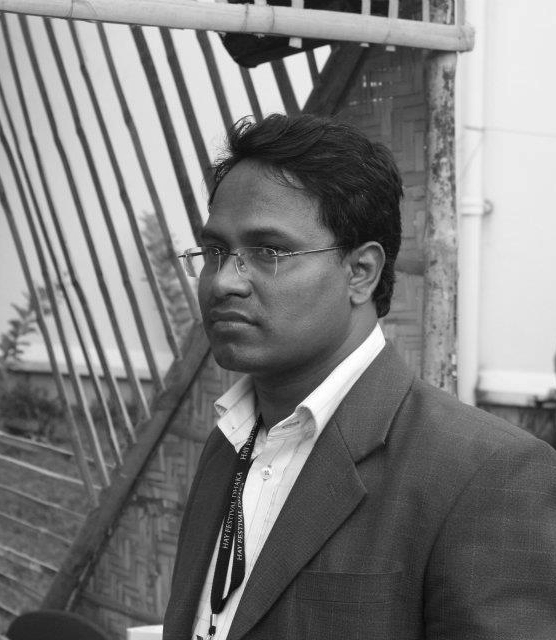
Dr Mohammad Shafiqul Islam, (ORCID: , is Professor in the Department of English, Shahjalal University of Science and Technology, Sylhet, Bangladesh. His research interests encompass, but are not restricted to, Postcolonialism, World Literature, Translation Studies, Anthropocene, and South Asian Literature. Other than scholarly work in literature, he is committed to creative writing, poetry, and literary translation. Dr Islam is the author of two poetry collections, most recently Inner State (2020), and the translator of Humayun Ahmed: Selected Short Stories and Aphorisms of Humayun Azad. His research articles, poetry, and translation have appeared in Journal of Postcolonial Writing, Critical Survey, Journal of World Literature, South Asian Review, Journal of Global Postcolonial Studies, Asia Pacific Translation and Intercultural Studies, English, Massachusetts Review, The NEHU Journal, and Poem: International English Language Quarterly.
EDUCATION

PhD, AUS, India (2018)
MA in English, CU, Bangladesh (2000; exam held in 2004)
BA (Hons) in English, CU, Bangladesh (1999; exam held in 2003)

RESEARCH INTERESTS

Postcolonialism, World Literature, Translation Studies, Anthropocene, and South Asian Literature
19

Scopus Publications

46

Scholar Citations

4

Scholar h-index

Scopus Publications

  • Re-Presenting and Re-Membering Birangonas: War, Rape, and Trauma in Neelima Ibrahim’s A War Heroine, I Speak
    Mohammad Shafiqul Islam
    South Asian Review, 2025
  • “A translator acts as a catalyst”: Mohammad Shafiqul Islam speaks to Fayeza Hasanat
    Mohammad Shafiqul Islam
    Asia Pacific Translation and Intercultural Studies, 2025
  • War, religion, and terror: Syed Shamsul Haq's two novellas blue venom and forbidden incense
    Writing Disaster in South Asian Literature and Culture the Limits of Empathy and Cosmopolitan Imagination, 2024
  • The Triumph of the Snake Goddess: A Composite Creative Translation of Verse into Prose
    Forum for World Literature Studies, 2024
  • The Return of the Wasteland
    Mohammad Shafiqul Islam
    Psychological Perspectives, 2024
    Here and nowbellows the wasteland.From a 20th century unreal city,the wasteland returnsto this surreal landwhere in monsoonthe Buriganga overflowsbut is almost deadwith pitch blackoiled water in su...
  • Two Poems
    Mohammad Shafiqul Islam
    Agenda, 2024
    Two Poems titled “The Central Jail of Silence” and “The Sea Has No Shore” explore the anguish, angst, and despair from which the speaker wishes to move away to an idyllic land, which may be compared to Keats’s land of the nightingale. The poems also demonstrate how a person seeks an alternative means to healing their depression and distress. Although the word ‘silence’ is key to understanding the atmosphere and essence of the poem “The Central Jail of Silence,” it implicates distinctive meanings: Resistance, escape, alternative space, a process to healing, and so on. “The Sea Has No Shore” also addresses a person’s wishes to escape but the destination is full of uncertainties.
  • Two Poems
    Mohammad Shafiqul Islam
    Journal of Poetry Therapy, 2023
  • Prufrock in the 21st Century
    Mohammad Shafiqul Islam
    English in Education, 2023
  • Writing war and womanhood: Representation of violence and disgrace in Dilruba Z. Ara's Blame
    Mohammad Shafiqul Islam
    Narratives of Trauma in South Asian Literature, 2022
    This chapter explores the atrocities against women in the 1971 Liberation War of Bangladesh, as represented in Dilruba Z. Ara’s Blame, the author’s latest and major work of fiction. How does the author handle the rape of women and the consequent struggle of the rape victims in postwar Bangladesh? Focusing on this question, the chapter attempts to analyze how women become easy prey to violence in war and assess the aftermath of these women’s traumatic experiences. Blame, Ara’s second novel, chronicles the turbulent years between 1965 and 1971, bringing to the fore the life of Laila, the protagonist of the novel, aged only 13 when the novel begins, as well as the life of Gita, Laila’s friend. Both Laila and Gita, representing womanhood in the war, go through harrowing experiences of being assaulted and raped in the war, but they feel dismayed and dazed when their families abandon them after their return at the end of the war. The author underlines how even their own families denounce them for the incident of rape for which they are, in no way, responsible – hence the title of the novel. Blame foregrounds, amid other concerns, pre-war days, communal tension, friendship, love, betrayal, a sense of freedom and belonging, and the minutiae of war between the well-armed Pakistani army and the Bengalis. The chapter, therefore, investigates the war to locate a wide range of atrocities perpetrated against women that Ara skillfully portrays in the novel.
  • 'YOU CAN'T HAVE A ONE SIZE FITS ALL STRATEGY IN TRANSLATION': AN INTERVIEW WITH FAKRUL ALAM
    Mohammad Shafiqul Islam
    English, 2022
    Fakrul Alam, an academic, editor, essayist, and critic, is one of the leading translators of Bengali literature. With more than four decades of teaching experience at Dhaka University, Bangladesh, where he is currently Director of Bangabandhu Sheikh Mujib Research Institute for Peace and Liberty, he has contributed widely to research and translation. His areas of research include, among others, colonial and postcolonial literatures, South Asian literature, and translation studies. Well known as a translator of Jibanananda Das (1899–1954), a great poet of Bengali literature, and Rabindranath Tagore (1861–1941), a Nobel Prize winning poet and writer, Alam has also translated works of various genres, including nonfiction and song-lyrics. His translations of the works of Sheikh Mujibur Rahman, the Father of the Nation, famously called ‘Bangabandhu,’ Friend of Bengal, are remarkable and internationally acclaimed. In this interview, Alam has given an account of his rich body of translated works as well as his motivations to venture into translation. Moreover, he has addressed various issues of translation and translation studies along with his long journey as a translator from a postcolonial nation like Bangladesh. The interview, above all, focuses on Alam’s career as a translator, his reflections on literary translation, the challenges and prospects of Bengali literature in translation into English, his own individual strategies and techniques of translation, and his current and future translation projects. The interview was conducted online during March and April 2021.
  • “Translators are bridge builders, linking people and cultures”: An interview with Mohammad A. Quayum
    Mohammad Shafiqul Islam
    Comparative Literature East and West, 2022
  • “A good translator can be androgynous”: an interview with Niaz Zaman
    Mohammad Shafiqul Islam
    Asia Pacific Translation and Intercultural Studies, 2022
  • Two Poems
    Journal of International Women S Studies, 2022
  • COP26 and the Crisis of Climate Change in Bangladesh
    Mohammad Shafiqul Islam
    Space and Culture India, 2022
  • Celebrating Silence
    Mohammad Shafiqul Islam
    Capitalism Nature Socialism, 2022
  • I Have Lodged a Lawsuit against Myself
    Mohammad Shafiqul Islam
    Scrutiny2, 2022
  • Bangladeshi poets writing in English exploring Kaiser Haq as the leading voice
    Mohammad Shafiqul Islam
    Journal of World Literature, 2020
  • Representation of Postcolonial Indian Women: Bimla and Nanda Kaul in Anita Desai’s Clear Light of Day and Fire on the Mountain
    Mohammad Shafiqul Islam, Rama Islam
    South Asian Review, 2019
  • Alienation, ambivalence and identity Jhumpa lahiri’s in other words
    Mohammad Shafiqul Islam
    Critical Survey, 2018

RECENT SCHOLAR PUBLICATIONS

  • Grief has no language
    MS Islam
    Journal of Postcolonial Writing, 1-2 , 2026
    2026
  • To Mihir
    MS Islam
    BRAC University Journal 12 , 2025
    2025
  • Metaphors Minus Meanings
    MSMMMCQDOI Islam
    Caribbean Quarterly 71 (2), 188 , 2025
    2025
  • Re-Presenting and Re-Membering Birangonas: War, Rape, and Trauma in Neelima Ibrahim’s A War Heroine, I Speak
    MS Islam
    South Asian Review , 2025
    2025
  • On the Other Side of Silence
    MS Islam
    Red River , 2025
    2025
  • Representation of Dhaka in The Book of Dhaka: A City in Short Fiction
    MS Islam
    Sustainability in South Asian Cities, 215-225 , 2025
    2025
  • Two Poems: "The Central Jail of Silence" and "The Sea Has No Shore"
    MS Islam
    Agenda , 2025
    2025
  • Selected Poems: Rudra Muhammad Shahidullah
    MS Islam
    Bangla Academy , 2025
    2025
  • “A translator acts as a catalyst”: Mohammad Shafiqul Islam speaks to Fayeza Hasanat
    MS Islam
    Asia Pacific Translation and Intercultural Studies 12 (1), 95-109 , 2025
    2025
  • The Return of the Wasteland
    MS Islam
    Psychological Perspectives (https://doi.org/10.1080/00332925.2024.2350900 … , 2024
    2024
  • Sk Sagir Ali is an assistant professor of English literature at Midnapore College, West Bengal, India. Pritha Banerjee is an assistant professor in the Department of English …
    S Basu, S Bhattacharjee, M Biswas, N Chakraborty, RC Sarngadharan, ...
    Writing Disaster in South Asian Literature and Culture, 195 , 2024
    2024
  • War, Religion, and Terror: Syed Shamsul Haq’s Two Novellas Blue Venom and Forbidden Incense
    MS Islam
    Writing Disaster in South Asian Literature and Culture: The Limits of … , 2024
    2024
  • The Triumph of the Snake Goddess: A Composite Creative Translation of Verse into Prose
    MS Islam
    Forum for World Literature Studies 16 (1), 40-59 , 2024
    2024
  • Writing Disaster in South Asian Literature and Culture: The Limits of Empathy and Cosmopolitan Imagination
    SS Ali, P Banerjee, M Biswas, S Bhattacharjee, S Basu
    Lexington Books , 2024
    2024
  • I Have Lodged a Lawsuit against Myself
    MS Islam
    Scrutiny2 (https://doi.org/10.1080/18125441.2023.2211744) , 2023
    2023
  • A City of Cynics
    MS Islam
    Journal of Postcolonial Writing (https://doi.org/10.1080/17449855.2022.2156711) , 2022
    2022
  • Writing War and Womanhood: Representation of Violence and Disgrace in Dilruba Z. Ara's Blame
    MS Islam
    Narratives of Trauma in South Asian Literature , 2022
    2022
  • JHUMPA LAHIRI: Translating Myself and Others
    MS Islam
    The Review of English Studies , 2022
    2022
  • “Translators are bridge builders, linking people and cultures”: An interview with Mohammad A. Quayum
    MS Islam
    Comparative Literature: East & West , 2022
    2022
    Citations: 2
  • Six Poems
    MS Islam
    Journal of Poetry Therapy (https://doi.org/10.1080/08893675.2022.2113344) , 2022
    2022

MOST CITED SCHOLAR PUBLICATIONS

  • Bangladeshi Poets Writing in English: Exploring Kaiser Haq as the Leading Voice
    MS Islam
    Journal of World Literature, 1-19 , 2020
    2020
    Citations: 7
  • Effects of Probiotics on Growth and Production of Monosex Tilapia (Oreochromis niloticus) in Nylon Net Cages at Dekar Haor, Sunamganj, Bangladesh
    P Das, MS Islam, M Biswas, PR Das, ASM Arif
    Journal of the Asiatic Society of Bangladesh, Science 44 (1), 69-78 , 2018
    2018
    Citations: 6
  • Emancipation of Women through Education and Economic Freedom: A Feminist Study of Begum Rokeya’s Utopias
    MS Islam, R Islam
    SUST Journal of Social Sciences 18 (4), 11-19 , 2012
    2012
    Citations: 6
  • COP26 and the Crisis of Climate Change in Bangladesh
    MS Islam
    Space and Culture, India (https://doi.org/10.20896/saci.v10i1.1241) 10 (1 … , 2022
    2022
    Citations: 4
  • Representation of Postcolonial Indian Women: Bimla and Nanda Kaul in Anita Desai’s Clear Light of Day and Fire on the Mountain
    MS Islam, R Islam
    South Asian Review 40 (1-2), 51-64 , 2019
    2019
    Citations: 3
  • Alienation, Ambivalence and Identity: Jhumpa Lahiri’s In Other Words
    MS Islam
    Critical Survey (DOI:https://doi.org/10.3167/cs.2018.300404) 30 (4), 40-53 , 2018
    2018
    Citations: 3
  • Nissim Ezekiel's Modern Position: 'A Clean Break with the Romantic Past'
    MS Islam
    The NEHU Journal 14 (2), 33-53 , 2016
    2016
    Citations: 3
  • “Translators are bridge builders, linking people and cultures”: An interview with Mohammad A. Quayum
    MS Islam
    Comparative Literature: East & West , 2022
    2022
    Citations: 2
  • Literary translation: trend and practice in Bangladesh
    MS Islam
    Asia Pacific Translation and Intercultural Studies 5 (1) , 2018
    2018
    Citations: 2
  • Romantic Par-excellence: Kazi Nazrul Islam's Selected Poems
    J Deb, MS Islam
    International Journal of Advancements in Research and Technology 2 (5), 270-275 , 2013
    2013
    Citations: 2
  • I belong to the world...
    MS Islam
    The Daily Star , 2010
    2010
    Citations: 2
  • ‘You Can’t Have a One Size Fits All Strategy in Translation’: An Interview with Fakrul Alam
    MS Islam
    English (https://doi.org/10.1093/english/efab031) , 2022
    2022
    Citations: 1
  • “A good translator can be androgynous”: an interview with Niaz Zaman
    MS Islam
    Asia Pacific Translation and Intercultural Studies (https://doi.org/10.1080 … , 2022
    2022
    Citations: 1
  • Multiple Approaches to Translating the Poems and Songs in The Essential Tagore
    MS Islam
    East West Journal of Humanities 7 (1), 137-151 , 2019
    2019
    Citations: 1
  • A Seamless Bond between River and Life in Tarfia Faizullah's Seam
    MS Islam
    Journal of Language, Literature and Culture 2 (1), 160-173 , 2019
    2019
    Citations: 1
  • The Quest for Beauty in Rabindranath Tagore’s Poetry
    MS Islam, R Mahmud
    Crossings: A Journal of English Studies 4, 61-75 , 2014
    2014
    Citations: 1
  • An In-depth Comparative Study of British English and American English
    MS Islam
    Metropolitan University Journal 1 (1), 33-52 , 2007
    2007
    Citations: 1
  • Grief has no language
    MS Islam
    Journal of Postcolonial Writing, 1-2 , 2026
    2026
  • To Mihir
    MS Islam
    BRAC University Journal 12 , 2025
    2025
  • Metaphors Minus Meanings
    MSMMMCQDOI Islam
    Caribbean Quarterly 71 (2), 188 , 2025
    2025

Publications

Inner State (poetry collection); Aphorisms of Humayun Azad (translation); Humayun Ahmed: Selected Short Stories (translation); Wings of Winds (poetry collection)