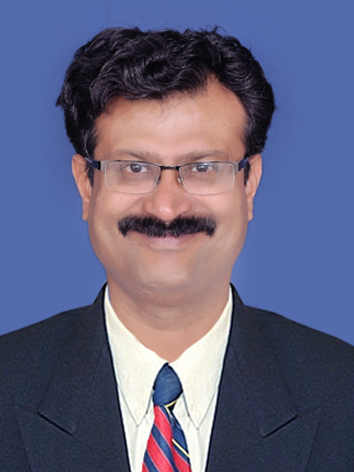
Professor and Head Department of Electronics and Telecommunication Engineering JSPM's Bhivarabai Sawant Institute of Technology and Research,Wagholi,Pune
His areas of Interest include Digital Signal Processing, Speech Processing, Mechatronics, IOT, Automation and Control Systems. He has published around 81 papers in various National and International Conferences and Journals. He had attended more than 70 Workshops, FDP’s, STTP’s, AICTE Funded Seminars. He had represented Savitribai Phule Pune University(SPPU) at State Level in AVISHKAR-2012. He had received grants of about Rs. 20 Lakhs for R&D, Seminars and Workshop from AICTE, Savitribai Phule Pune University and other funding agencies till date. He is Co-author of 3 books of Mechatronics. He is invited as resource person around all around in India. He is a Chartered Engineer (Institute of Engineers, India), Member of Institute of Engineers (India), Life Member of Instrument Society of India. He is Vice Chairman of IETE Pune Center. He is recognized Ph.D Guide in Electronics and Telecommunication Engineering of Savitribai Phule Pune University, Pune.
EDUCATION
BE(Instrumentation) Completed June 1996, ME(Instrumentation) August 2002 , Completed in March 2013,
Ph.D. Thesis tile "Speech Recognition Techniques: Study of Some aspect and Developments of algorithms"
RESEARCH, TEACHING, or OTHER INTERESTS
Engineering, Electrical and Electronic Engineering, Control and Systems Engineering, Multidisciplinary
Sewage water management and healthcare monitoring in IoT using Optimized deep residual network Dipali Shende, Yogesh S. Angal Journal of Experimental and Theoretical Artificial Intelligence, 2025 The Internet of Things (IoT) is termed as the interconnection of different smart objects with respect to devices. In this research, two different application scenarios are considered to show the efficiency of the Deep Residual Network (DRN) through multicast routing. The entities involved in the process are IoT nodes, IoT heads, and base stations (BS). The nodes are allowed to capture the information, and the collected data are routed to BS through the head node. The process of routing is made using the CrowWhale optimisation algorithm that enables to transfer the data packets from IoT nodes to BS. In the sewage water management system, entering sewage water into fresh water is detected by DRN which is trained using an optimisation algorithm. In the healthcare system, heart disease prediction is done using DRN to detect normal and abnormal cases more effectively. The adopted CrowWhale-ETR+DRN offered energy, accuracy and sensitivity as 82.54, 0.967, and 0.978 with 100 nodes for the environmental protection dataset. The energy, accuracy, and sensitivity obtained by the proposed model are 83.232, 0.964, and 0.974 using 100 nodes for the heart disease dataset, respectively.
Implemented OBL-DE assisted Tasmanian devil optimisation for selecting the optimal features using EEG signal for stress detection Dipali Nilesh Dhake, Yogesh Suresh Angal International Journal of Ad Hoc and Ubiquitous Computing, 2024 This article introduces a stress detection framework called opposition learning differential evaluation assisted Tasmanian devil optimisation (OBLDETO)-based hybrid classifier for stress detection (OBLDETO-HC) using EEG signal. The model includes four stages like: 1) pre-processing; 2) feature extraction; 3) feature selection; 4) classification. The source EEG signal is subjected to pre-process. Further, from the pre-processed signal. Features are extracted in terms of Stockwell transform, proposed common spatial pattern and DWT features. From the extracted features, optimal features will be chosen. For optimal feature selection, this paper introduces an OBL-DE-assisted Tasmanian devil optimisation (OBLDETO) model. These chosen features will be provided as the source of the detection phase. The classification process takes place via hybrid classification that combines a gated recurrent unit (GRU) and an improved deep belief network (IDBN). Here, the final classification result will be determined by the improved score level fusion.
Performance evaluation and comparative analysis of CrowWhale-energy and trust aware multicast routing algorithm Dipali K. Shende, Yogesh S. Angal Web Intelligence, 2023 Multipath routing helps to establish various quality of service parameters, which is significant in helping multimedia broadcasting in the Internet of Things (IoT). Traditional multicast routing in IoT mainly concentrates on ad hoc sensor networking environments, which are not approachable and vigorous enough for assisting multimedia applications in an IoT environment. For resolving the challenging issues of multicast routing in IoT, CrowWhale-energy and trust-aware multicast routing (CrowWhale-ETR) have been devised. In this research, the routing performance of CrowWhale-ETR is analyzed by comparing it with optimization-based routing, routing protocols, and objective functions. Here, the optimization-based algorithm, namely the Spider Monkey Optimization algorithm (SMO), Whale Optimization Algorithm (WOA), Dolphin Echolocation Optimization (DEO) algorithm, Water Wave Optimization (WWO) algorithm, Crow Search Algorithm (CSA), and, routing protocols, like Ad hoc On-Demand Distance Vector (AODV), CTrust-RPL, Energy-Harvesting-Aware Routing Algorithm (EHARA), light-weight trust-based Quality of Service (QoS) routing, and Energy-awareness Load Balancing-Faster Local Repair (ELB-FLR) and the objective functions, such as energy, distance, delay, trust, link lifetime (LLT) and EDDTL (all objectives) are utilized for comparing the performance of CrowWhale-ETR. In addition, the performance of CrowWhale-ETR is analyzed in terms of delay, detection rate, energy, Packet Delivery Ratio (PDR), and throughput, and it achieved better values of 0.539 s, 0.628, 78.42%, 0.871, and 0.759 using EDDTL as fitness.
EEG Signal Enhancement using Wavelet based Soft-thresholding Approach Dipali Dhake, Yogesh Angal 2022 3rd International Conference for Emerging Technology Incet 2022, 2022 In recent year, Electroencephalogram (EEG) signals has attracted researchers’ attention for various Brain-Computer Interface (BCI) applications. The EEG signals provide information regarding an individual’s emotional, mental, psychological, behavioral, awakeners, alertness, health, and mental activities. However, EEG signals are often tainted by various artifacts generated due to external electromagnetic interference and body movement. It is essential to minimize these noises and artifacts without a loss of actual data to maintain the quality of EEG signals. In this paper, we present Wavelet Packet Decomposition (WPD) to minimize various artifacts in single-channel EEG signals. The WPD helps to minimize or remove the artifacts without a loss of the actual content of the signal. The results of the anticipated technique are estimated based on Peak Signal to Noise Ratio (PSNR), Mean Square Error (MSE), Mean Absolute Error (MAE), and Cross-Correlation (CCR). The simulation outcomes of the anticipated method are compared with the traditional state of arts and it is observed that the anticipated approach gives significant improvement over traditional techniques.
An Iterative CrowWhale-Based Optimization Model for Energy-Aware Multicast Routing in IoT Dipali K. Shende, Yogesh S. Angal, S.C. Patil. International Journal of Information Security and Privacy, 2022 This paper proposes an energy-aware multicast routing protocol (MRP) based on the optimization algorithm named iterative Crow Whale-Energy Trust routing (iterative CrowWhale-ETR). The CrowWhale-ETR is developed by including the historical terms from Taylor series in the CrowWhale optimization algorithm. Initially, the effective nodes for the multicast routing process are considered by measuring the trust and energy level of nodes. Based on the fitness factor, the protected nodes are selected relies on the trust and energy level of individual nodes. Once the secure nodes are selected, route detection and route selection is performed based on iterative CrowWhale-ETR. Finally, the route maintenance is done as per the remaining energy and trust factors of the nodes in the network. The comparative analysis of developed iterative CrowWhale-ETR is performed with the evaluation metrics, like energy, delay, throughput and detection rate using 50 and 100 nodes in the presence as well as absence of attacks.
Sound Source Localization in 3D using Asymmetrical Positioned and Skew Aligned Two-Array Microphone - Experimentation Vipin Vibhute, B. Suryakanth, Yogesh Angal 2021 6th International Conference for Convergence in Technology I2ct 2021, 2021 A human is capable detecting sounds coming from all directions around him. The quest to develop cognition in a robot has opened many opportunities for researchers. In robots, sound source detection has been researched for decades and is successful in detecting in 2D as well as 3D. This paper focuses on an experimental setup that is developed to imbibe hearing cognitive in a robot. 3D sound source localization is achieved using only 2 microphones. Our experiment goes beyond the human cognition by utilizing animal cognition for sound localization that considers perceptual capabilities of humans. Barn owl ear alignment is being used as reference for robot ear alignment. The ear alignment in Barn owl is not symmetrical but one ear is at higher location than the other. To be more specific, the paper is related to directional (but not distance of sound source) sound source localization in a robot in three-dimensional space, using only two microphones; wherein the microphones are positioned asymmetrical in the robot head to form skewed alignment and one microphone is rotated to create the skew alignment at different angles between the microphones. The location of a sound source is determined by studying the TDOA computed from sound signal recorded at the different angles between the microphones.
Fall detection system for older adults Yogesh Angal, Arti Jagtap 2016 IEEE International Conference on Advances in Electronics Communication and Computer Technology Icaecct 2016, 2016