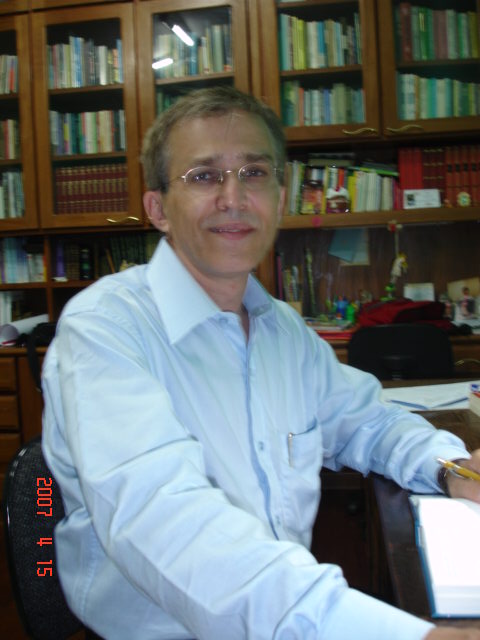
LUIZ CLÁUDIO de Almeida Barbosa, natural de Além Paraíba, MG, é graduado em Química e mestre em Agroquímica pela Universidade Federal de Viçosa (UFV) – com aperfeiçoamento em Química de Produtos Naturais pela Universidade Federal de Minas Gerais (UFMG) – e Ph.D. na área de Síntese Orgânica pela Universidade de Reading (Inglaterra). Realizou estágio de pós-doutoramento na Universidade de Oxford (Inglaterra). Foi Professor Titular do Departamento de Química da UFV até 2012, quando se tornou professor da UFMG. Pesquisador do CNPq desde 1992, publicou mais de 270 artigos científicos. É autor do livro-texto INTRODUÇÃO À QUÍMICA pela Pearson Education do Brasil (. Publicou também pela Editora UFV “Os Pesticidas, o Homem e o Meio Ambiente” e “Espectroscopia no Infravermelho na Caracterização de Compostos Orgânicos”; pela Editora Letramento o livro Nitrogênio: o sétimo elemento.
EDUCATION
PhD - University of Reading (1991); Post-doctoral research Fellow, University of Oxford (2009)
RESEARCH INTERESTS
Organic Synthesis; Natural Products; Essential Oils; History of Chemistry.
Design and Synthesis of Thymol Derivatives Bearing a 1,2,3-Triazole Moiety for Papaya Protection against Fusarium solani Mariana Belizário de Oliveira, Poliana Aparecida Rodrigues Gazolla, Leandra Martins Meireles, Róbson Ricardo Teixeira, Danilo Aniceto da Silva, et al. Journal of Agricultural and Food Chemistry, 2025 Azole-based fungicides are among the market’s most widely used and effective agents. However, their indiscriminate use can lead to reduced efficacy and increased pathogen resistance. This highlights the need for novel fungicides that offer improved efficiency and lower environmental impact for controlling phytopathogenic fungi. In this study, a series of 20 novel thymol derivatives, incorporating a 1,2,3-triazole moiety, were synthesized via a three-step process, with the key step being the copper(I)-catalyzed azide–alkyne cycloaddition (CuAAC) reaction. The antifungal activity of these compounds was evaluated against Fusarium solani, the etiological agent of papaya fruit and stem rot. Additionally, molecular docking was performed to assess the binding energy and interaction modes of these derivatives with the F. solani lanosterol 14α-demethylase (FsCYP51) enzyme. Docking results demonstrated that all derivatives bound to the catalytic pocket of FsCYP51 with lower binding energy (<−10 kcal/mol) compared to the azole fungicide tebuconazole (−8.2 kcal/mol) and the substrate lanosterol (−9.0 kcal/mol). The observed fungicidal activity is likely due to the occupancy of the entrance tunnel and active site of the FsCYP51 by these derivatives, thereby blocking lanosterol and its conversion into ergosterol.
Conchocarpus J. C. Mikan (Rutaceae): Chemical Constituents and Biological Activities Anderson R. Santos, Vanderlúcia F. de Paula, Luiz C. A. Barbosa Chemistry and Biodiversity, 2025 Rutaceae Juss. stands out as a botanical family recognized for its remarkable diversity in taxonomy, worldwide distribution, chemical composition, and biological activity exhibited by its compounds. Conchocarpus J. C. Mikan is one of the main genera of this family, comprising 50 species distributed throughout the Neotropical America. Brazil is the main center of diversity for this genus, hosting 66 % of the species as endemic. This is the first review concerning the genus Conchocarpus, emphasizing its chemical composition and biological activities. The selected papers for this review cover studies on 11 species, of which were identified 88 compounds. Among these, quinoline and acridone alkaloids predominate (57 %), followed by flavonoids, amides, coumarins and terpenoids. The biological activities of extracts and compounds indicate trypanocidal and leishmanicidal actions, as well as cytotoxic, fungicidal, molluscicidal, insecticidal, anticholinesterase and antioxidant activities.
SCIENTIFIC DENIALISM: AN ANCIENT AND PERSISTENT PRACTICE THROUGHOUT HISTORY. Luiz C. A. Barbosa, Carlos A. L. Filgueiras Quimica Nova, 2025 SCIENTIFIC DENIALISM: AN ANCIENT AND PERSISTENT PRACTICE THROUGHOUT HISTORY. The search for scientific truth has long been the target of denialism, which obstructs progress and demands perseverance from those advocating new discoveries. While subjective preferences in fields such as literature, music, and the arts may lead to favoring works from the past, in science, denialism hampers advancement. This study highlights the persistence of scientific denialism across various fields, from the opposition to the new Gregorian calendar, the denial of Lavoisier’s combustion theory, Berthelot’s rejection of atomism, and resistance to van’t Hoff’s three-dimensional molecular structures, to recent opposition to covid-19 vaccines and the patronage of quackery during the pandemic. These cases, drawn from both universal and national histories, illustrate how such resistance to science has spanned centuries and continues to affect scientific progress.
JOSÉ ISRAEL VARGAS: ESSENCES OF THE LIFE AND WORK OF A SCIENCE LEADER IN BRAZIL Luiz C. A. Barbosa, Luciano E. Faria, José D. Fabris Quimica Nova, 2025 JOSÉ ISRAEL VARGAS: ESSENCES OF THE LIFE AND WORK OF A SCIENCE LEADER IN BRAZIL. A brief overview of the long-standing and rich academic and scientific career of Professor José Israel Vargas is presented, along with some of his thoughts and notable achievements since obtaining his university degree in Chemistry from Federal University of Minas Gerais (UFMG) in Belo Horizonte, Brazil. He received his doctorate from the Faculty of Physical Chemistry (1960, Cambridge University, UK), working with radiochemistry and hyperfine interactions. Six years after his return to Brazil, he began working as a leading researcher at the Centre d’Études Nucléaires de Grenoble, France, where he stayed until 1972. He then once more returned to Brazil and initiated a time of intense scientific activity at the Department of Chemistry, UFMG, as well as of great involvement in science and technology policy in Brazil. In 1977, he was appointed the first state secretary for Science and Technology in Minas Gerais; from 1994 to 2000, he served as the Brazilian Minister of Science, Technology, and Innovation. The present paper will highlight his key role in fostering the scientific careers of numerous young scientists and also pay him homage to recognize his significant contributions to Brazilian and French science, particularly in chemistry and physics.
HUMPHRY DAVY ON THE PAGES OF BRAZILIAN EARLY - NINETEENTH CENTURY PUBLICATIONS Luiz C. A. Barbosa, Pedro G. M. Gomes, Carlos A. L. Figueiras Quimica Nova, 2025 HUMPHRY DAVY ON THE PAGES OF BRAZILIAN EARLY - NINETEENTH CENTURY PUBLICATIONS. Humphry Davy (1778-1829) occupies a singular place in the history of science. His career flourished after the great systematizations carried out at the final decades of the eighteenth century and the early years of the following century. His many discoveries, both of a fundamental as well as of an applied nature, opened numerous pathways in chemistry. This paper aims to show how his research was followed attentively by many in Brazil, at a time when the country was just beginning to establish its very first institutions of higher education and scientific research. It is interesting to see how those new discoveries were avidly followed from a distance and the repercussions they were enjoying at such an early stage in Brazil as an autonomous state.
Powerful antioxidants within Cupressus arizonica Greene female cones and leaves essential oil Seyyed Khalil Hosseinihashemi, Fatemeh Barzegari, Hadi Baseri, Luiz Claudio Almeida Barbosa Natural Product Research, 2025 The composition and antioxidant activity of the essential oil obtained from the female cones and leaves of Cupressus arizonica were assessed using the DPPH assay. The total oil yields obtained through hydrodistillation from the female cones and leaves were 1.9% (v/w) and 0.65% (v/w), respectively. The GC-MS chemical analysis of the oils from the female cones and leaves resulted in the identification of 17 and 45 compounds, respectively. Moreover, the essential oils obtained from C. arizonica female cones were predominantly composed of monoterpene hydrocarbons, with α-pinene being the most abundant component at 72.20%. In contrast, the oil extracted from the leaves was rich in oxygenated monoterpenes, particularly umbellulone (17.33%). The oils extracted from the leaves exhibited remarkable DPPH radical scavenging activity, displaying a value of 95.6%. This value was comparable to that of ascorbic acid (99.6%) and BHT (96.9%) when tested at a concentration of 59 mg/mL.
Natural Rubrolides and Their Synthetic Congeners as Inhibitors of the Photosynthetic Electron Transport Chain Milandip Karak, Jaime A. M. Acosta, Héctor F. Cortez-Hernandez, Johnny L. Cardona, Giuseppe Forlani, et al. Journal of Natural Products, 2024 Rubrolides are a family of naturally occurring 5-benzylidenebutenolides, which generally contain brominated phenol groups, and nearly half of them also present a chlorine attached to the butenolide core. Seven natural rubrolides were previously synthesized. When these compounds were tested against the model plant Raphanus sativus, six were found to exert a slight inhibition on plant growth. Aiming to exploit their scaffold as a model for the synthesis of new compounds targeting photosynthesis, nine new rubrolide analogues were prepared. The synthesis was accomplished in 2-4 steps with a 10-39% overall yield from 3,4-dichlorofuran-2(5H)-one. All compounds were evaluated for their ability to inhibit the whole Hill reaction or excluding photosystem I (PSI). Several natural rubrolides and their analogues displayed good inhibitory potential (IC50 = 2-8 μM). Molecular docking studies on the photosystem II-light harvesting complex II (PSII-LHCII supercomplex) binding site were also performed. Overall, data support the use of rubrolides as a model for the development of new active principles targeting the photosynthetic electron transport chain to be used as herbicides.