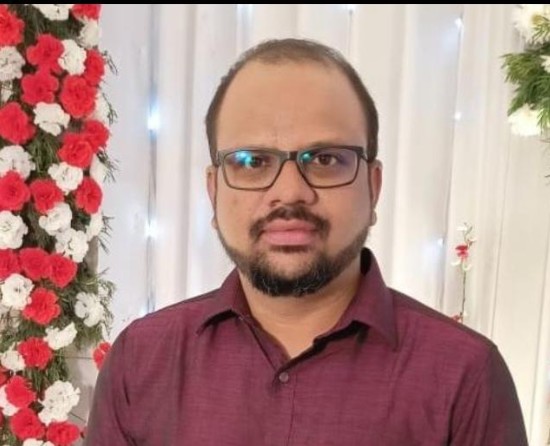
I am M.K.Mohamed Faizal, I have completed my UG degree in 2008 from Sastra University, PG degree in 2013 from M.I.E.T Engineering College and I am pursing my research work from Anna University, Chennai. I have worked as Programmer in Sapience, Chennai, from January 2009 to June 2009, I have worked as Lecturer in the Department of Computer Science and Engineering at M.I.E.T Engineering College from June 2009 to August 2011 and June 2012 to October 2013, I have worked as Assistant Professor in the Department of Computer Science and Engineering at M.I.E.T Engineering College from November 2013 to July 2023, Totally 15.6 years of wide experience in teaching field and I am currently working as Assistant Professor in the Department of Artificial Intelligence and Data Science at K.Ramakrishnan College of Engineering and published various papers in SCI, Scopus Indexed Journals and Conferences, Patents ( India, Foreign ), Books, UGC Care Journals.
EDUCATION
B.Tech - Computer Science and Engineering, M.E.- Computer Science and Engineering, Ph.D (Pursuing)
RESEARCH, TEACHING, or OTHER INTERESTS
Computer Engineering, Artificial Intelligence, Computer Science, Computer Networks and Communications
24
Scopus Publications
28
Scholar Citations
4
Scholar h-index
Scopus Publications
Power Electronics-Based Grid Stabilization Using a Self-Tuning Fractional Order PID Controller Shamim Ahmad Khan, Gaurav Krushna Sukhadeve, Sattar Jabar Daham Wassif, Noor Kaylan Hamid, D. Jyothi Preshiya, M.K. Mohamed Faizal 6th Biennial International Conference on Nascent Technologies in Engineering Icnte 2026, 2026 Grid stability is one of the greatest challenges modern power systems face due to increasing load variations and disturbances. Traditional PID (Proportional-IntegralDerivative) controllers are not suitable for dynamic conditions of the grid due to their static parameters, while FOPID (Fractional Order Proportional-Integral-Derivative) controllers can be applied for dynamic manuals but require optimum parameters for better performance. This study advocates closed-loop real-time stabilization in power electronic-based systems using an optimized self-tuning FOPID controller by GWO (Grey Wolf Optimizer). The novelty of adopting the technique is that the GWO uses a dynamic search mechanic to tune the FOPID parameters for the best control performance under changing grid conditions. The development of the proposed framework is a grid-connected power electronic system and its mathematical modeling on grid dynamics, formulation of FOPID control law, and parameter selection through GWO optimization. Evident through simulation results, GWO-tuned FOPID controller reduced rise time, settling time, and overshoot and was way much better than error minimization achieved using traditional PID and non-optimized FOPID controllers. The superiority of the system regarding disturbance robustness stability makes it promising for realworld power system applications. GWO-optimized FOPIDs, therefore, are quite advanced and reliable devices for improving grid stability in power electronics-based systems, thereby concluding the study.
Efficient Face Morphing and Demorphing with Explainable AI using FSGAN M. K. Mohamed Faizal, S.Geetha, A.Barveen Proceedings of International Conference on Sustainable Communication Networks and Application Icscn 2025, 2025 Face morphing attacks present a significant threat to biometric security systems, often enabling imposters to gain unauthorized access by blending features from multiple identities. This study suggests a new face morphing and demorphing combined with explainable AI and identity-preserving face recognition under Face Swapping GAN (FSGAN) architecture. First, the identity embeddings are projected by facial images that are encoded with alignment through a pre-trained ArcFace model to guarantee identity representation. The FSGAN generates morphing images through the interpolation of source attributes and target features with a ratio of 70:30 to generate visually appealing hybrid identities. Demorphing, in its turn, rebuilds the original identities following a latent-space inversion method and cosine similarity to check. Explainability tools such as Grad-CAM and SHAP are added to visualize the decision-making process of the face recognition subjected to morph attack conditions to maintain transparency. Experimental results on the CelebA data demonstrate that the suggested approach presents the morphing precision of 97.56%, identity recovery accuracy of 95.88%, and morph detection score of 96.45%, which beats other current models such as StarGAN and DeepFakeGAN. Moreover, the false acceptance rate in view of morphing attacks is kept to the bare minimum of 3.12%, reflecting their high security strength. It will use a binary XGBoost classifier that leverages deep and handcrafted features to differentiate real and morphed images as well. The given overall and explainable solution is indicative to the real-time deployment of biometric security. The presented FSGAN-XAI pipeline does not only offer proper morph generation, reversal, and recognition but also offers increased stability and forensic usefulness of automated identity verification systems.
Blockchain-Driven Federated Learning for Real-Time Threat Defense and Forensic Insight S.T. Gopukumar, Sheik Jamil Ahmed, Hajar Kadhim, Malik Bader Alazzam, Aaied Eqab Muraay Majed, M.K. Mohamed Faizal International Conference on Innovations in Intelligent Systems Advancements in Computing Communication and Cybersecurity Isac3 2025, 2025 Real-time, privacy-conserving forensic analysis is needed as cyber threats become more sophisticated. Centralized machine learning models face data privacy, security, and scalability issues, while traditional federated learning does not have integrity verification or adaptive threat indication. This paper presents a Blockchain-Integrated Federated Learning (BFL) framework for supporting digital forensics and real-time cyber threat defense. BFL facilitates forensic organizations to jointly train models without sharing raw data, ensuring data privacy. Blockchain guarantees tamper-evident forensic logs, safe model updates, and automated verification via smart contracts. Experimental outcomes verify that BFL greatly surpasses centralized and traditional federated learning methods, with a detection accuracy of 98.5% for cyber threats. Incorporating blockchain enhances model security, verifies latency, and increases adversarial robustness. By integrating distributed learning with immutable forensic logging, the framework proposed provides an scalable, reliable solution to real-time cyber protection. The research sets an encouraging basis for next-generation AI-based digital forensic systems in secure and smart cybersecurity investigations.
Graph Centric Scheduling A Novel Adaptive Framework for Resource Constrained CPS M Elumalai, M. Venkatachalapathy, Hajar Kadhim, Sadashiv G Dapke, Sabah Abdul Wahab Sheet, M.K. Mohamed Faizal 2025 IEEE Madhya Pradesh Section Conference Mpcon 2025, 2025 Cyber-Physical Systems require effective real time allocation to deal with the computational and physical resources. The conventional approaches do not scale or change the dynamic limitations. It also suggests a new approach to CPS scheduling in the form of a graph-theoretic framework that models tasks and dependencies as graphs. The algorithm employs graph coloring to decrease collisions of tasks, clique partitions to schedule them temporarily simultaneously], and dominating sets to schedule resource allocation. A task as a graph is expressed as nodes and conflict as edges. It has resource-aware priority scaling and it effectively resolves timing and resource conflicts. The experimental evidence indicates that in a variety of CPS situations, the actual deadline meet and contention manage accuracies exceed 92 percent. The proposed approach results in 15-20 percent increase in the efficiency of the scheduling process in comparison to the traditional algorithms with the benefit of the increased throughput rates and reduced delays. It is a scalable, unified approach that augments responsiveness and is readily applicable in dynamic, future-oriented CPS applications.
Enhancing Smart Healthcare Services Through Deep Learning-Based Medical Data Analysis Sheik Jamil Ahmed, Saira Banu Atham, Hajar Kadhim, Deepak Gupta, Aaied Eqab Muraay Majed, M. K. Mohamed Faizal Proceedings of 2025 3rd International Conference on Intelligent Systems Advanced Computing and Communication Isacc 2025, 2025 In order to enhance patient care and medical decision-making, smart healthcare services are progressively utilizing cutting-edge technologies. Deep learning (DL), one of these technologies, has become a potent instrument for evaluating enormous volumes of medical data, allowing for improved clinical procedures and more precise diagnosis. This study focuses on enhancing smart healthcare services through deep learning-based medical data analysis, with a particular emphasis on Named Entity Recognition (NER) and Relation Extraction (RE) tasks from clinical records. The study is implemented using Python software on the MIMIC-III dataset, utilizing an optimized Particle Swarm Optimization (PSO)-BioBERT model. The model achieved remarkable performance in both NER and RE tasks, with accuracy rates of 99.2% for NER and 99.5% for RE, and F1-scores of 98.1% and 98.8%, respectively. Compared to traditional models like Bi-LSTM and BERT, the PSO-BioBERT model significantly outperformed them, with the proposed model exceeding Bi-LSTM by 6.2% in accuracy and BERT by 12.12%. The findings highlight that the PSO-BioBERT model provides substantial improvements in extracting and classifying medical entities and their relationships from clinical data. These developments revolutionize smart healthcare services by making it possible to analyze unstructured medical information more accurately and consistently. The study emphasizes the effectiveness of deep learning models, particularly PSO-BioBERT, in improving data-driven decision-making in healthcare, which could ultimately enhance patient care outcomes and healthcare system efficiency. Future work could focus on integrating these models with real-time clinical systems for broader applications, including predictive analytics and personalized treatment plans. This approach holds promise for revolutionizing how healthcare data is utilized to improve overall patient care.
Improving Automated Assessment of English Spoken Discourse Using Transfer Learning Models-Wav2Vec 2.0 N. Sheik Hameed, S. Vijayakumar, K. Rajaraman, V. Vinod Kumar, Tamilarasan P, M. K. Mohamed Faizal 2025 5th International Conference on Advances in Electrical Computing Communication and Sustainable Technologies Icaect 2025, 2025 Automated Assessment of English Spoken Discourse is invaluable tool used in the process of learning foreign languages, teaching and communication as it is capable of delivering a large number of assessments of spoken language without significant human interferences. However, common approaches may yield some issues in terms of accuracy, methods' applicability to a variety of accents and languages, and the scalability of the techniques. Conventional techniques including HMM-GMM and contemporary DL techniques like the CNN-RNN triangulate unsatisfactory results due to the inability to capture more intricate spoken discourse since they are unable to pick tune from the din. In response to these difficulties, this research proposal presents the following framework using Wav2Vec 2.0, a self-supervised learning model involved in speech signals. The proposed method makes use of Wav2Vec 2.0 to capture rich representations directly from the raw input data to minimize dependence on labelled data and improve robustness to different patterns of speech. Applicable in Python, the model is fine-tuned in spoken discourse datasets and is assessed based on primary metrics of performance; test performance: 99.1%. These results are much better than traditional and baseline methods and clearly demonstrate the high stability and potential of the model. This way, the study that addresses prior limitations and offers a stable solution contributes to the development of the automated speech assessment. Further work that could be suggested is the selection of multimodal integration approaches and real time as a way to increase more the scores of the different models and the flexibility of the system that has been proposes in education and work environments.
Enhancing Spoken English Assessment Using Convolutional Recurrent Neural Networks Md. Sahidul Islam, A. Sulochana, T. Sugadev, N. Sheik Hameed, S. Vijayakumar, M.K. Mohamed Faizal 2025 5th International Conference on Advances in Electrical Computing Communication and Sustainable Technologies Icaect 2025, 2025 The assessment of spoken English is important to ensure accurate identification and evaluation of various factors that affect oral and written English. Conventional techniques or automated computational models, for instance, rule-based approaches, fail in challenges like the scalability in grading and the capacity to solve complicated tasks with a wide range of Speech accents and varieties. Such limitations call for better and quicker, accurate and suitable assessment approaches. In this present research, a new method in the evaluation of spoken English is proposed through the implementation of Convolutional Recurrent Neural Networks (CRNN). The CRNN integrates convolutional ones which learn spatial features of the sound signals and recurrent ones which address temporal characteristics of the speech, thus enabling the system to reasonably evaluate speech comprehensively. Applied in Python, the model works with features such as the Mel-spectrograms and responds to the pronunciation, fluency and grammatical aspects adequately. From the experimental evaluation, the use of the CRNN model improves on the previous ML techniques by obtaining high accuracy levels of 99.2%. This high performance shows the model for performing fast and efficient dynamic assessment of spoken English skills across the learners with different national languages and accents. The given method identifies and solves the problems of previous approaches, providing an accurate and fast way to assess the given language, with further research being directed at expanding the possibilities of the model's application to other multilingual datasets.
Hybrid CNN-Transformer Model for Multi-Scale Environmental Impact Assessment in Circular Waste Management Systems Franciskus Antonius Alijoyo, Malik Bader Alazzam, Abdul Hameed Al-Shammari, Sharmeen Izzat Hassan, Saranya D V, M.K.Mohamed Faizal 2025 International Conference on Sustainability Innovation and Technology Icsit 2025, 2025 The assessment of the impact of the circular waste management system cannot be done by the conventional methods of impact assessment due to the stochastic distribution of waste and the temporal nature of its effects. This research work propose a new model which is a combination of CNN-Transformer for better and deeper assessment of environmental impacts enhancing the effectiveness of Convolutional Neural Networks (CNNs) and Transformer models. The CNN component performs the best in extracting spatial features from environmental data which includes feature extraction of map of pollution levels, distribution maps of waste, etc., which is useful for the determination of spatial distribution of waste and its effects. The model is built based on the dataset collected from Kaggle that contain solid waste generation records on a daily basis, weather conditions, and various socio-economic factors affecting the waste management system. For the given dataset, the preprocessing includes data cleaning, data normalization, and feature extraction so as to feed the model with quality data. The combined CNN-transformer model is coded in the Python programming language and is highly efficient due to the accuracy of about 98% of the evaluation of environmental results. To prove the authenticity of the model, several assessments are used to support the predicted model, including accuracy, accurate recall and Pisces ABS error (MAE). In the sense of real-world waste management systems, the model gives a treasure of practical information that can increase decision-making processes and improve the operation of waste management systems. The continuous evaluation of the model and the actual versatility of the model increase, and the lasting circular waste contributes to a reliable contribution to management systems.
Advanced Deep-Sea Robotics: Hybrid Graph Neural Networks and Reinforcement Learning for Enhanced Communication and Navigation M. Shailaja, Nimmati Satheesh, V. Thrimurthulu, Shamim Ahmad khan, Sunita Pachar, M. K. Mohamed Faizal International Conference on Intelligent Communication Networks and Computational Techniques Icicnct 2025, 2025 Advances in deep-sea robotics are critical for exploring and monitoring underwater environments, yet effective communication and navigation in these conditions remain challenging. This paper presents a novel approach that integrates Hybrid Graph Neural Networks (GNN) and Reinforcement Learning (RL) to enhance deep-sea robotic systems. The methodology begins with data collection from various sensors and communication devices deployed in underwater environments. This data undergoes preprocessing using Min-Max Normalization to standardize the input features and ensure effective model performance. The core of the approach involves employing Hybrid GNN and RL techniques to address the dual challenges of communication and navigation. GNNs are utilized to model and optimize communication networks by analyzing the graph-based structure of nodes and links, thus identifying resilient communication pathways amidst environmental uncertainties. Meanwhile, RL is employed to refine navigation strategies, enabling the robot to adapt its movements in response to real-time feedback from its environment. The integration of GNN and RL allows the robot to maintain reliable communication and navigate efficiently, balancing exploration and exploitation to achieve optimal performance. The system is implemented in python software. This hybrid framework significantly improves the robot's ability to handle the complex and dynamic conditions of deepsea exploration, providing a robust solution for underwater missions. The proposed approach gains higher accuracy of <tex xmlns:mml="http://www.w3.org/1998/Math/MathML" xmlns:xlink="http://www.w3.org/1999/xlink">$\mathbf{9 8 \%}$</tex> when compared to existing approaches such as GRU and LSTM. The results demonstrate enhanced communication reliability and navigation accuracy, displaying the potential of combining advanced machine learning techniques to overcome the inherent challenges of deep-sea environments.
BIRTH DEFECTS DIAGNOSIS AND CLASSIFICATION USING HYBRID DEEP LEARNING THROUGH THE THREE-DIMENSIONAL ULTRASOUND EQUIPMENT Journal of Environmental Protection and Ecology, 2025
INVESTIGATING THE ACCURACY OF MACHINE LEARNING FOR PREDICTING SPINAL COMPRESSION FRACTURES IN OSTEOPOROSIS USING DUAL-ENERGY X-RAY ABSORPTIOMETRY (DXA) DATA Journal of Environmental Protection and Ecology, 2025
Using AI for Personalized English Writing Feedback on Educational Platforms Sameena Begum, M Vimochana, V. Arunadevi, A Chrispin Antonieta Dhivya, Veera Ankalu Vuyyuru, M.K.Mohamed Faizal 2024 International Conference on Artificial Intelligence and Quantum Computation Based Sensor Applications Icaiqsa 2024 Proceedings, 2024
Creating an AI English Tutor with Personalized Content and Dynamic Lessons J Naga Madhuri, Gulnaz Fatma, Aruna Kumari K, Punit Pathak, Sreela B, M.K. Mohamed Faizal 2024 International Conference on Artificial Intelligence and Quantum Computation Based Sensor Applications Icaiqsa 2024 Proceedings, 2024
Genetic Algorithm Routing for Enhancing Energy Efficiency in Underwater Wireless Sensor Networks OD Varma, SA Khan, SAW Sheet, NM Aljawarneh, MI Mahmoud, ... 2026 2nd International Conference on Cognitive Computing in Engineering … , 2026 2026
Quantum-Resistant Signature Scheme for Future-Proofing Blockchain Networks in Cryptocurrency Payment and Transaction Systems YS Yali, SHI Gardezi, BS Khalaf, F Almarashdi, MKM Faizal 2026 International Conference on Emerging Systems and Intelligent Computing … , 2026 2026
Power Electronics-Based Grid Stabilization Using a Self-Tuning Fractional Order PID Controller SA Khan, GK Sukhadeve, SJD Wassif, NK Hamid, DJ Preshiya, ... 2026 6th Biennial International Conference on Nascent Technologies in … , 2026 2026
Multimodal Neuroimaging–Driven Artificial Intelligence for Vision Defect Identification and Classification M Kavitha, MA Kumar, GN Keerthana, P Manikandan, R Elankeerthana, ... 2026 International Conference on Smart Futuristic Technology, 1-7 , 2026 2026
Energy Efficient Optimization of Peer-to-Peer Energy Exchanges in Microgrids Using Blockchain-Enabled Federated Learning R Kolandaisamy, A ArunKumar, AN Sasikumar, V Sivakumar, ... Sustainable Computing: Informatics and Systems, 101290 , 2025 2025
Efficient Face Morphing and Demorphing with Explainable AI using FSGAN MKM Faizal, S Geetha, A Barveen 2025 International Conference on Sustainable Communication Networks and … , 2025 2025
Performance Comparison of Wavelet Transforms based Medical Image Compression. V Anusuya, G Srividhya, MK Mohammed Faizel, GA Kumaran, ... Journal of Cybersecurity & Information Management 16 (2) , 2025 2025 Citations: 1
Advanced Deep-Sea Robotics: Hybrid Graph Neural Networks and Reinforcement Learning for Enhanced Communication and Navigation M Shailaja, N Satheesh, V Thrimurthulu, S Pachar, MKM Faizal 2025 International Conference on Intelligent Communication Networks and … , 2025 2025
Graph Centric Scheduling A Novel Adaptive Framework for Resource Constrained CPS M Elumalai, M Venkatachalapathy, H Kadhim, SG Dapke, SAW Sheet, ... 2025 IEEE Madhya Pradesh Section Conference (MPCON), 37-42 , 2025 2025
Hybrid CNN-Transformer Model for Multi-Scale Environmental Impact Assessment in Circular Waste Management Systems FA Alijoyo, MB Alazzam, AH Al-Shammari, SI Hassan, S DV, MKM Faizal 2025 International Conference on Sustainability, Innovation & Technology … , 2025 2025
Blockchain-driven federated learning for real-time threat defense and forensic insight ST Gopukumar, SJ Ahmed, H Kadhim, MB Alazzam, AEM Majed, ... 2025 International Conference on Innovations in Intelligent Systems … , 2025 2025 Citations: 8
Personalized Patient Risk Prediction Using Multi-modal AI on EHR and Medical Imaging Data SV Kulkarni, B Abdurasul, BS Khalaf, GK Anbazhagan, H Kadhim, ... 2025 International Conference on Next Generation Information System … , 2025 2025
Enhancing smart healthcare services through deep learning-based medical data analysis SJ Ahmed, SB Atham, H Kadhim, D Gupta, AEM Majed, MKM Faizal 2025 3rd International Conference on Intelligent Systems, Advanced Computing … , 2025 2025 Citations: 1
Enhancing Spoken English Assessment Using Convolutional Recurrent Neural Networks MS Islam, A Sulochana, T Sugadev, NS Hameed, S Vijayakumar, ... 2025 Fifth International Conference on Advances in Electrical, Computing … , 2025 2025 Citations: 1
Improving Automated Assessment of English Spoken Discourse Using Transfer Learning Models-Wav2Vec 2.0 NS Hameed, S Vijayakumar, K Rajaraman, VV Kumar, MKM Faizal 2025 Fifth International Conference on Advances in Electrical, Computing … , 2025 2025
A Secure Zero-Watermarking Framework for 3D Medical Data Using Hyper chaos and Dual-Tree Complex Wavelet Transform in IoMT MMKMF Dr. Pratibha C. Kaladeep Yalagi, 2T.M. Suresh kumar, 3 Dr.T Sathis ... International Journal of Environmental Sciences 11 (17), 1596 - 1602 , 2025 2025
BIRTH DEFECTS DIAGNOSIS AND CLASSIFICATION USING HYBRID DEEP LEARNING THROUGH THE THREE?DIMENSIONAL ULTRASOUND EQUIPMENT AR M. RAJAKANIa*, R. ROSHAN JOSHUAb , SAKKARAVARTHI SHANMUGAIYAc , R. JOTHI ... Journal of Environmental Protection and Ecology 26 (3), 1083–1093 , 2025 2025
INVESTIGATING THE ACCURACY OF MACHINE LEARNING FOR PREDICTING SPINAL COMPRESSION FRACTURES IN OSTEOPOROSIS USING DUAL-ENERGY X-RAY ABSORPTIOMETRY (DXA) DATA AR D. KANCHANAa *, ATTARDE VIREN BHASKARb , P. SHANMUGAPRIYAc , RAJESHWARI ... Journal of Environmental Protection and Ecology 26 (4), 1516–1525 , 2025 2025
Creating an AI English Tutor With Personalized Content and Dynamic Lessons JN Madhuri, G Fatma, A Kumari, P Pathak, MKM Faizal 2024 International Conference on Artificial Intelligence and Quantum … , 2024 2024 Citations: 1
Using AI for Personalized English Writing Feedback on Educational Platforms S Begum, M Vimochana, V Arunadevi, ACA Dhivya, VA Vuyyuru, ... 2024 International Conference on Artificial Intelligence and Quantum … , 2024 2024 Citations: 4
MOST CITED SCHOLAR PUBLICATIONS
Blockchain-driven federated learning for real-time threat defense and forensic insight ST Gopukumar, SJ Ahmed, H Kadhim, MB Alazzam, AEM Majed, ... 2025 International Conference on Innovations in Intelligent Systems … , 2025 2025 Citations: 8
Machine Learning Strategies for Customer Churn Prediction in Competitive Enterprises P Ramesh, R Nithyanandhan, MKM Faizal, V Nivakumar, M Nalini 2024 International Conference on Sustainable Communication Networks and … , 2024 2024 Citations: 5
Meme expressive classification in multimodal state with feature extraction in deep learning A Barveen, S Geetha, MKM Faizal 2023 Second International Conference on Electrical, Electronics, Information … , 2023 2023 Citations: 5
Using AI for Personalized English Writing Feedback on Educational Platforms S Begum, M Vimochana, V Arunadevi, ACA Dhivya, VA Vuyyuru, ... 2024 International Conference on Artificial Intelligence and Quantum … , 2024 2024 Citations: 4
Performance Comparison of Wavelet Transforms based Medical Image Compression. V Anusuya, G Srividhya, MK Mohammed Faizel, GA Kumaran, ... Journal of Cybersecurity & Information Management 16 (2) , 2025 2025 Citations: 1
Enhancing smart healthcare services through deep learning-based medical data analysis SJ Ahmed, SB Atham, H Kadhim, D Gupta, AEM Majed, MKM Faizal 2025 3rd International Conference on Intelligent Systems, Advanced Computing … , 2025 2025 Citations: 1
Enhancing Spoken English Assessment Using Convolutional Recurrent Neural Networks MS Islam, A Sulochana, T Sugadev, NS Hameed, S Vijayakumar, ... 2025 Fifth International Conference on Advances in Electrical, Computing … , 2025 2025 Citations: 1
Creating an AI English Tutor With Personalized Content and Dynamic Lessons JN Madhuri, G Fatma, A Kumari, P Pathak, MKM Faizal 2024 International Conference on Artificial Intelligence and Quantum … , 2024 2024 Citations: 1
Unveiling Market Anomalies: Harnessing Convolutional Neural Networks for Fraud Detection in Finance NK Thakre, M Misba, SL Sajja, SK Fardale, VA Vuyyuru, MKM Faizal 2024 International Conference on Communication, Control, and Intelligent … , 2024 2024 Citations: 1
Diagnosing Progressive Face Recognition from Face Morphing Using ViT Technique Through DL Approach MKM Faizal, S Geetha, A Barveen 2023 International Conference on Networking and Communications (ICNWC), 1-7 , 2023 2023 Citations: 1
Genetic Algorithm Routing for Enhancing Energy Efficiency in Underwater Wireless Sensor Networks OD Varma, SA Khan, SAW Sheet, NM Aljawarneh, MI Mahmoud, ... 2026 2nd International Conference on Cognitive Computing in Engineering … , 2026 2026
Quantum-Resistant Signature Scheme for Future-Proofing Blockchain Networks in Cryptocurrency Payment and Transaction Systems YS Yali, SHI Gardezi, BS Khalaf, F Almarashdi, MKM Faizal 2026 International Conference on Emerging Systems and Intelligent Computing … , 2026 2026
Power Electronics-Based Grid Stabilization Using a Self-Tuning Fractional Order PID Controller SA Khan, GK Sukhadeve, SJD Wassif, NK Hamid, DJ Preshiya, ... 2026 6th Biennial International Conference on Nascent Technologies in … , 2026 2026
Multimodal Neuroimaging–Driven Artificial Intelligence for Vision Defect Identification and Classification M Kavitha, MA Kumar, GN Keerthana, P Manikandan, R Elankeerthana, ... 2026 International Conference on Smart Futuristic Technology, 1-7 , 2026 2026
Energy Efficient Optimization of Peer-to-Peer Energy Exchanges in Microgrids Using Blockchain-Enabled Federated Learning R Kolandaisamy, A ArunKumar, AN Sasikumar, V Sivakumar, ... Sustainable Computing: Informatics and Systems, 101290 , 2025 2025
Efficient Face Morphing and Demorphing with Explainable AI using FSGAN MKM Faizal, S Geetha, A Barveen 2025 International Conference on Sustainable Communication Networks and … , 2025 2025
Advanced Deep-Sea Robotics: Hybrid Graph Neural Networks and Reinforcement Learning for Enhanced Communication and Navigation M Shailaja, N Satheesh, V Thrimurthulu, S Pachar, MKM Faizal 2025 International Conference on Intelligent Communication Networks and … , 2025 2025
Graph Centric Scheduling A Novel Adaptive Framework for Resource Constrained CPS M Elumalai, M Venkatachalapathy, H Kadhim, SG Dapke, SAW Sheet, ... 2025 IEEE Madhya Pradesh Section Conference (MPCON), 37-42 , 2025 2025
Hybrid CNN-Transformer Model for Multi-Scale Environmental Impact Assessment in Circular Waste Management Systems FA Alijoyo, MB Alazzam, AH Al-Shammari, SI Hassan, S DV, MKM Faizal 2025 International Conference on Sustainability, Innovation & Technology … , 2025 2025
Personalized Patient Risk Prediction Using Multi-modal AI on EHR and Medical Imaging Data SV Kulkarni, B Abdurasul, BS Khalaf, GK Anbazhagan, H Kadhim, ... 2025 International Conference on Next Generation Information System … , 2025 2025