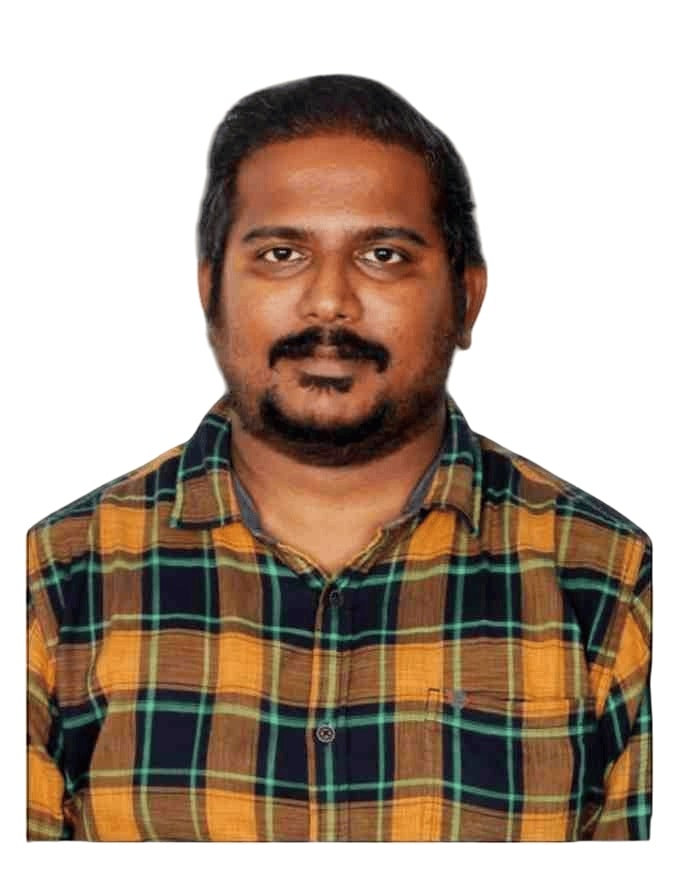
Senthilkumar Parivel

@cuchd.in

Assistant Professor, University Institute of Architecture, Chandigarh University
Chandigarh University

I'm an enthusiastic architect and planner dedicated to crafting meaningful architecture. I firmly believe that within the expansive realm of the Built Environment, architecture serves as the linchpin, harmonizing various sciences to address spatial challenges effectively.

EDUCATION

I hold a Bachelor’s degree in Architecture (2015) from Periyar Maniammai University and a Master’s degree in Urban and Regional Planning (2018) from the School of Planning and Architecture, Vijayawada. I am currently pursuing a part-time Ph.D. at SPA Vijayawada.
My professional background includes two years of industry experience with PTK Architects, Chennai, and NEODES India Pvt. Ltd., Hyderabad, complemented by six years of academic experience—two years at Aditya Academy, Bangalore, and four years at KL Deemed to be University. I joined the University Institute of Architecture, Chandigarh University, Mohali, as an Assistant Professor in August 2025.
With a strong passion for teaching and research, I am eager to contribute meaningfully to the academic excellence and growth of your esteemed university.

RESEARCH, TEACHING, or OTHER INTERESTS

Architecture, Building and Construction, Urban Studies, Multidisciplinary
7

Scopus Publications

40

Scholar Citations

1

Scholar h-index

1

Scholar i10-index

Scopus Publications

  • The Impact of Remote Work on Employee Engagement and Organizational Culture in the Post-Pandemic Computational Perspective
    Vijay C R, Sreesakthivelan M, Rajkumar S, Aishwariya MR, Rajendran K, Ar. Senthilkumar. P
    2025 International Conference on Automation and Computation Autocom 2025, 2025
    Background: The COVID-19 epidemic has hastened the move to remote work, therefore altering corporate interactions with employees and influencing their protection of their culture. Concurrent with this change has been issues with communication, teamwork, and preserving a common organizational identity. The transition has generated some challenges even if it has increased skill pool and adaptability. Motivation: The purpose of this study is to evaluate, in the years following an outbreak, the effects of working remotely on employee engagement and the corporate culture. Findings: Based on the findings of quantitative research, 54<sup xmlns:mml="http://www.w3.org/1998/Math/MathML" xmlns:xlink="http://www.w3.org/1999/xlink">%</sup> of respondents have indicated a decline in natural workplace cooperation while 68% have stated continuous productivity using a range of research approaches including qualitative interviews with human resource managers from fifty companies spanning medium to big in size and surveys with 500 remote workers. Results: While working remotely helps to achieve a work-life balance, the results reveal that it can be bad for the nonverbal signals needed for the cohesiveness and reliability of a team. To properly close these divisions, a structure incorporating hybrid models and regular virtual team-building activities has been developed. This indepth research seeks to highlight the complex effects of working remotely and provide strategic insights for organizational leaders so enabling more employee involvement while maintaining their culture.
  • Automated Building Layout Generation Through Deep Resnet Architecture
    Mohan Vamsi Sykam, G. Viswanatha Kumar, Senthil kumar P, Varun V
    2024 2nd International Conference on Disruptive Technologies Icdt 2024, 2024
    Conventional methods of planning the layout of a building often involve labor-intensive manual operations that result in solutions that are less than ideal. There is a possibility that the automation of building plan generation could be a game-changer in this business, and the development of deep learning algorithms has opened the door to this possibility. The incorporation of ResN et architecture into the study will assist in overcoming these limitations, which will result in a greater understanding of spatial linkages as well as the capacity to design architectural layouts that are more realistic and varied. The proposed method involves training a deep ResN et model with a dataset consisting of several building layouts. This model is able to capture the intricate interactions that occur between the various architectural components. It is possible to ensure adaptation and flexibility to a variety of design requirements by using the trained model to generate new building plans in accordance with user-defined criteria. In addition to demonstrating that the proposed method is effective, the results also demonstrate how the deep ResN et architecture can deliver a wide range of realistic building layouts.
  • Edge Computing in Smart Cities: Enhancing Real-Time Data Processing
    S Rajakumari, C Natarajan, Vinod N. Alone, P Senthilkumar, R. Gayathri, J Godwin John
    2024 2nd International Conference on Advances in Computation Communication and Information Technology Icaiccit 2024, 2024
    One of the most crucial issues that smart cities have to keep addressing as they grow is urban mobility improvement. Maximizing the efficiency of transportation, so lowering congestion, and so optimizing traffic flow can help to solve the growing urbanization and increasing vehicle numbers. This research aims to develop and implement a deep learning method based on DenseNet in order to reach the target of raising the effectiveness of urban traffic management. The unique selling proposition that distinguishes this sector from others is the introduction of modern technologies into a sector that has always depended on conventional methods. The main goal of the work was to apply DenseNet architecture to analyze traffic patterns. Considering the two other strategies, the proposed option has a lot of possibilities. From evaluation criteria-which comprised recall, precision, and F1-score, the proposed solution outperformed the approaches regarded to be state-of-the-art.
  • CONSTRUCTION PROGRESS MONITORING IN SMART CITIES USING DEEP ALEXNET
    A. Rajavel, S. Karkuzhali, Sarvdaman Sharma, Sitesh Kumar Singh, Senthilkumar P, S. Jhansi Ida
    2023 IEEE International Conference on Research Methodologies in Knowledge Management Artificial Intelligence and Telecommunication Engineering Rmkmate 2023, 2023
    Construction progress monitoring plays a crucial role in ensuring the timely and efficient completion of infrastructure projects within smart cities. This paper proposes a novel approach utilizing the Deep AlexNet architecture for construction progress assessment in smart cities. The Deep AlexNet model is trained on a diverse dataset of images captured from construction sites, enabling it to accurately analyze the visual cues indicative of construction advancement. By leveraging deep learning techniques, our system extracts and processes features from images, enabling automated and real-time progress evaluation. The proposed method contributes to enhancing construction management practices by providing stakeholders with a reliable tool to monitor and manage construction projects efficiently. Experimental results demonstrate the effectiveness and robustness of the Deep AlexNet-based approach in accurately assessing construction progress, thereby facilitating informed decision-making throughout the construction lifecycle.
  • A Smart Capacity Enhancement and Estimation Model for Hybrid Buildings by using Light Weight Deep Learning Model
    Senthil Kumar, Nageswara Rao Atyam, Khadar Nawas K, Shashank Awasthi, M. Kotteeswaran, K. S. Thirunavukkarasu
    2023 International Conference on Disruptive Technologies Icdt 2023, 2023
    Generally, for the buildings constructed in our areas, the conventional foundation known as 'shallow', i.e. from the ground level downwards, is set up in three dimensions such as length, width and depth. Foundations are not the same for all types of structures. The size and structure of the foundation varies depending on the nature of the prevailing soil, ground water level of the plot, type of building, and total load of the structure. In this paper an innovation estimation model was proposed based on light weigth deep learning technique. The proposed model introduces capacity estimation and energy efficiency plans and designs. These are all relating to commercial buildings, craft facilities and mass housing projects to enable design, construction. It also maintains the buildings under minimum energy consumption without stressing the operation of buildings. The health and comfort of the occupants are establishing compliance standards and ensure the maximum standards for energy efficiency in the plans or designs of commercial buildings. The proposed model also focuses the capacity estimation and energy efficiency programs beyond maximum standards.
  • ANALYSIS OF CONCRETE CRACKS AND FATIGUE IN SMART CITIES USING YOLOV3
    U. Archana, Sarvdaman Sharma, Sitesh Kumar Singh, Sureshkumar R, Senthilkumar P, T. Harish Babu
    2023 IEEE International Conference on Research Methodologies in Knowledge Management Artificial Intelligence and Telecommunication Engineering Rmkmate 2023, 2023
    This study focuses on the application of the YOLOv3 (You Only Look Once version 3) object detection algorithm for the analysis of concrete cracks and fatigue within Smart Cities. Concrete infrastructure plays a crucial role in urban environments, and its structural integrity is paramount for ensuring public safety and sustainable development. The proposed approach utilizes YOLOv3 to identify and localize instances of concrete cracks and signs of fatigue in images and videos captured from various urban settings. By leveraging deep learning techniques, this research aims to enhance the efficiency and accuracy of monitoring and maintaining concrete structures, contributing to the overall resilience and longevity of Smart Cities. The findings of this study present valuable insights into the potential of utilizing advanced computer vision methods for proactive infrastructure management in the urban landscape.
  • ANALYSIS OF EPOXY COMPOSITES REINFORCED WITH THE EXTRACTION OF MICRO-CELLULOSE FROM HS FIBER
    European Chemical Bulletin, 2022

RECENT SCHOLAR PUBLICATIONS

  • The Impact of Remote Work on Employee Engagement and Organizational Culture in the Post-Pandemic Computational Perspective
    V C R, S M, R S, A MR, R K, A Senthilkumar. P
    2025 International Conference on Automation and Computation (AUTOCOM) , 2025
    2025
  • The Impact of Remote Work on Employee Engagement and Organizational Culture in the Post-Pandemic Computational Perspective
    V C R, S M, R S, A MR, R K, A Senthilkumar. P
    2025 International Conference on Automation and Computation Autocom 2025Open … , 2025
    2025
  • Automated Building Layout Generation Through Deep Resnet Architecture
    MV Sykam, GV Kumar, S kumar P, V V
    2024 2nd International Conference on Disruptive Technologies (ICDT) , 2024
    2024
    Citations: 1
  • Edge Computing in Smart Cities: Enhancing Real-Time Data Processing
    S Rajakumari, C Natarajan, VN Alone, P Senthilkumar, R Gayathri, ...
    2024 2nd International Conference on Advances in Computation, Communication … , 2024
    2024
  • CONSTRUCTION PROGRESS MONITORING IN SMART CITIES USING DEEP ALEXNET
    SJ Rajavel, A., Karkuzhali, S., Sharma, S., (...), Senthilkumar, P., Ida
    2023 IEEE International Conference on Research Methodologies in Knowledge … , 2023
    2023
  • ANALYSIS OF EPOXY COMPOSITES REINFORCED WITH THE EXTRACTION OF MICRO-CELLULOSE FROM HS FIBER
    PK Prashant Kumar Gangwar[a], Mulugeta Tesema[b], V. L. Raja[c ...
    European Chemical Bulletin 1 (8), 111–117 , 2022
    2022
    Citations: 39

MOST CITED SCHOLAR PUBLICATIONS

  • ANALYSIS OF EPOXY COMPOSITES REINFORCED WITH THE EXTRACTION OF MICRO-CELLULOSE FROM HS FIBER
    PK Prashant Kumar Gangwar[a], Mulugeta Tesema[b], V. L. Raja[c ...
    European Chemical Bulletin 1 (8), 111–117 , 2022
    2022
    Citations: 39
  • Automated Building Layout Generation Through Deep Resnet Architecture
    MV Sykam, GV Kumar, S kumar P, V V
    2024 2nd International Conference on Disruptive Technologies (ICDT) , 2024
    2024
    Citations: 1
  • The Impact of Remote Work on Employee Engagement and Organizational Culture in the Post-Pandemic Computational Perspective
    V C R, S M, R S, A MR, R K, A Senthilkumar. P
    2025 International Conference on Automation and Computation (AUTOCOM) , 2025
    2025
  • The Impact of Remote Work on Employee Engagement and Organizational Culture in the Post-Pandemic Computational Perspective
    V C R, S M, R S, A MR, R K, A Senthilkumar. P
    2025 International Conference on Automation and Computation Autocom 2025Open … , 2025
    2025
  • Edge Computing in Smart Cities: Enhancing Real-Time Data Processing
    S Rajakumari, C Natarajan, VN Alone, P Senthilkumar, R Gayathri, ...
    2024 2nd International Conference on Advances in Computation, Communication … , 2024
    2024
  • CONSTRUCTION PROGRESS MONITORING IN SMART CITIES USING DEEP ALEXNET
    SJ Rajavel, A., Karkuzhali, S., Sharma, S., (...), Senthilkumar, P., Ida
    2023 IEEE International Conference on Research Methodologies in Knowledge … , 2023
    2023