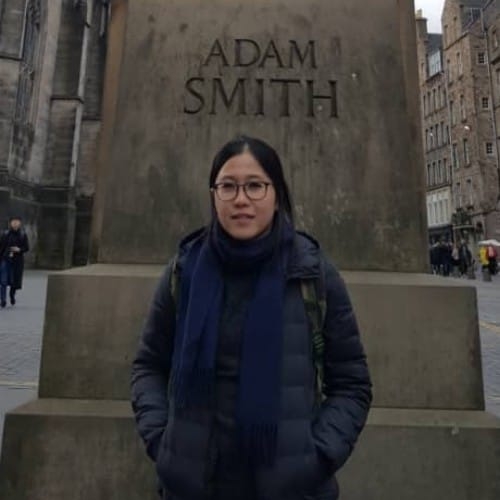
Kiky Kirina Hj Abdillah is an academic currently affiliated with the Faculty of Social Sciences and Humanities (FSSH), Universiti Malaysia Sarawak (UNIMAS), where she teaches and conducts research on development planning and management. Her career at UNIMAS began in 2009, first as a tutor and then as a lecturer. Educated in the field of Development Studies, she holds a Master's and Doctoral degree from Universiti Kebangsaan Malaysia (UKM). In addition to land administration/policy and resettlement, her research interests include public housing, urban poverty, and community development.
EDUCATION
Doctor of Philosophy (Development Science), National University of Malaysia, 2023
Master of Social Science (Development Science), National University of Malaysia, 2012
Bachelor of Social Science with Honors (Development Planning & Management), Universiti Malaysia Sarawak, 2009
RESEARCH, TEACHING, or OTHER INTERESTS
Development, Geography, Planning and Development
6
Scopus Publications
86
Scholar Citations
4
Scholar h-index
3
Scholar i10-index
Scopus Publications
FROM LOCAL AGENDA 21 TO SDG LOCALISATION: A PATHWAY FOR SUSTAINABLE DEVELOPMENT IN MIRI Khalid Zanudin, Kiky Kirina Abdillah, Yusfida Ayu Abdullah, Bemen Wong Win Keong, Arnold Puyok Planning Malaysia, 2026 Local Agenda 21 (LA21) was introduced in Malaysia in 2000 with four local authorities including Majlis Bandaraya Miri (MBM) selected as pioneers for its implementation. The purpose is to establish partnerships between local authorities and the community in achieving sustainable development. This initiative continues with the Sustainable Development Goals (SDGs). Few studies have examined the contribution of LA21 implementation by local authorities in Malaysia to enhancing their capacity to implement the SDGs in their respective localities. Lack of financial and institutional capacity, along with communities' limited awareness, potentially dampened the transition process between the two agendas. This research addresses the question "To what extent does the implementation of the LA21 contribute to the localisation of the SDGs by MBM?" A case study approach was employed, utilising reports and in-depth interviews with key stakeholders, namely public officers, councillors, and academicians. Findings show that MBM's LA21 initiatives, such as solid waste reduction and pollution control, have laid the foundation for localising the SDGs. However, challenges such as financial constraints and a lack of political support hindered the full realisation of these agendas. The research concludes that while LA21 provides a platform for community participation, stronger integration of community involvement and institutional support is necessary to fully localise the SDGs in Miri.
Deciphering Property Crime Through OLS Regression: A Demographic Study Tarmiji Masron, Azizul Ahmad, Kiky Kirina Abdillah, Asykal Syakinah Mohd Ali, Syahrul Nizam Junaini, Yoshinari Kimura International Social Science Journal, 2025 This study explores the correlation between property crime and demographic factors in Kuala Lumpur and Putrajaya using spatial autocorrelation (SA) and ordinary least squares (OLS) regression from 2015 to 2020. The 2016 SA analysis shows a significant increase in Moran's I index (0.012905), with a positive z‐score of 2.020088 and a p value of 0.043374, indicating spatial clustering of crime. The study examines how factors like total population, household areas, residential areas, male populations and female populations influence number of property crime cases, revealing varying relationships year by year. By highlighting fluctuations in R‐squared and F‐statistic values, this research challenges static crime models, advocating for adaptable, data‐driven strategies in crime prevention. These findings emphasize the importance of continuous policy adjustments to address the evolving socio‐economic dynamics of urban areas.
Assessing Malaysia’s Urban Security through Emerging Hot Spot Analysis (EHSA): A Spatiotemporal Investigation of Burglary Patterns within Police Jurisdictions of Selangor, Kuala Lumpur, and Putrajaya, Malaysia M.S. Redzuan, T. Masron, A. Ahmad, K.K. Abdillah, A. Yusuf, et al. International Journal of Geoinformatics, 2025 This study investigates the spatiotemporal patterns of midnight burglary (12 am–6:59 am) across 84 Police Station Boundaries (PSBs) in Selangor, Kuala Lumpur, and Putrajaya using Emerging Hot Spot Analysis (EHSA). The research addresses critical issues in urban crime dynamics, particularly the impact of the COVID-19 pandemic on burglary trends. The objectives include identifying intensifying, diminishing, and other hotspot categories to enhance understanding of spatial crime distributions. A spatiotemporal design, utilizing advanced GIS tools, classifies crime hotspots into nuanced categories, enabling a comprehensive analysis of burglary trends from 2015–2020. Findings reveal significant disparities in burglary intensification in areas such as Kajang (8.60%), Selayang (4.73%), and Klang (4.56%), with diminishing trends observed in regions like Sri Muda. Oscillating and emerging patterns were noted in Kuang and Rawang. Conclusions emphasize the need for targeted, evidence-based law enforcement strategies to mitigate crime risks effectively. The study underscores implications for collaborative urban security policies, advocating for adaptive resource allocation and strategic interventions amidst evolving socio-economic disruptions. This work contributes to criminological literature by demonstrating the utility of EHSA in spatiotemporal crime analysis and informing public safety initiatives.
ANALYSING PROPERTY CRIME MOVEMENTS IN URBAN MALAYSIA: THE ROLE OF STANDARD DEVIATIONAL ELLIPSE (SDE) AND MEAN CENTRE (MC) TECHNIQUES , TARMIJI MASRON, AZIZUL AHMAD, , KIKY KIRINA ABDILLAH, , SYAHRUL NIZAM JUNAINI, , NORITA JUBIT, , YOSHINARI KIMURA, , RUSLAN RAINIS, and Journal of Sustainability Science and Management, 2025 Property crime poses a significant threat to urban safety, socioeconomic stability, and sustainable development in Malaysia’s rapidly urbanising cities. However, the lack of advanced spatial analyses has limited the understanding of crime pattern evolution. This study investigates the spatial and temporal dynamics of 58,130 property crime incidents in Kuala Lumpur and Putrajaya from 2015 to 2020, employing Standard Deviational Ellipse (SDE) and Mean Centre (MC) techniques to map directional trends and identify crime hotspots. The analysis reveals strong diurnal patterns, with peak incidents at 8:00 p.m. (8.12%) and the lowest at 4:00 a.m. (0.61%), consistent with routine activity theory. Spatially, crime shifted from commercial areas (e.g., Jalan Tuanku Abdul Rahman) to transportation corridors (e.g., Jalan Raja Laut) and re-converged in urban commercial hubs (e.g., Pertama Complex) by 2020. The SDE area varied from 100.82 km² to 117.01 km², with increased dispersion and rotation in 2020, reflecting socioeconomic disruptions, notably from the COVID-19 pandemic. Although comprehensive statistical modelling of socioeconomic variables was limited, observable shifts suggest economic vulnerability and urban development as key drivers. The findings highlight the utility of spatial analytics for predictive policing and evidence-based urban planning, enabling more effective crime prevention and resilient city design.
Land tenure security for low-income residents' urban livelihoods: A human development approach review of temporary occupation license Kiky Kirina Abdillah, Azima Abdul Manaf, Abd Hair Awang Land Use Policy, 2022 Existing studies on the human development approach discuss how eliminating capability deprivation and enlarging people’s choice led to improvement on their overall wellbeing. However, land tenure security, the pre-condition to safeguard secure livelihood for poor and low-income urban residents is rarely discussed. This study examines the potential of the human development approach to the land tenure security debate by using a desk review of literature on both concepts. It employs the usage of a land policy instrument, known as the Temporary Occupation License (TOL), which aims to provide urban low-income residents with tenure security despite their lack of formal ownership over the land. In this context, land tenure security is understood from the subjective perspective, rather than from its traditional economic objectives. Findings show that the pursuit of human development through TOL results in an enhanced security of tenure amongst urban low-income residents in two forms. Firstly, protecting them against the threat of eviction through the principle of equity in which TOL provides opportunity for nonlandowners with legal access to state land for housing. Secondly, allowing households to gain the benefits of labour and capital invested in the land. For instance, the principle of efficiency embedded within TOL allows households to utilise land according to their priorities and needs; empowerment allows them to make decisions pertaining to housing and tenure upgrading, whereas sustainability allows citizens and authority to achieve developmental results that benefit both parties. The study concludes that the pursuit of the human development approach in land management, through administrative decisions and conducted in a participatory manner, can indeed enhance land tenure security for urban low-income residents.
Poverty and primary education of the orang asli children C. Joseph Policies and Politics in Malaysian Education Education Reforms Nationalism and Neoliberalism, 2017 This chapter considers the significance of African international students in Malaysia's higher education in reference to Malaysia's economic and foreign policy. It presents the ideals of South–South cooperation have been reinvested with meaning and urgency because of the 60th anniversary of the Bandung conference in 2015. The anti-racist stance was not only a show of political solidarity with South Africa, it was also part of South–South initiatives where Malaysia pledged economic support for developing economies, many of which were African. Inherent in the racialized structure of Malaysian society and the racialization of African students as a symbol of diversity in Malaysia's higher education is the potential for discrimination based on race, as has been experienced by numerous African students. Malaysia's higher education sector has been built upon an image of anti-racism and solidarity. The development of Malaysia's private higher education sector has thus benefitted from the increased political and economic ties with African countries.
RECENT SCHOLAR PUBLICATIONS
FROM LOCAL AGENDA 21 TO SDG LOCALISATION: A PATHWAY FOR SUSTAINABLE DEVELOPMENT IN MIRI K Zanudin, KK Abdillah, YA Abdullah, BWW Keong, A Puyok PLANNING MALAYSIA 24 , 2026 2026
Analyzing Property Crime Movements in Urban Malaysia: The Role of Standard Deviational Ellipse (SDE) and Mean Center (MC) Techniques T Masron, A Ahmad, KK Abdillah, SN Junaini, N Jubit, Y Kimura, R Rainis Journal of Sustainability Science and Management 20 (12), 2573-2595 , 2025 2025 Citations: 3
Deciphering property crime through OLS regression: A demographic study T Masron, A Ahmad, KK Abdillah, ASM Ali, SN Junaini, Y Kimura International Social Science Journal 75 (256), 395-412 , 2025 2025 Citations: 12
Assessing Malaysia's Urban Security through Emerging Hot Spot Analysis (EHSA): A Spatiotemporal Investigation of Burglary Patterns within Police Jurisdictions of Selangor … MS Redzuan, T Masron, A Ahmad, KK Abdillah, A Yusuf, SN Junaini, ... International Journal of Geoinformatics 21 (3) , 2025 2025 Citations: 6
Land tenure security for low-income residents' urban livelihoods: A human development approach review of temporary occupation license KK Abdillah, AA Manaf, AH Awang Journal of Land Use Policy 119, 1-10 , 2022 2022 Citations: 29
Pemakaian Lesen Pendudukan Sementara dalam memperuntukkan keselamatan pegangan tanah: Satu keperluan terhadap Pendekatan Pembangunan Manusia KK Abdillah, A Abdul Manaf, AH Awang Geografia Malaysian Journal of Society and Space 18 (2), 90-102 , 2022 2022 Citations: 1
Poverty and primary education of the Orang Asli children BWK Wong, KK Abdillah Policies and Politics in Malaysian Education, 54-71 , 2017 2017 Citations: 29
Applying territorial approach to rural agribusiness development in Malaysia’s aboriginal (Orang Asli) settlements: A comparative study of Pos Balar, Kelantan and Pos Sinderut … GS Ching, WS Kiong, KK Abdillah, SK Zamhari, MS Masri, C Perumal, ... Malaysian Journal of Society and Space 12 (4), 109-115 , 2016 2016 Citations: 2
Empowering Civil Society: An Analysis of Local Human Rights Based Non-govermental Organizations (NGOs) in Sarawak FY Siti Khatijah Zamhari, Kiky Kirina Abdillah The 10th International Malaysian Studies Conference (MSC10), 11 , 2016 2016
Kemunduran sosioekonomi dan penyisihan sosial komuniti Bumiputera di Bandaraya Kuching: Kajian kes di Kampung Kudei Baru dan Kampung Sinar Budi Baru Batu Kawa (Socio-economic … KK Abdillah, J Sulehan Geografia 11 (13) , 2015 2015 Citations: 4
MOST CITED SCHOLAR PUBLICATIONS
Land tenure security for low-income residents' urban livelihoods: A human development approach review of temporary occupation license KK Abdillah, AA Manaf, AH Awang Journal of Land Use Policy 119, 1-10 , 2022 2022 Citations: 29
Poverty and primary education of the Orang Asli children BWK Wong, KK Abdillah Policies and Politics in Malaysian Education, 54-71 , 2017 2017 Citations: 29
Deciphering property crime through OLS regression: A demographic study T Masron, A Ahmad, KK Abdillah, ASM Ali, SN Junaini, Y Kimura International Social Science Journal 75 (256), 395-412 , 2025 2025 Citations: 12
Assessing Malaysia's Urban Security through Emerging Hot Spot Analysis (EHSA): A Spatiotemporal Investigation of Burglary Patterns within Police Jurisdictions of Selangor … MS Redzuan, T Masron, A Ahmad, KK Abdillah, A Yusuf, SN Junaini, ... International Journal of Geoinformatics 21 (3) , 2025 2025 Citations: 6
Kemunduran sosioekonomi dan penyisihan sosial komuniti Bumiputera di Bandaraya Kuching: Kajian kes di Kampung Kudei Baru dan Kampung Sinar Budi Baru Batu Kawa (Socio-economic … KK Abdillah, J Sulehan Geografia 11 (13) , 2015 2015 Citations: 4
Analyzing Property Crime Movements in Urban Malaysia: The Role of Standard Deviational Ellipse (SDE) and Mean Center (MC) Techniques T Masron, A Ahmad, KK Abdillah, SN Junaini, N Jubit, Y Kimura, R Rainis Journal of Sustainability Science and Management 20 (12), 2573-2595 , 2025 2025 Citations: 3
Applying territorial approach to rural agribusiness development in Malaysia’s aboriginal (Orang Asli) settlements: A comparative study of Pos Balar, Kelantan and Pos Sinderut … GS Ching, WS Kiong, KK Abdillah, SK Zamhari, MS Masri, C Perumal, ... Malaysian Journal of Society and Space 12 (4), 109-115 , 2016 2016 Citations: 2
Pemakaian Lesen Pendudukan Sementara dalam memperuntukkan keselamatan pegangan tanah: Satu keperluan terhadap Pendekatan Pembangunan Manusia KK Abdillah, A Abdul Manaf, AH Awang Geografia Malaysian Journal of Society and Space 18 (2), 90-102 , 2022 2022 Citations: 1
FROM LOCAL AGENDA 21 TO SDG LOCALISATION: A PATHWAY FOR SUSTAINABLE DEVELOPMENT IN MIRI K Zanudin, KK Abdillah, YA Abdullah, BWW Keong, A Puyok PLANNING MALAYSIA 24 , 2026 2026
Empowering Civil Society: An Analysis of Local Human Rights Based Non-govermental Organizations (NGOs) in Sarawak FY Siti Khatijah Zamhari, Kiky Kirina Abdillah The 10th International Malaysian Studies Conference (MSC10), 11 , 2016 2016