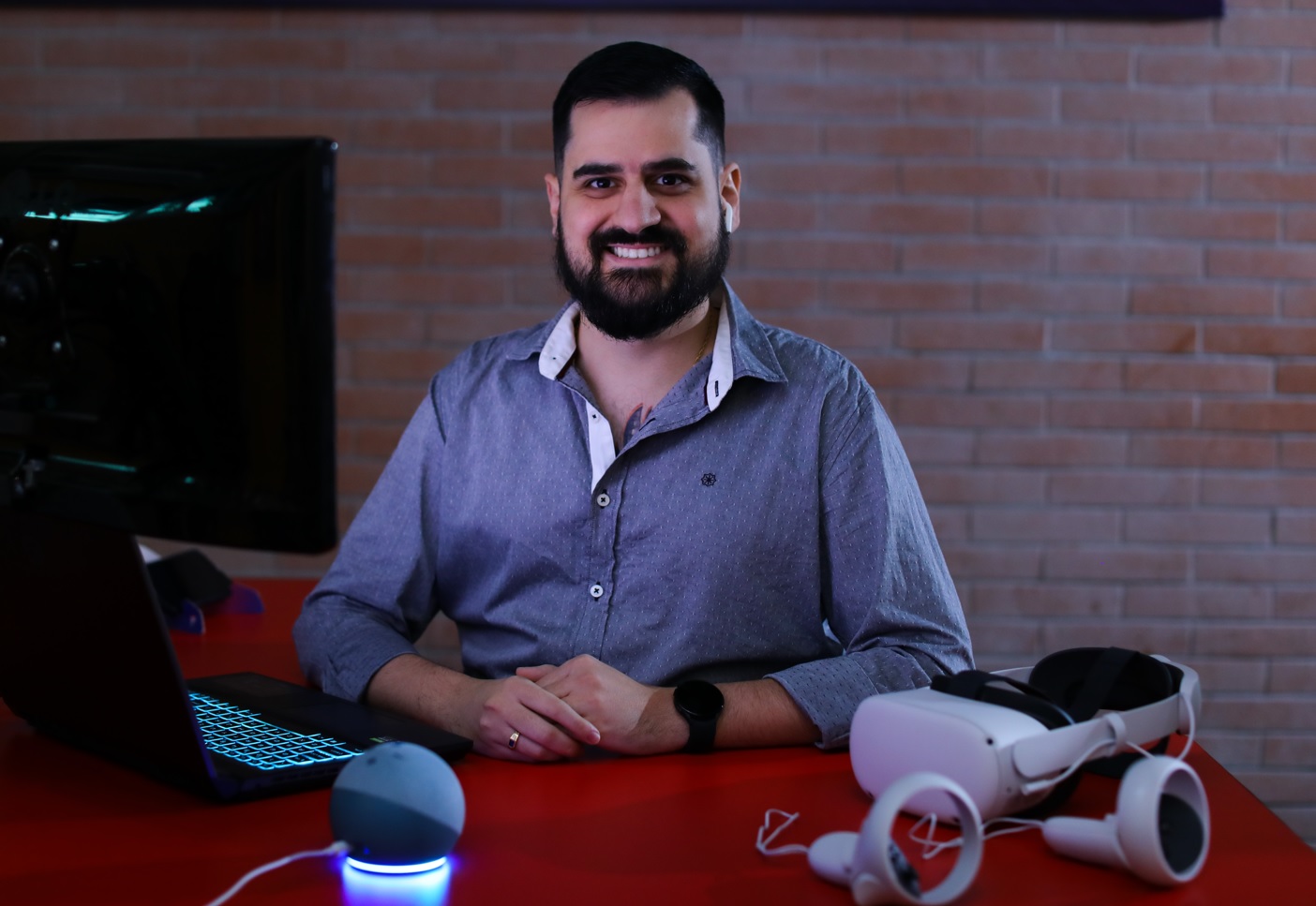
Joel Sotero da Cunha Neto

@unifor.br

Professor at the technological science center
Universidade de Fortaleza

Graduated in Control and Automation Engineering (2014), holds a master's degree and is currently a doctoral candidate in Applied Informatics at the University of Fortaleza. He works as a professor in Computer Science and various engineering courses, focusing on industrial automation (PLCs, industrial networks, instrumentation, supervisory control, and Industry 4.0) and, in the field of computing, on the Internet of Things, cyber-physical systems, game development, and hardware prototyping. He also works as a guest professor in the Professional Master's Program in Technology and Innovation in Nursing, teaching courses focused on the development of technologies for health. Furthermore, he leads projects in the VORTEX program, focused on technological training and innovation, and develops innovative research and projects for the health sector, using techniques in programming, artificial intelligence, neural networks, image and signal processing, gamification, 3D modeling, electronic and m
RESEARCH, TEACHING, or OTHER INTERESTS

Computer Science, Engineering, Multidisciplinary
6

Scopus Publications

Scopus Publications

  • MIDTs: Interdisciplinary Method for Technological Research Development with a Focus on Health
    José Eurico de Vasconcelos Filho, Joel Sotero da Cunha Neto, José Fernando Ferreira
    Digital Healthcare A Multidisciplinary and Comprehensive Vision, 2026
  • Brain activity and autonomic regulation in untreated migraine patients
    Isabel Oliveira Monteiro, Juliana Novakovic, Miguel K. Rodrigues, Joel S. Cunha Neto, Maíra O. V. Rela, et al.
    Arquivos De Neuro Psiquiatria, 2025
    Migraine causes intense pain, significant disability, deficits in attention and memory, slowed information processing, and cognitive disorders. However, it is unclear how migraine, cardiovascular, and cerebral issues impact daily life or relate to future adverse events.To evaluate the brain activity and autonomic regulation in untreated migraine patients.In the present case-control study, we compared untreated migraine patients with healthy controls. The participants underwent cognitive testing (Stroop Color Test, Trail Making Test, Addenbrooke's Cognitive Examination, and Reaction Time Test), brain activity measurement (MindWave Mobile), and autonomic regulation assessment via heart rate variability (Polar V800).No differences were found between the groups in terms of cognitive test scores. However, the healthy controls consistently showed increased variation in brain activity during the cognitive tests, while migraine patients exhibited decreased activity across all tests (p < 0.05). During the Stroop Color Test, the controls showed a positive change in brain activity (Δ = 5.12 ± 3.64) while the migraine patients showed a negative change (Δ = −5.41 ± 2.21). In addition, the control group demonstrated a normal autonomic response, with increased sympathetic activity (low-frequency [LF] band: 70.2–84.4 Hz) and decreased parasympathetic activity (high-frequency [HF] band: 29.6–15.6 Hz) during cognitive tasks (p < 0.05). In contrast, the migraine group showed imbalanced autonomic regulation, characterized by minimal changes in both sympathetic (LF band: 74.0–74.8 Hz) and parasympathetic activity (HF band: 25.9–25.1 Hz) (p > 0.05).Despite the similar cognitive test scores, migraine patients exhibited reduced variation in brain activity during cognitive tests and an imbalanced autonomic regulation, characterized by decreased sympathetic activity and increased parasympathetic activity.
  • Identifying congenital generalized lipodystrophy using deep learning-DEEPLIPO
    Natália Bitar da Cunha Olegario, Joel Sotero da Cunha Neto, Paulo Cirillo Souza Barbosa, Plácido Rogério Pinheiro, Pedro Lino Azevêdo Landim, et al.
    Scientific Reports, 2023
    Congenital Generalized Lipodystrophy (CGL) is a rare autosomal recessive disease characterized by near complete absence of functional adipose tissue from birth. CGL diagnosis can be based on clinical data including acromegaloid features, acanthosis nigricans, reduction of total body fat, muscular hypertrophy, and protrusion of the umbilical scar. The identification and knowledge of CGL by the health care professionals is crucial once it is associated with severe and precocious cardiometabolic complications and poor outcome. Image processing by deep learning algorithms have been implemented in medicine and the application into routine clinical practice is feasible. Therefore, the aim of this study was to identify congenital generalized lipodystrophy phenotype using deep learning. A deep learning approach model using convolutional neural network was presented as a detailed experiment with evaluation steps undertaken to test the effectiveness. These experiments were based on CGL patient’s photography database. The dataset consists of two main categories (training and testing) and three subcategories containing photos of patients with CGL, individuals with malnutrition and eutrophic individuals with athletic build. A total of 337 images of individuals of different ages, children and adults were carefully chosen from internet open access database and photographic records of stored images of medical records of a reference center for inherited lipodystrophies. For validation, the dataset was partitioned into four parts, keeping the same proportion of the three subcategories in each part. The fourfold cross-validation technique was applied, using 75% (3 parts) of the data as training and 25% (1 part) as a test. Following the technique, four tests were performed, changing the parts that were used as training and testing until each part was used exactly once as validation data. As a result, a mean accuracy, sensitivity, and specificity were obtained with values of [90.85 ± 2.20%], [90.63 ± 3.53%] and [91.41 ± 1.10%], respectively. In conclusion, this study presented for the first time a deep learning model able to identify congenital generalized lipodystrophy phenotype with excellent accuracy, sensitivity and specificity, possibly being a strategic tool for detecting this disease.
  • Development of intelligent and integrated technology for pattern recognition in EMG signals for robotic prosthesis command
    Yongzhao Xu, Paulo C. S. Barbosa, Joel S. da Cunha Neto, Lijuan Zhang, Vimal Shanmuganathan, et al.
    Expert Systems, 2023
    Prostheses play an important role in the rehabilitation of people who have suffered some type of amputation. However, due to its high‐cost and high complexity in performing movements of everyday tasks, users of these prostheses may encounter many difficulties. Therefore, this work proposes the development of a future artificial intelligence technology based on a low‐cost functional prosthesis prototype (manufactured in a 3D printer). In the present work, we describe an intelligent system that uses an artificial neural network to recognize patterns in muscle biopotential signals in order to control a prosthesis prototype in real time. Such a system is divided into three parts: the first that performs a human–machine integration through a graphical user interface; the second that performs the signal acquisition; the third that performs the training and generalization steps of the artificial neural network. The developed interface runs on a web application that has a database hosted in the cloud and in it the system user can: Acquisition of electromyography signals; Training phase of the artificial neural network; Sends the matrix of weights of the trained network to the microcontroller; Activates in the microcontroller, the state of action of the commands from the identified gestures. To compose the results of the present work, a search was initially carried out for the ideal parameters of the artificial neural network through signals obtained from 20 volunteers. In this step, it was possible to identify the topology that best classifies the signals of each gesture, as well as the investigation of the number of neurons in the hidden layer that causes a low generalization power due to overfitting. At the end of the project, it was possible to validate the use of the system with 15 new volunteers, and it was observed that in most cases, the performance of the commands in the prosthesis prototype were performed correctly. In addition, a project cost analysis was carried out, and it was possible to verify that the prototype developed is viable and has an affordable cost in relation to the Brazilian cost of living standards. In this way, the objective of the present work is in the development of a low cost artificial intelligence technology. Such a system is equipped with an algorithm based on neural networks that can deal with different muscle biopotential signals, in order to command a robotic prosthesis.
  • Dynamic Evaluation and Treatment of the Movement Amplitude Using Kinect Sensor
    Joel S. Da Cunha Neto, Pedro P. Reboucas Filho, Guilherme P. Ferreira Da Silva, Natalia B. Da Cunha Olegario, Joao Batista F. Duarte, et al.
    IEEE Access, 2018
  • GoNet a new movement dynamic evaluation system in real time
    Joel Neto, Victor Albuquerque, Guilherme Silva, Natalia Olegario, Joao Manuel R. S. Tavares
    IEEE Latin America Transactions, 2015