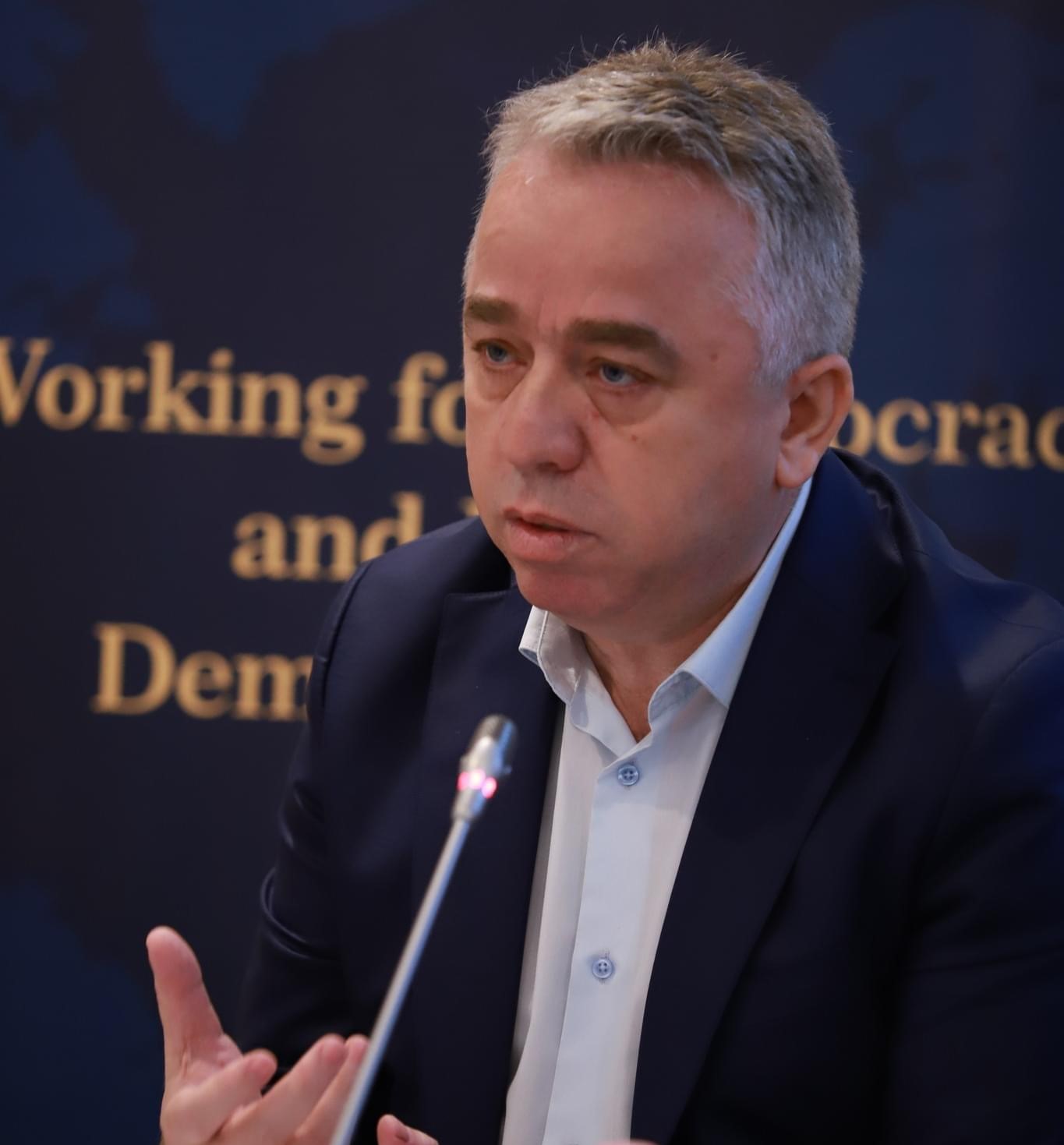
Afrim Krasniqi is a Professor and researcher on contemporary history (Institute of History), and executive Director of the Albanian Institute for Political Studies (IPS). Professor Krasniqi earned his Doctorate title from the University of Tirana, defending the thesis “South Eastern Europe in the post-communist period: Analysis of political and governmental systems”. He holds a master’s degree from Viadrina University (Frankfurt, Oder, Germany). He worked as a political adviser to the office of two Albanian presidents, and appears as a columnist and political commentator on different media platforms in Albania and in the region. Furthermore, he has published many monographs, books, studies, and articles about political systems, party politics, civil society, elections, and democracy in Albania and South Eastern European (SEE) countries.
RESEARCH, TEACHING, or OTHER INTERESTS
History, Law, Social Sciences, Political Science and International Relations
9
Scopus Publications
963
Scholar Citations
15
Scholar h-index
17
Scholar i10-index
Scopus Publications
What Pre-Election Perceptions and Evidence From the 2025 Parliamentary Election Reveal About Electoral Integrity for Albania as a “Grey Regime” Dorina Bërdufi, Afrim Krasniqi Interdisciplinary Journal of Research and Development, 2025 The objective of this article is to investigate the electoral integrity of Albania, positioned globally in the grey zone democracy, through an analyses of pre-election perceptions and evidence from the 2025 parliamentary elections. To evaluate the extent to which the quality and reliability of Albanian elections encounter international standards of free and fair elections, a mixed-method approach have been employed. The research data is based on original statistics collected through a national-level survey conducted by the authors as part of a project implemented by the Institute for Political Science, objectively measured data by PEI and V-Dem and furthermore are incorporated expert analysis and official documents. The results highlight the ongoing challenges and limitations of the electoral process, which are recurrent over time, and its linkage to the voters’ perception and declining trust in its integrity. Apart from identifying the in progress factors associated to quality of elections, this study results could serve as a tool to strengthen institutional legitimacy and a possible advance of political policies toward a better functional democracy. Received: 20 May 2025 / Accepted: 28 July 2025 / Published: 01 August 2025
ALBANIA’S PARLIAMENTARY ADMINISTRATION Afrim Krasniqi Routledge Handbook of Parliamentary Administrations, 2023 Albania current parliamentary system has only 30 years of age. Since 1990, Albania is a parliamentary republic, with a unicameral parliament composed of 140 MPs. The Assembly is recognized as Albania's main representative political institution, but the Constitution does not provide any definition of the role and function of the Assembly and of its position in relation to other constitutional bodies, describing it only as the highest body that exercises legislative power. In 2020, Albania marked the 100th anniversary of the first parliament, and the scientific papers of the conference, with research authors and academics, constitute some of the few reference sources on Albanian parliamentarism. Generally, Albanian state institutions, including the Assembly, prefer to resort to the financial compensation of the unjustly fired staffers through funding from the state budget, rather than to proceed with the reinstatement of the dismissed officials for political reasons.
DEMOCRACY STATE AND AUTOCRATIZATION FEATURES IN THE REPUBLIC OF ALBANIA Dorina Bërdufi, Afrim Krasniqi Journal of Liberty and International Affairs, 2022 This article examines the Albanian political regime, as a single case study, for the period 2013-2021, as part of the Western Balkans' experience of democratic backsliding, by investigating the framework of factors linked with the formidable challenge posed by the emergence of a hybrid regime of Albania in these years. For the first time in Albania’s post-communist history, the incumbent Socialist Party of Albania won for the third time in a row the parliamentary elections of April 2021, thus making the bid for the power of the leading opposition parties much harder. This paper uses country-expert statistical data from V-Dem and qualitative data analyses. The study reveals that the over-reliance on strong leaders, the growing government control over public life, fragmentation of the opposition, its lack of appeal, organization, and mobilization, the boycott of the parliamentary mandates, combined with the weakening role of media and distrust of the citizens in democratic institutions, led to the resurgence of the authoritarian mechanisms, making the liberal democratic transformation in Albania an increasingly challenging task.
What kind of democracy? Which kind of pluralism? Comparing president ramiz alia’s meetings with the intellectuals and with the student representation Afrim Krasniqi End of Communist Rule in Albania Political Change and the Role of the Student Movement, 2019 Focusing on one of the crucial events, Afrim Krasniqi compares the meetings of Ramiz Alia with the leading intellectuals—such as Ismail Kadare, Sali Berisha, and Gramoz Pashko, a meeting that took place in August 1990—and with the student representation in December 1990. Krasniqi shows convincingly that Alia’s position was relatively similar in both cases and he was not willing to allow the establishment of a multiparty democratic system. Alia was pleading for the democrats to ask for some form of democratization but the intellectuals refused to rise to the occasion. Ismail Kadare claimed that he did not know what pluralism was. Sali Berisha claimed that the people was not prepared for the establishment of a pluralist party system and that the system needed reforming but not radical change. On the other hand, in the decisive meeting that took place on December 11th, 1990, the student leaders, on their own, and on behalf of the Student Movement, were able to stand their ground and to ask for the establishment of a multiparty system. The intellectuals had failed to demand the establishment of a pluralist democratic system, even when directly prodded by Alia.
Albania Afrim Krasniqi Political Campaigning and Communication, 2019
Immigrant's vote? A postponed challenge for Albania Afrim Krasniqi Mediterranean Journal of Social Sciences, 2014 Even though Albania is one of the smallest European countries, it has one of the highest rates of emigration. It is among the few countries that have not yet implemented the participation of emigrants abroad in political elections. The study analyzes the problems of the case of Albania, the features of emigration and the political behavior with the regard to it, the constitutional and legal rapports, as well as the contrast between the international commitments of Albania, the expectations of emigrants themselves, the electoral promises of the parties, and the fragile practical achievements. My paper argues that due to the significant importance that emigration has with regard to the total number of population, the regional and global trend of granting emigrants the voting right, and the need of the political system for expansion, competition, inflows of ideas and energy, Albania has to make an immediate, stable and effective choice for involving all emigrants in political decision making.
The electoral systems in SEE countries: From experiments to consolidation Afrim Krasniqi Mediterranean Journal of Social Sciences, 2014 This study analyzes the performance of the electoral systems in South Eastern European countries during the last two decades. It will argue that no other European region has experimented more with electoral systems than the SEE region. This has happened for many reasons: the lack of democratic experience, the nature of the new authoritarian regimes, the political interests of major parties and ethnical composition. Periodic changes that are made to the electoral systems are reflected by changes in the political systems. Countries where electoral systems have had more stability are those that have also had the most stable democracy levels.The study discusses the progress of the electoral process in each of the South Eastern European Country. It analyzes the features, common indicators, external and internal influences, as well as the formulas for translating votes into seats. The current study shows the tendency of regional countries to shift from the majoritarian electoral systems, introduced at first, to proportional electoral systems, as well as the new trends of specific formulas used to represent the ethnic communities and groups of citizens living abroad. While in the early 90’s the electoral system had the tendency towards new political inflows, current tendencies are opposite. The traditional parties have a tendency to control the political representation system, while the new political inflows demanding political representation face obvious difficulties.
RECENT SCHOLAR PUBLICATIONS
What Pre-Election Perceptions and Evidence From the 2025 Parliamentary Election Reveal About Electoral Integrity for Albania as a “Grey Regime” D Bërdufi, A Krasniqi Interdisciplinary Journal of Research and Development 12 (2), 105-105 , 2025 2025
Shqipëria dhe Kosova në vitet 1998–1999: kriza dhe lufta,“learning by doing” A Krasniqi Instituti i Historisë" Ali Hadri" Kosovë, 179-217 , 2025 2025
VRASJET NË KUFI NË VITIN 1990: MIDIS LIGJIT, IDEOLOGJISË DHE DHUNËS SHTETËRORE A Krasniqi Studime Historike , 2025 2025 Citations: 1
Do Demographic Factors Correlate To Voter Behavior? A Statistical Analyses A Krasniqi, D Bërdufi EIRP Proceedings 20 (1), 77-88 , 2025 2025
Albania and Kosovo, Commonalities and Differences in the Government Systems and Models of Representative Democracy A Krasniqi Kosovo and Albania, 43-57 , 2025 2025 Citations: 1
Albania's Political Integrity: From Decommunization to Decriminalization (1990-2015) A Krasniqi, D Bërdufi Acta U. Danubius Jur., 7 , 2025 2025
Shqipëria 1990-1991: Ndikimi i miteve dhe i teorive në shpjegimin e ndryshimit politik A Krasniqi Historia dhe historiografia: Refleksione mbi shqipërinë e viteve 1945-1990 … , 2023 2023
Fuqitë e Mëdha dhe ndikimet në shtetformimin në Evropën Juglindore: rasti i Shqipërisë dhe praktikat krahasuese në Greqi dhe Bullgari A Krasniqi Instituti i Historisë" Ali Hadri" Kosovë, 43–62-43–62 , 2023 2023
Albania's Parliamentary Administration A Krasniqi The Routledge Handbook of Parliamentary Administrations, 463-475 , 2023 2023 Citations: 38
Kosovo and Albania, a Special Relationship: Retrospectives and Challenges Toward the Future A Krasniqi Kosovo’s Foreign Policy and Bilateral Relations, 55-75 , 2023 2023 Citations: 32
Kriza, renia e regjimit dhe tranzicioni drejt demokracise (1986-1998) A Krasniqi Historia e shqiptareve gjate shekullit XX (1945-1990) 5, 102-150 , 2023 2023
Three Decades Later: A Summary of Albania's Transition A Krasniqi Studime Historike , 2022 2022 Citations: 6
Democracy state and autocratization features in the Republic of Albania D Bërdufi, A Krasniqi Journal of Liberty and International Affairs 8 (3), 34-46 , 2022 2022 Citations: 13
Kriza e të djathtës 1991-2021-Speciale (Newsbomb. al) A Krasniqi Newsbomb, 30-35 , 2022 2022
Transition without justice in post-communist Albania: Its implications to collective memory building and democracy promotion A Gjeta OSCE Tirana , 2021 2021 Citations: 2
Ngjarjet e korrikut 1990 dhe përpjekjet e regjimit për ta minimizuar impaktin e tyre politik A Krasniqi EMIGRACIONI POLITIK SHQIPTAR NË VITET 1944-1990, 130-153 , 2021 2021
Baza dhe konceptet kushtetuese në vendimmarrjet mbi sistemin qeverisës 1946-1990 A Krasniqi Memoria 1 (1), 45-68 , 2021 2021
Parlamentarizmi në tranzicion dhe mitet e përfaqësimit: rasti i Shqipërisë pas 1990 A Krasniqi Parlamentarizmi shqiptar ndër vite , 2021 2021
Impact on Democracy of Emergency Measures Against Covid-19: The Case of Albania A Krasniqi ISLRev 8, 28 , 2021 2021 Citations: 6
Kriza e ambasadave: Shqipëria në vitet 1990: monografi A Krasniqi Akademia e Studimeve Albanologjike, Instituti i Historisë , 2020 2020
MOST CITED SCHOLAR PUBLICATIONS
Partite politike ne Shqiperi 1920-2006 / Political Parties in Albania (1920-2006) A Krasniqi Historia dhe tiparet e partive, parlamenteve dhe te zhvillimeve politike … , 2006 2006 Citations: 425
Shoqëria civile në Shqipëri: historia e lindjes, zhvillimit dhe sfidat e saj A Krasniqi GEER , 2004 2004 Citations: 58
Sistemet politike në Shqipëri 1912-2008 / Political Systems in Albania 1912-2008 A Krasniqi Politische Sisteme in Albanien) AIPS, Tiranë, 390 , 2009 2009 Citations: 52
Zgjedhjet në Shqipëri (1991-2008)-Zgjedhjet parlamentare, lokale dhe referendumet A Krasniqi Konica , 2009 2009 Citations: 39
Albania's Parliamentary Administration A Krasniqi The Routledge Handbook of Parliamentary Administrations, 463-475 , 2023 2023 Citations: 38
The presidentialisation of political parties in Albania: parliamentary constraints A Krasniqi The presidentialisation of political parties in the Western Balkans, 169-192 , 2018 2018 Citations: 36
Kosovo and Albania, a Special Relationship: Retrospectives and Challenges Toward the Future A Krasniqi Kosovo’s Foreign Policy and Bilateral Relations, 55-75 , 2023 2023 Citations: 32
Rënia e demokracisë: Shqipëria në muajt janar-qershor 1997: publicistikë, politikë A Krasniqi EurRilindja , 1997 1997 Citations: 32
Demokracia e brendshme në partitë politike shqiptare / Internal democracy in Albanian political parties A Krasniqi, A Hackaj Friedrich-Erbert–Stiftung, 160 , 2013 2013 Citations: 28
Organization of parties and internal democracy of political parties in Albania A Krasniqi COMPARATIVE BALKAN POLITICS, 49 , 2017 2017 Citations: 26
Midis dy dekadave: Media dhe partitë në fushata elektorale A Krasniqi Studimi-Midis-dy-dekadave-Media-dhepartit% C3% AB, Link: http://politike. al … , 2016 2016 Citations: 21
Thirty Years of Political Campaigning in Central and Eastern Europe: Albania A Krasniqi Thirty Years of Political Campaigning in Central and Eastern Europe, 179-197 , 2020 2020 Citations: 20
What Kind Of Democracy? Which Kind Of Pluralism? Comparing President Ramiz Alia’s Meetings With The Intellectuals And With The Student Representation A Krasniqi The End of Communist Rule in Albania, 208-226 , 2019 2019 Citations: 19
Fundi i siberisë shqiptare: lëvizja studentore dhjetor 1990 dhe shkurt 1991: publicistike politike A Krasniqi Albin , 1998 1998 Citations: 18
Sjellja zgjedhore dhe identifikimi i votes në Shqipëri A Krasniqi Konica, Tiranë , 2012 2012 Citations: 15
Democracy state and autocratization features in the Republic of Albania D Bërdufi, A Krasniqi Journal of Liberty and International Affairs 8 (3), 34-46 , 2022 2022 Citations: 13
Partite politike dhe sistemet politike: historia, roli, organizimi, modelet dhe tiparet e partive dhe sistemeve politike A Krasniqi Ilar , 2008 2008 Citations: 12
Control through fear–the enemy at the gates: the case of Albania A Krasniqi Remembrance and solidarity 1 (6), 85-102 , 2018 2018 Citations: 9
Trajtimi i të kaluarës në raport krahasues: Shqipëria dhe Evropa Lindore A Krasniqi Të mohuar nga regjimi , 2020 2020 Citations: 8
Three Decades Later: A Summary of Albania's Transition A Krasniqi Studime Historike , 2022 2022 Citations: 6